
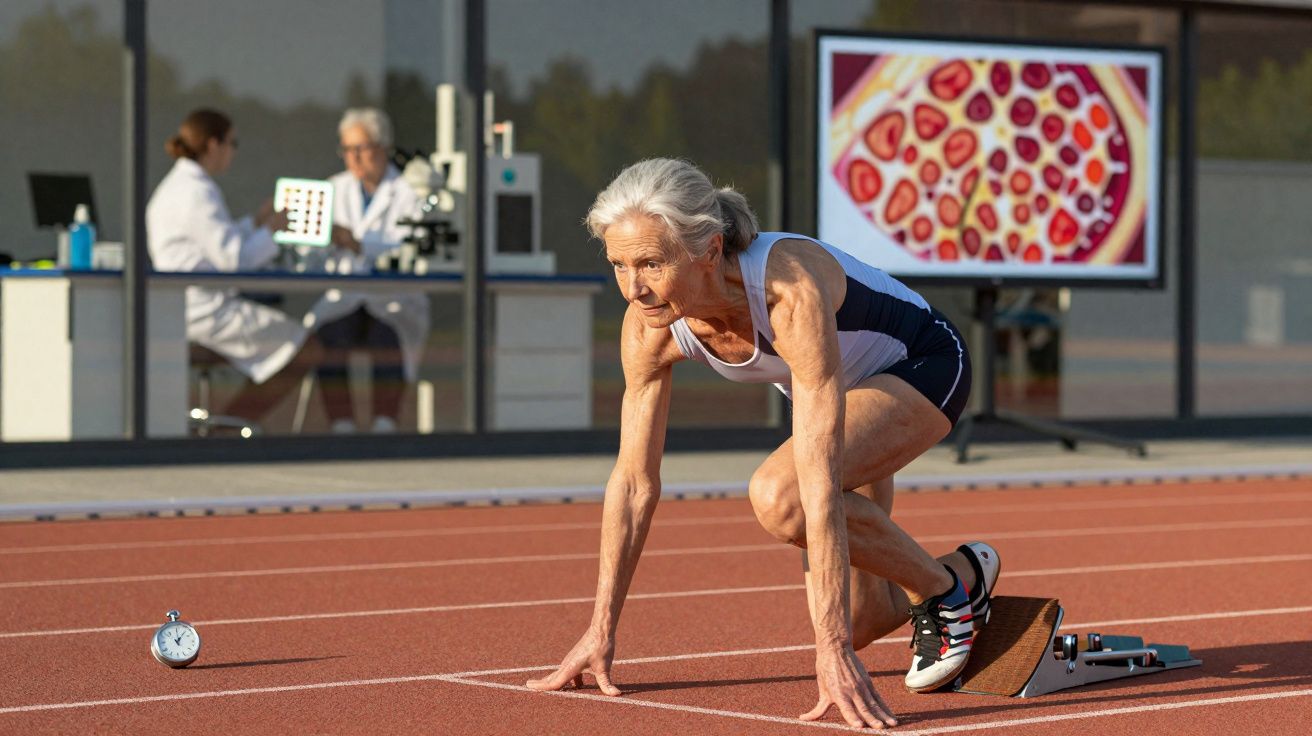
They begin on a running track, head into a lab, and then return to the track.
Scientists in Italy and the United States are following a nonagenarian sprinter whose body keeps ignoring the usual assumptions about decline. Her race times, training diary and even muscle samples are now being studied alongside stopwatch data. The puzzle is not simply how she runs, but what her physiology might reveal about ageing well.
From starting blocks to the lab bench
Emma Maria Mazzenga has long been drawn to both biology and movement. She studied at the University of Padua in the 1950s, and first put on spikes at 19. Later, family commitments brought competitive athletics to a halt. Then, at 53, she returned to the running track-and from that point onwards, she kept going.
Her schedule is straightforward: she trains outdoors two or three times a week, whether it is windy or raining. During lockdowns, she improvised to protect the habit, running up and down a 20-metre corridor or looping around the block at night.
Emma Maria Mazzenga’s late comeback built on routine
- A simple diet with no rigid plan, plus consistent bedtimes.
- Warm-ups before every session, then repeated short sprints and intervals.
- No meals within three hours of a race to reduce stomach load.
- Race entries decided a few months ahead, while training remains steady.
At 91, she ran 200 metres outdoors in 51.47 seconds, setting the women’s 90+ world record. The next year, she improved it again. The numbers are striking, but the trajectory is even more so: continued improvement deep into the nineties is rare.
The heavy lifting seems to come from consistency. Small habits that can be repeated reliably may compound in older bodies as well as in younger ones.
What her muscles are telling researchers
In April 2024, Mazzenga travelled to the University of Pavia for a detailed assessment by physiologists. The group, led by Simone Porcelli, carried out a muscle biopsy alongside strength tests and respiratory measurements. What emerged was a “split” profile.
Her fast-twitch fibres-the ones most responsible for acceleration-resembled those of an active person in their seventies. Her slow-twitch fibres-the endurance workhorses-looked far younger, closer to what you would expect in a well-trained 20-year-old.
The project then became transatlantic. Samples and datasets were sent to the United States for cellular work at Marquette University in Milwaukee, in the lab run by Chris Sundberg. Early findings indicated highly efficient mitochondria, the organelles that convert oxygen and nutrients into usable energy. Cardiovascular testing also suggested performance markers that would usually be seen in someone two or three decades younger. Marta Colosio, part of the collaboration, has highlighted how unusual it is to find a nonagenarian with such a profile who can also be tested and tracked in detail.
| Feature | Typical over-90 profile | Mazzenga’s profile |
|---|---|---|
| Fast-twitch fibres | Marked decline in size and recruitment | Similar to a very active 70-something |
| Slow-twitch fibres | Reduced endurance efficiency | Comparable to a trained young adult |
| Mitochondrial function | Lower energy output per unit of oxygen | High efficiency preserved |
| Cardiovascular response | Blunted heart-rate range and recovery | Closer to midlife norms |
Her slow-twitch fibres appear young, while her fast-twitch fibres look “older-athlete good”. That combination likely helps sustain sprinting with reliable repeatability.
Ageing thresholds, nudged and moved
None of this cancels ageing; it refines how we think about it. Athletic performance typically drops decade by decade as muscle mass shrinks, nerve conduction slows and aerobic capacity falls. But the pace and shape of that decline differ widely between individuals. In Mazzenga’s case, three factors look especially influential: training that stays regular and never fully disappears, recovery that is sufficient, and a metabolism that remains “tidy” enough to fuel frequent sessions.
Genetics almost certainly contributes, and so does a lifetime of movement. Notably, her training looks modest rather than extreme, which likely lowers injury risk and makes it easier to repeat sessions week after week. That repeatability may help preserve the nervous system’s connection to muscle-often the weak link after 70. The biopsy findings also imply that metabolic machinery may stay adaptable much later in life than many training plans assume.
An additional angle worth considering is environment and support. Older athletes who keep training often do so because they can access safe spaces, predictable routines and social reinforcement-clubs, training partners, or simply a familiar local facility. Those practical factors can be as decisive as physiology when it comes to maintaining consistency over years.
Hydration and fuelling can matter more with age, too. Thirst cues may be less reliable, and low energy intake can quietly erode recovery. While Mazzenga keeps her diet simple, the broader lesson for older runners is to ensure they are eating enough protein and total calories to support training, and to treat sleep as a performance tool rather than an optional extra.
What this might mean for the rest of us
- Small doses can beat big phases: two or three brief sessions per week may maintain muscle quality and economy.
- Keep some speed: gentle strides or short hill sprints can help preserve fast-twitch fibres recruitment without heavy strain.
- Lift something: basic strength work supports joints, posture and tendon health as fibres change with age.
- Move the breath: brisk walking, cycling or swimming helps maintain stroke volume and oxygen delivery.
- Protect the habit: plan training that survives bad weather and busy weeks-corridors count if necessary.
Safety still comes first. Speak with your GP before introducing sprints or heavy lifts, particularly if you have heart or joint conditions. Increase volume gradually, and stop a session if pain sharpens or your form starts to break down.
Inside the muscle: why slow versus fast fibres matter
Human muscle is a mix of slow-twitch and fast-twitch fibres. Slow-twitch fibres support longer efforts, use oxygen efficiently and resist fatigue. Fast-twitch fibres generate force quickly but tire sooner. With ageing, fast-twitch fibres are often the first to deteriorate. Nerves withdraw from some fibres, and the body compensates by grouping remaining fibres into larger “motor units”. That helps maintain basic strength, but it can blunt fine control and reduce explosive “pop”.
Training can partially reverse that functional loss by improving recruitment and helping maintain cross-sectional area. One plausible part of Mazzenga’s advantage is that her frequent sprint cues keep those neural circuits active rather than letting them fade.
The lab focus now: mitochondria, nerves and recovery
Research teams in Italy and the US are now concentrating on three critical junctions:
- How mitochondria in ageing muscle keep producing energy under repeated sprint stress.
- How the nervous system coordinates rapid recruitment as synapses age.
- How recovery signalling repairs small, repeated muscle damage without tipping into chronic inflammation.
If those mechanisms become clearer, the benefits would extend beyond sport-informing hospital rehabilitation as well as the training of masters athletes.
The aim is to identify principles that transfer: not a one-off genetic miracle, but practical protocols that help more people stay mobile and strong into their eighties and nineties.
Practical add-ons for athletes and coaches
A simple two-week cycle for older runners could look like this: one day of short hill sprints (6–8 repeats of 6–10 seconds, with full walk-back recovery), one day of easy running for 20–30 minutes plus drills, and one day of light strength work (chair squats, step-ups, calf raises, band pulls). Add mobility work on non-running days. Keep a training diary noting sleep, soreness and mood-patterns quickly show how much volume you can tolerate.
Coaches can also use basic phone apps to check stride frequency and ground contact time. When ground contact lengthens or cadence drifts, it often signals fatigue or reduced stiffness. In that case, swapping a hard workout for relaxed strides can be the smarter call. Tendons tend to respond best to steady rhythm rather than chaotic spikes of intensity, and regular gentle loading often outperforms sporadic hard sessions.
One more consideration for readers living with long-term conditions: medication timing can change how training feels. Beta-blockers can blunt heart-rate response, and a small proportion of people experience muscle soreness with some statins. It can help to discuss your weekly session types with your GP or pharmacist, as small adjustments may make training smoother.
Sports science is likely to keep evaluating Mazzenga for as long as she keeps showing up. She still plans races only a few months ahead and keeps her week uncomplicated. It feels less like rebellion and more like craft. If her story shifts anything, it may be our expectations of what steady practice can still build after 70-not spectacle, but usable capacity: climbing stairs, carrying bags, and, on a cool morning, sprinting cleanly down a straight.

Comments
No comments yet. Be the first to comment!
Leave a Comment