
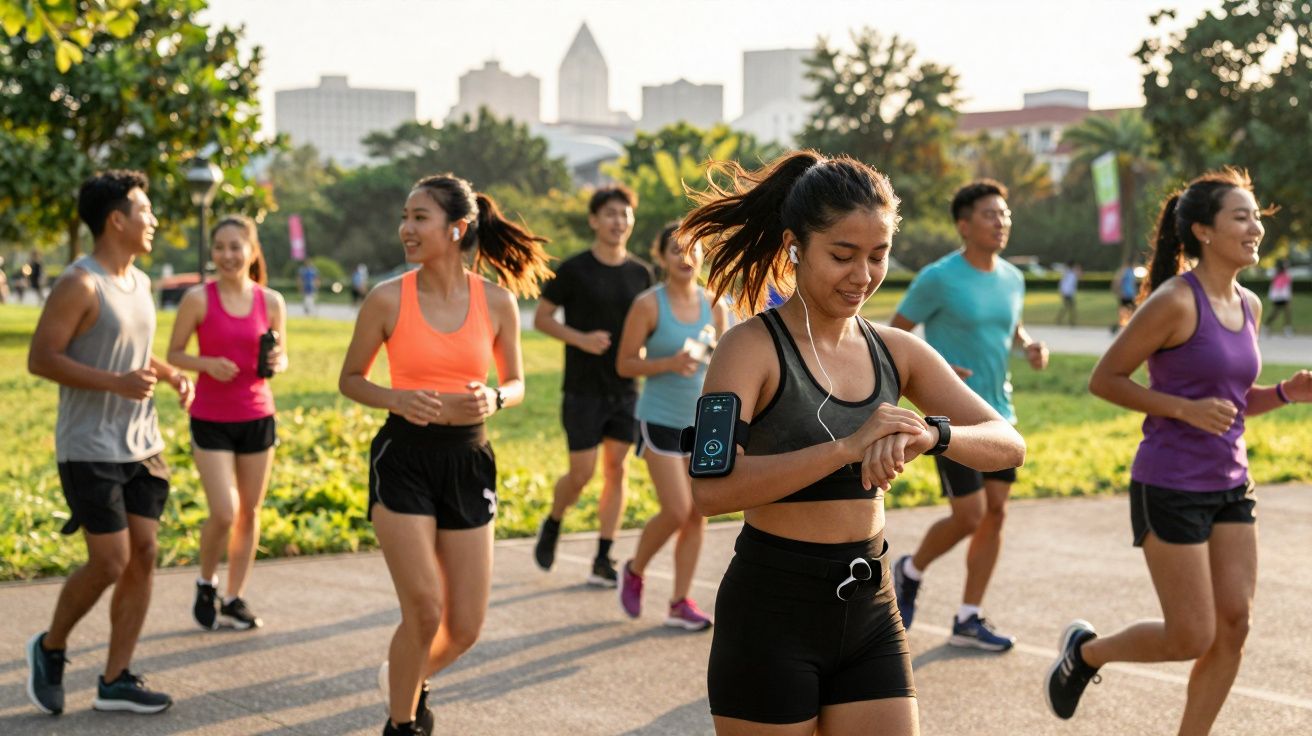
Across parks, high streets and university tracks, young adults are swapping late-night doomscrolling for early-morning kilometres. What began as a niche habit inside fitness apps is starting to look like a broader reset in how Gen Z spends its time, money and social energy.
From infinite scroll to finish lines
New insights from Strava’s latest Year in Sport report point to a clear change: under-25s are moving more, and doing so deliberately. Strava reviewed billions of uploaded activities from over 185 countries, then added a survey of 30,000 people. The global signal is consistent: many young adults now choose “movement time” over extra screen time.
Running remains the platform’s biggest activity, but Gen Z is doing more than a quick loop of the block. They enter races, jump between different sports and watch their stats with almost forensic attention. Compared with Gen X, Gen Z is far more likely to say that a race or organised event is the main reason they train.
For many young adults, the new status symbol is not follower counts, but finish lines crossed.
Strength training has risen sharply too. In the survey, Gen Z names lifting as a primary sport at roughly twice the rate of Gen X. It matches what many gyms and coaches are seeing day to day: busy weights areas, packed barbell sessions, and a generation that’s unusually at home with squats and deadlifts.
Women driving the strength boom
Women are a key force behind this shift. On Strava, women logged about a fifth more strength-training sessions than men this year. The gap hints at a cultural move away from old worries about “bulky muscles” and towards a more performance-led approach.
Variety is another hallmark of Gen Z’s fitness habits. More than half of users now log more than one type of activity. Walking has quietly climbed into second place on Strava-behind running, but ahead of many traditional sports. For students and young professionals, a brisk walk can be an active commute, a mental reset and (at times) a chance to catch up with friends.
Performance metrics suggest this is not merely casual experimentation. Training app Runna reports that 86% of its users set at least one personal record this year, pointing to steady training patterns and a preference for measurable progress over one-off fitness kicks.
Sport as a social and financial priority
All of this is happening while inflation remains stubborn. About two-thirds of Gen Z say higher prices are affecting their day-to-day lives-yet many still protect a budget for sport and fitness.
Strava’s figures show that nearly a third of Gen Z plan to increase their sports spending in 2026. That spend includes race entries, gym memberships, club fees and technology. When money is tighter, something else often has to drop, and for many it seems to be nights out and impulse purchases rather than their training routine.
When pushed to choose, most young adults would rather buy new sports kit than pay for a romantic date.
Around 64% of surveyed Gen Z say they would prioritise sports equipment over a night out for two. It may sound blunt, but it reflects a wider reprioritisation: health, performance and shared activity increasingly outrank candlelit dinners in busy restaurants.
A further factor in the UK context is the appeal of low-cost entry points. Free or inexpensive options-such as community running events, park-based workouts and student sport-make it easier to keep moving even when budgets are under pressure, and they help turn “fitness” from a luxury into a routine.
Connected gear instead of endless feeds
Gen Z isn’t turning its back on technology; it is putting it to work. Compared with Gen X, Gen Z is notably more likely to spend on connected kit such as GPS watches, heart-rate straps and smart rings.
Strava chief executive Michael Martin notes that more than half of Gen Z expect to use Strava more often in 2026, while many say they will use Instagram and TikTok the same amount-or less. The smartphone still sits at the centre of the day, but it is increasingly used as a performance dashboard rather than purely an entertainment hub.
- Activity apps take the place of some social feeds.
- GPS watches replace wearables chosen mainly for fashion.
- Race bibs start to replace festival wristbands as keepsakes.
For brands, this shift in attention has real consequences. If a young runner checks split times and club comments more often than short-form videos, advertising budgets will tend to follow the kilometres.
A related change is how kit is bought and valued. As training becomes more central, durability, repairability and second-hand marketplaces matter more-especially for Gen Z consumers who are cost-aware and often sustainability-minded, but still want dependable shoes, layers and data-ready devices.
The club effect: from online groups to real-life crews
One of the most striking signals in Strava’s data is community. The number of Strava Clubs has almost quadrupled in a year, reaching roughly one million groups worldwide. Hiking clubs and running crews are growing fastest, frequently developing from informal chats into properly organised communities.
These groups set up regular meet-ups, weekend long runs and themed sessions. Turning up in person converts online kudos into handshakes, shared snacks and training plans scribbled on coffee-stained napkins.
What begins as a “follow” or a kudos online can end up as a Wednesday track session with 40 people on the start line.
Sport is also becoming a more common way for Gen Z to meet new people. Compared with Gen X, young adults are much more likely to use sport as a route to expanding their social circle. Local run clubs, five-a-side leagues and hiking groups are acting as practical antidotes to the loneliness many under-30s report.
Holidays with running shoes packed first
The change is spilling into travel habits too. Gen Z respondents are far more likely than Gen X to say holidays and sport should go hand in hand. City breaks become race weekends, and beach trips are paired with sunrise runs or paddle sessions.
Technology comes along for the ride. The Apple Watch remains the most-used fitness watch on Strava, while around seven in ten users still record activities with their smartphones. Even on holiday, the phone functions less as a distraction machine and more as a trip log, route guide and training partner.
Why Gen Z chooses movement over mindless scrolling
Several forces are pushing young adults towards activity. Gen Z came of age through the pandemic, heightened climate anxiety and a cost-of-living shock. Many have reached a limit with constant news pings, comparison culture and the sensation of being permanently “on”.
Running, lifting or walking offers a different bargain: effort you can control, results you can see, and a clear endpoint. A 5 km run doesn’t argue back, and a deadlift personal record doesn’t require carefully worded replies. For a generation used to managing multiple digital identities, sport can feel refreshingly simple.
Mental health is part of the story too. Surveys repeatedly show high levels of anxiety and burnout symptoms among students and young workers. Structured exercise-particularly in groups-adds routine, improves sleep and creates belonging in a way an extra hour of scrolling rarely does.
For many in Gen Z, a run club functions as both support group and pressure-release valve, pencilled in like a weekly therapy appointment.
What this shift means for schools, cities and brands
Schools, colleges and universities can build on existing demand. Linking timetables to local run clubs, keeping facilities open later in the evening, or backing student-led hiking groups could help remove barriers. The data suggests the appetite is already there; reducing friction may be the most effective move.
City leaders face a similarly clear brief. Safe cycle lanes, well-lit running routes and accessible green space are no longer just “nice extras” for an urban brochure. They directly support how a growing share of residents prefers to socialise, decompress and stay healthy.
For sports brands and technology firms, Gen Z’s habits tend to favour products that simplify rather than over-gamify. Devices that last a week on a single charge, capture accurate data and integrate cleanly with training apps are likely to do better than flashy, notification-heavy gadgets that pull users back into the old attention economy.
Practical angles: where this trend could go next
Several follow-on questions are emerging. If more young adults replace late-night screen time with early alarms, sleep patterns could change-affecting everything from public transport demand to morning coffee sales. Employers may also see greater appetite for flexible working, so people can fit in lunchtime sessions or travel on Fridays for races.
The line between amateur and semi-professional could blur further. With detailed data, structured plans and large communities, a motivated 23-year-old marketing assistant can train like an experienced club athlete. That raises real issues around overtraining, injury risk and performance pressure-especially when training metrics become another thing to compare, curate and post.
At the same time, the move from passive habits to active ones brings clear long-term public health benefits. Even small shifts-from scrolling to walking, or from late-night feeds to gym sessions-can reduce cardiovascular risk and improve mood. If Gen Z stays on this path, health services could feel the impact decades down the line.
For now, the picture is straightforward: the “start run” button is taking time away from the “like” button. As new cohorts enter university and the workplace, trainers and race bibs may end up saying more about them than any follower count ever did.

Comments
No comments yet. Be the first to comment!
Leave a Comment