
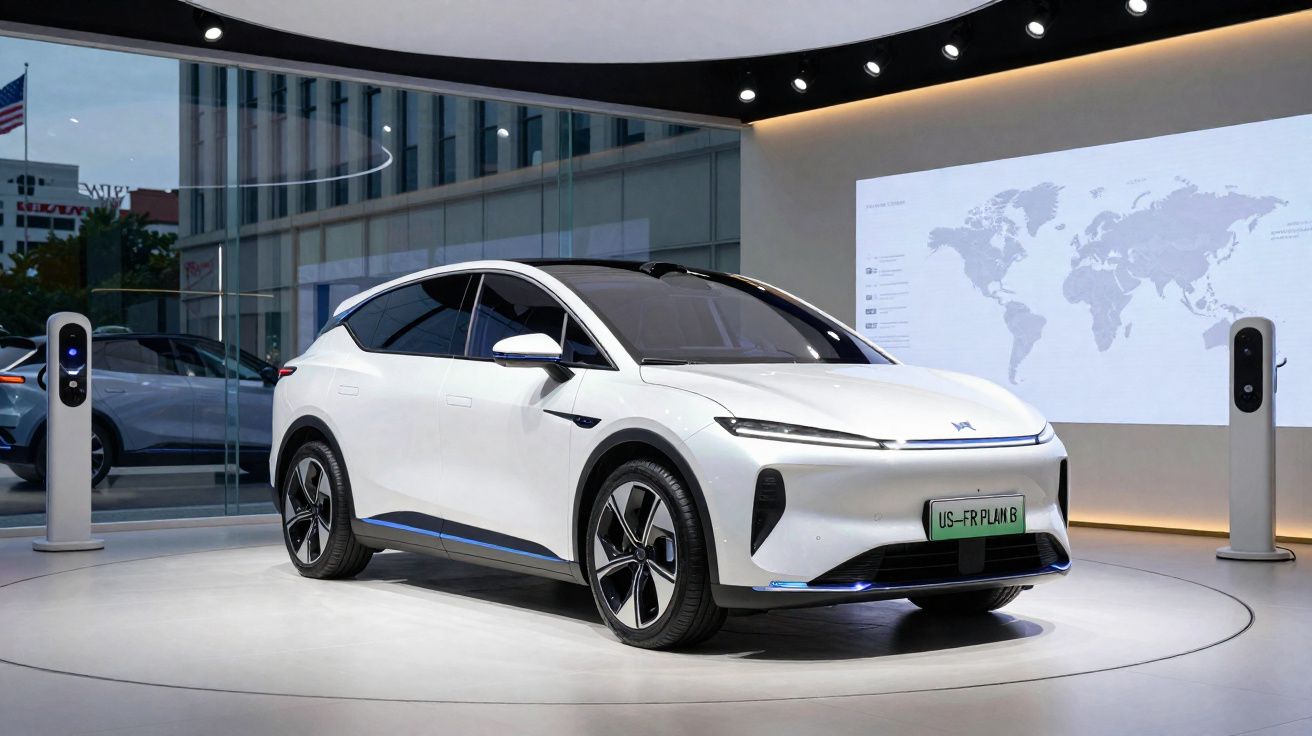
An American carmaker shaking hands with a French one, assembly lines in northern France, and a third, quiet presence in the room: China.
It sounds like something from a geopolitical thriller, yet it is playing out on factory floors and across negotiating tables in the automotive industry. Ford and Renault have opted to join forces in Europe around the electric car, in a move that goes well beyond launching a few new city-friendly compact models.
An unexpected Ford–Renault alliance under Chinese pressure
The starting gun is a letter of intent signed by Ford-an emblem of the American car-and Renault, one of the cornerstones of French manufacturing. On paper, the deal refers “only” to building compact electric cars and light commercial vehicles. In reality, it reads as a coordinated answer to mounting pressure from Chinese carmakers and to the rising costs of the energy transition.
From 2028, the plan is to produce at least two compact electric car models and one light commercial vehicle at Ampere’s ElectriCity complex (Ampere is Renault’s electric subsidiary) in northern France. Assembly is expected to be concentrated across the Douai, Maubeuge and Ruitz sites, which together employ around 5,000 people.
The partnership lets Ford keep selling “affordable” electric cars in Europe without having to build a continent-wide manufacturing set-up from scratch.
The timing is deliberate. China’s push with low-cost electric vehicles is already squeezing margins and threatening market share in Europe-especially in the very segment Ford has been stepping back from.
How France becomes the US “Plan B” for Europe
Over recent years, Ford has steadily pared back its traditional internal-combustion line-up in Europe. Well-known models such as the Focus have dropped out of the catalogue. The company has redirected effort towards SUVs, commercial vehicles and higher-margin ranges, leaving a gap where cheaper, compact cars once sat.
This agreement is Ford’s attempt to fill that gap without committing to multi-billion-pound investments in new, proprietary compact-EV platforms.
The French platform that won Ford over: AmpR Small
The compact models expected to come from this alliance will be built on the AmpR Small platform-already used for the Renault 5, Renault 4 and the forthcoming electric Twingo. This vehicle “skeleton” was designed specifically for urban cars: smaller footprints, tighter cost control and mass-market intent.
The platform also bakes in a portion of Asian know-how, developed with partners in the region and supported by components sourced from China. The result is a hybrid industrial model: engineering and assembly in Europe, a global supply chain, and a clearly Asian presence in the bill of materials.
- A shared base for several compact models
- Lower development costs
- More efficient production scale
- Use of Chinese components to help keep prices in check
For Ford, it is like boarding a train that is already moving rather than laying brand-new track. For Renault, it means extra volume, better cost absorption, and a confidence signal from a major American group.
The approach mirrors the line pushed by Ford CEO Jim Farley: prioritise “highly efficient” businesses and lean on partnerships to withstand the cost shock of electrification.
Electric vans: the second pillar of the deal
The agreement is not limited to passenger cars. A major focus is light commercial vehicles, a segment undergoing a quieter transformation as urban deliveries grow and European cities tighten environmental rules.
Ford is targeting Renault’s new family of electric vans directly: Trafic Van E-Tech, Estafette E-Tech and Goelette E-Tech. These models are intended for last-mile logistics as well as for small firms that must operate in city centres where combustion vehicles face restrictions.
City-focused electric vans for European streets
Across some configurations, the range is expected to reach roughly 450 km-well matched to regional routes and intensive delivery cycles. The Trafic E-Tech, for instance, pairs a 10.3-metre turning circle-similar to a compact hatch such as the Clio-with up to 5.8 m² of usable load volume in the long-wheelbase version.
The new Estafette E-Tech leans into practicality by allowing the user to stand upright in the cabin, appealing to professionals who are in and out of the vehicle throughout the day. The Goelette is positioned for broader use cases, from public services to small businesses.
| Model | Key strength | Typical use |
|---|---|---|
| Trafic Van E-Tech | Strong manoeuvrability and large usable load space | Urban and regional deliveries |
| Estafette E-Tech | Interior height that allows standing | Mobile services, workshops, food trucks |
| Goelette E-Tech | Flexible configurations | Service fleets and small businesses |
Had Ford attempted to develop a full, Europe-specific electric-van range alone, it would have run into a wall of technical requirements, environmental standards and platform investment. Working with Renault reduces that burden and speeds up the route to competitive products in showrooms.
Renault, in turn, gains credibility and scale: having a US giant as a customer strengthens the bet on electric vans as a core pillar of the brand’s future.
From factory floors to geopolitics: the message aimed at China
Behind the production targets sits a clearly political layer. Rather than relying on Chinese-owned plants already operating in Europe-often the cheaper route-Ford has chosen a European partner with deep industrial roots in France.
That choice sends two messages at once: to European governments, it signals alignment with reindustrialisation goals and local job protection; to Chinese brands, it suggests the US and Europe can combine forces to slow a flood of Asia-made vehicles into the market.
On the Chinese side, analysts have already started to frame the move differently. Some argue Renault becomes a European “filter” for a supply chain that remains tightly connected to Asia. The logic goes like this: by integrating Chinese components into French platforms and then supplying vehicles to Ford, Renault could help delay a more direct route from Chinese manufacturers to European customers.
Why this matters to governments and consumers
European governments see this web of alliances as a way to safeguard jobs, technology and production capacity without shutting the door entirely to Asia. For consumers, the intended outcome is a wider choice of electric cars and vans at less punishing price points-built within Europe.
At the same time, China’s competitive pressure does not disappear. Chinese brands continue to offer aggressively priced EVs, and much of that edge comes from integrated production chains and global scale.
The underlying question is whether Western tie-ups on their own can match the pace of China’s electric-vehicle offensive.
Two concepts that clarify the strategy
Two phrases come up repeatedly: “affordable segment” and “platform”. In this context, the affordable segment does not mean cheap in the traditional sense; it means less expensive within a category that remains costly overall. Rather than premium models, Ford wants compact cars priced closer to what an average European buyer can realistically finance.
A platform, meanwhile, is the shared set of structures, components and electronic architecture that underpins multiple vehicles. Designing one from scratch is expensive and time-consuming. By sharing AmpR Small with Ford, Renault spreads development costs across more units, while Ford avoids duplicating the same investment.
What could come next-and where the risks lie
If the programme progresses smoothly, a likely end-of-decade picture is European streets filled with compact electric cars “made in France”, carrying shared Renault–Ford DNA, competing head-on with Chinese models and with German brands that are also accelerating their transitions.
However, the route is not risk-free. EU regulatory shifts, trade disputes involving China, or battery technology delays could all change today’s assumptions. Another sensitive point is customer perception: if prices do not fall in a tangible way-even with joint production-demand may underperform.
For fleet operators and logistics firms, the move creates clear openings. Long-term contracts for electric vans born from this partnership could lower running costs for energy and maintenance and support the environmental targets of large clients. Equally, those operators will still need to solve the practicalities of charging infrastructure, staff training and route redesign.
One additional pressure point is the value chain around batteries and parts. Even with final assembly in France, exposure to global component pricing and availability remains significant-particularly where Chinese-sourced inputs are involved. Any disruption can quickly ripple into lead times and final prices.
There is also the customer experience beyond the showroom to consider. Wider adoption will depend not just on vehicle supply, but on reliable public charging, workplace charging, and predictable residual values-especially for vans that rack up high mileage. Partnerships like Ford and Renault’s can accelerate product launches, but they still have to land in a market where charging access and total cost of ownership are decisive.
In the background, the rapprochement between an American icon and a French manufacturer makes one thing plain: the contest with China in the electric car era will not be fought in isolation. It will run through unlikely alliances, retooled factories, and political decisions that cross oceans-ending up, eventually, on the driveway of the everyday buyer.




Comments
No comments yet. Be the first to comment!
Leave a Comment