
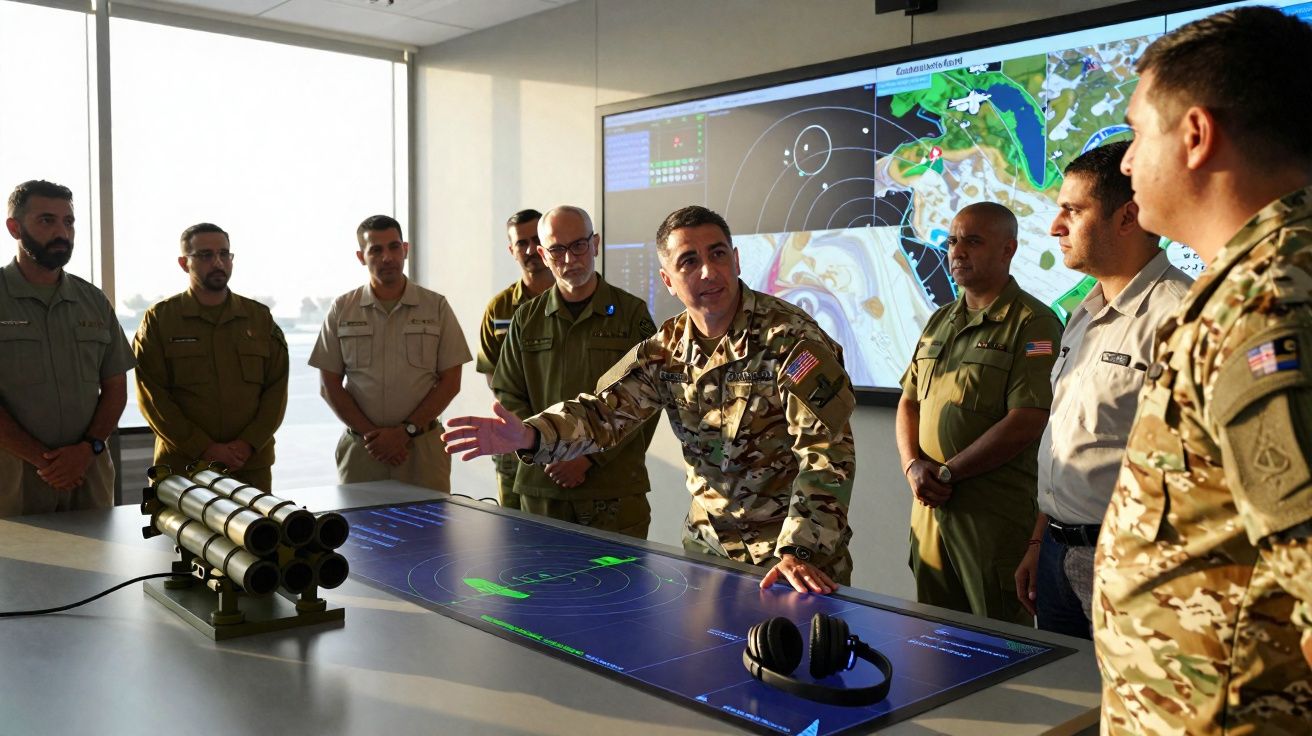
The United States has stood up a new air and missile defence operations cell in Qatar, aiming to bring regional forces closer to a single, shared protective umbrella against drones, cruise missiles and ballistic threats across the Middle East.
A new coordination hub at Al Udeid Air Base
The unit-officially titled the Middle Eastern Air Defense – Combined Defense Operations Cell (MEAD‑CDOC)-is now operating from Al Udeid Air Base in Qatar, the largest United States military installation in the region.
MEAD‑CDOC has been established within the existing Combined Air Operations Center (CAOC), the US‑led nerve centre that has coordinated air activity with 17 partner nations across the Middle East for roughly two decades.
MEAD‑CDOC is intended to combine radar tracks, warning information and engagement decisions from several countries into one shared picture of the airspace.
US Central Command (CENTCOM) describes the cell as a major change in how regional air and missile defence is run. Instead of each state detecting and engaging threats independently, the ambition is to enable a coalition response that can be managed minute by minute.
Why the US is upgrading air defences now
The announcement arrives during an uneasy period in US–Iran relations, with Iranian officials warning that US bases could become targets if Iran is attacked. Tensions have been heightened by recent strikes in and around Qatar; Israeli and Iranian actions linked to Hamas and US forces have reinforced the reality that even well‑protected locations can remain exposed.
US officials and outside specialists emphasise that MEAD‑CDOC should not be taken as evidence that conflict is imminent. Rather, they frame it as the result of long‑running efforts to strengthen defensive cooperation with Gulf partners.
Analysts argue the cell represents a sustained US commitment to protect Doha and other Gulf capitals, not a hurried response to the latest headlines.
Ryan Bohl, a senior Middle East and North Africa analyst at the RANE Network, says Washington assesses Iran as entering a phase marked by domestic strain alongside more assertive behaviour abroad. From that perspective, US planners want deterrence to be unmistakable: credible defences established before any confrontation accelerates.
MEAD‑CDOC and deterrence through preparedness
US commanders are effectively wagering that visible integration will make Tehran think carefully before escalating with drone or missile attacks against American sites or partner infrastructure. The logic is straightforward: when several radar networks and interceptor systems are connected, the odds of a successful surprise strike fall.
At the same time, analysts underline that hardware and connectivity do not determine outcomes on their own. Iran retains a diverse set of capabilities, and escalation ultimately depends on political decision‑making in Tehran and Washington-not only on interceptor performance or the sophistication of command centres.
From isolated systems to regional integration
For years, Gulf states have spent heavily on US‑supplied systems such as Patriot and THAAD batteries, modern fighter aircraft and advanced radar platforms. While these tools can each detect and engage threats, cross‑border coordination has often been uneven and, in practice, improvised.
Kristian Alexander, a senior fellow at the Rabdan Security and Defence Institute in the United Arab Emirates, says the Qatar‑based cell points to a deeper shift.
The emphasis is changing from simply deploying more missiles in the desert to linking early warning, tracking and decision‑making across national boundaries.
In Alexander’s view, MEAD‑CDOC is intended to:
- Distribute early warnings across multiple countries within seconds
- Follow missiles, drones and aircraft from launch to impact through a combined radar picture
- Determine which nation’s interceptor has the best geometry or range for the engagement
- Lower the risk of friendly fire when several militaries operate in the same airspace
He argues this move away from “platform‑centric” defence-where each country primarily buys more equipment-is designed to close gaps that adversaries have exploited before, such as routing missiles along border seams or using swarms of low‑flying drones that can slip through radar coverage.
A further practical driver is interoperability: shared tactics, common procedures and dependable communications links matter as much as the interceptors themselves. Without agreed rules on identification, engagement authority and prioritisation, a networked defence can still respond too slowly-or respond inconsistently-when multiple threats arrive at once.
Who is involved at the Qatar cell?
MEAD‑CDOC sits inside the CAOC framework, which already brings together 17 partner nations. Not all participants are expected to contribute the same quantity or sensitivity of information, but the goal is a layered network with different levels of integration.
| Actor | Role in MEAD‑CDOC framework |
|---|---|
| United States (CENTCOM / Air Forces Central) | Leads command and control, supplies key radar, satellites and interceptor systems |
| Qatar | Hosts Al Udeid Air Base, contributes national radar and missile defence capabilities |
| Other Gulf partners (e.g. Saudi Arabia, UAE, Bahrain, Kuwait) | Provide regional radar coverage, fighter aircraft and ground‑based air defence batteries |
| Coalition members in CAOC | Coordinate air operations and share intelligence and threat data |
Lt Gen Derek France, Commander of US Air Forces Central, has said he expects the cell to serve as a “consistent venue” where partners can exchange know‑how and develop new defensive approaches, including methods for defeating complex drone swarms or mixed missile salvos.
What threats is MEAD‑CDOC designed to face?
The Middle East has increasingly served as a proving ground for missile and drone tactics. Iran and aligned groups have deployed:
- Ballistic missiles able to strike US bases and critical energy infrastructure
- Cruise missiles that fly low and follow terrain to reduce radar detection
- Small, low‑cost drones used for surveillance and one‑way attack missions
- Coordinated barrages combining several weapon types at the same time
Events in recent years-from attacks on Saudi oil facilities to strikes on shipping and US positions in Iraq and Syria-demonstrate that even wealthy states can struggle to detect and defeat every incoming threat when attacks are dispersed across a wide area.
The Qatar cell is built on the premise that the next major assault is unlikely to be a single missile, but a layered attack using multiple systems at once.
By pooling sensors and coordinating decisions, MEAD‑CDOC is meant to spot patterns more quickly and assign interceptors more effectively-avoiding situations where several countries engage the same target while another threat penetrates elsewhere.
Signal to Iran and reassurance for Gulf capitals
Bohl and Alexander both caution against reading the timing as a direct response to Iranian domestic unrest or as evidence that US strikes are imminent. Instead, they describe the move as broader strategic signalling-a way of demonstrating that US defensive posture and alliances remain active even as Washington debates its longer‑term role in the region.
For Qatar, hosting MEAD‑CDOC strengthens an already close security relationship with Washington after years as a key operational hub for US activity linked to Afghanistan, Iraq and Syria. Bohl adds that it also bolsters a US defence commitment to Doha, which has sought clearer assurances following past regional disputes and the blockade led by some neighbouring states.
For other Gulf capitals, the initiative is presented as reassurance that the United States is still willing to invest in shared security infrastructure, even while attention and resources are pulled towards Europe and Asia.
Key terms and what they actually mean
Several technical terms are central to understanding what MEAD‑CDOC is intended to do-and how it could shape any future crisis.
Integrated air and missile defence (IAMD) means connecting sensors, command centres and interceptors so they function as one system. Rather than each battery or fighter unit acting alone, data is shared and targets can be handed to the unit best positioned to respond.
Command and control (C2) is the information framework that makes such integration workable. At a site like Al Udeid, C2 involves teams monitoring displays, maintaining communications and managing decision processes: taking raw radar tracks, checking them against intelligence, and deciding whether to warn, observe or engage.
MEAD‑CDOC operates precisely at this intersection-between what sensors detect, what authorities permit, and what pilots or missile crews execute.
A related, often overlooked, consideration is airspace deconfliction, including coordination with civilian aviation routes. In a high‑tempo situation, separating military engagements from commercial traffic-and ensuring timely notifications-can be as important as the intercept itself, especially when multiple countries operate in proximity.
Possible scenarios and risks
In a crisis, Iranian forces or aligned groups could launch a combination of ballistic missiles and drones against several targets at once-for example, a US base in Qatar, a desalination plant in the UAE and an oil facility in Saudi Arabia. Within seconds, radars in different countries could each detect parts of the overall picture.
With MEAD‑CDOC, those fragments can be merged into a single common operating picture. Commanders could then decide which nation should fire which interceptor, so that the system with the best shot engages first-and scarce high‑end interceptors are not expended on low‑cost decoys.
This approach also brings complications. Real‑time data sharing can reveal vulnerabilities, such as radar locations or weaker coverage sectors, and some partners may be reluctant to disclose everything. There is also the danger of miscalculation: a false alarm or misidentified object could trigger a cascade of responses if procedures are not followed rigorously.
Even so, for US and Gulf planners, operating in isolation is often viewed as the larger risk. Regional states recognise that a single successful strike on a major port, gas facility or power grid could ripple through global energy markets within hours. A more tightly connected defensive network is therefore seen as one way to limit both physical damage and wider economic shock.






Comments
No comments yet. Be the first to comment!
Leave a Comment