
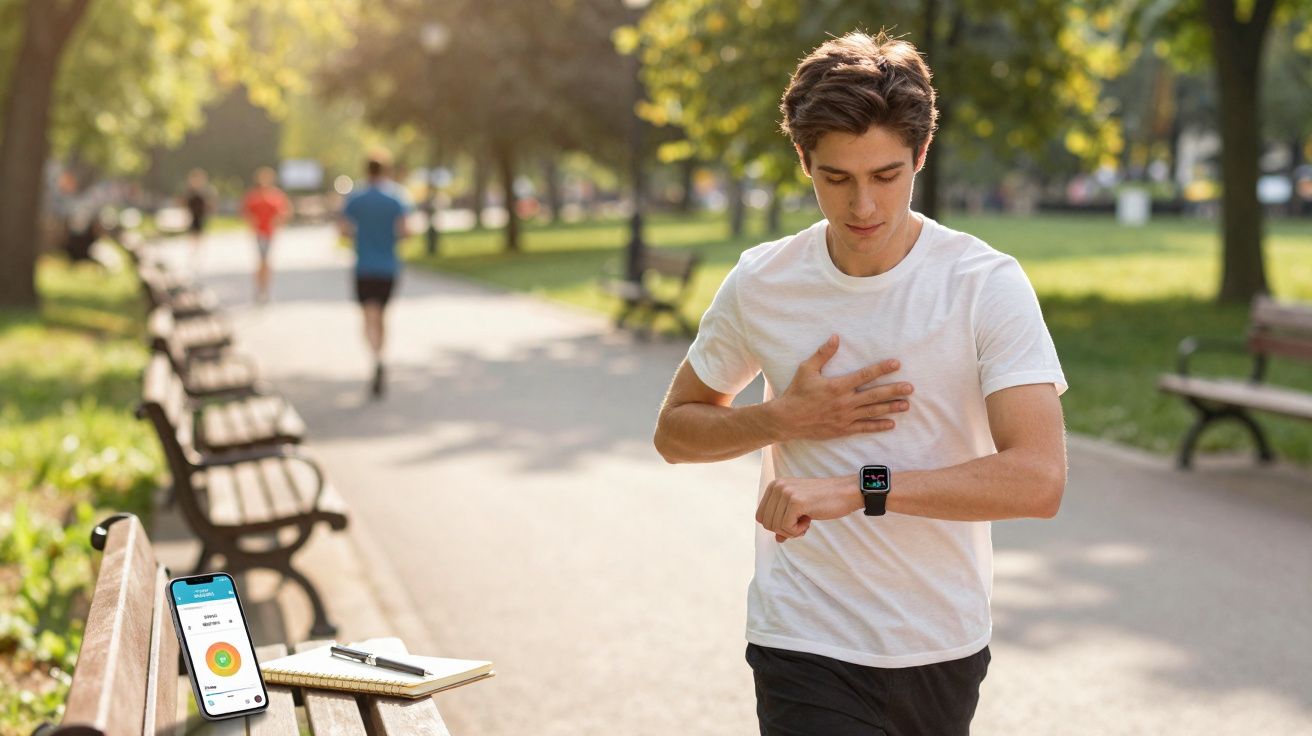
The woman crossing the park barely glances at the trees. Instead, she keeps checking her wrist.
Headphones in, rhythm unbroken, eyes dropping every few seconds: 3,241 steps… 3,278… 3,315. A man slips past her with his hands in his coat pockets-no watch, no phone on show. He’s slower, breathing a touch harder, and his expression looks oddly distant, as if he’s walking somewhere else entirely.
A psychologist once described it to me as “the modern rosary”: each buzz, each extra 100 steps, another tiny bead to thumb through in the mind. The question is uncomfortable once you notice it-are we genuinely walking more, or simply thinking more about the fact we’re walking?
Listen closely and a pattern emerges: people who count their steps often end up counting their stress as well.
And once that happens, the walk stops being just a walk.
When tracking steps becomes tracking stress (step counting and stress)
They start choosing side roads, looping the block the long way, and glancing down at crossings with the faintest look of arithmetic: How many steps will this add?
Psychologists say those same people are also more likely to register subtler signs of strain-chest tightness in a meeting, sleep that turns choppy, a clenched jaw on the train home. Step counters don’t only quantify distance; they can turn someone into a person who measures everything.
Often it’s not discussed openly, but you can spot it in small behaviours: an exhale after a tense call, a deliberate breath before going back into the office, a quick look at the stress widget on a smartwatch.
A recent study from a UK university followed adults who wore step counters and recorded their mood every day for several weeks. The researchers didn’t stop at how far people walked; they asked participants to rate how stressed they felt, how restless their sleep had been, and how “on edge” they were on a scale from 1 to 10. People who logged their steps consistently were also more attentive to those stress ratings.
They opened the app more often, noticed the small spikes on high-pressure days, and were quicker to connect a difficult meeting or an argument with a poor night’s sleep. One participant realised her stress score rose whenever her manager sent late emails, and she caught herself pacing around her flat to “walk it off”. She wasn’t only recording steps-she was recording how her body responded to her life.
That’s the point psychologists find especially revealing.
What the researchers are picking up is a move from hazy self-awareness to precise, concrete monitoring. Once you get used to thinking in figures-5,000, 8,000, 10,000-feelings can start to follow the same pattern. Stress shifts from “I feel awful” to “I’ve been at an eight out of ten all week”.
The reasoning is straightforward. If your watch can quantify movement, your mind begins to wonder what else can be captured: heart rate, sleep quality, even that familiar 3 pm knot in your stomach.
Psychologists refer to this as self-monitoring. People who track their steps regularly often develop a sharper internal radar-particularly for stress. Sometimes that brings a sense of control. Sometimes it adds pressure. Quite often, it does both at the same time.
One extra complication worth naming is comparison. Many trackers quietly nudge you towards leaderboards, streaks, and social sharing. For some people that’s motivating; for others it turns step counting into a daily performance. If you notice competitiveness making your shoulders rise, it may be a clue that the device is amplifying stress rather than easing it.
How to turn step counting into real stress relief
If you already track your steps, you can convert the habit into a practical stress tool with one small tweak: attach a quick stress check-in to each walk. Keep it simple-log a number from 1 to 10 in your notes app right after the walk, plus one word that fits how you feel.
- Walk to the station? “Stress: 6. Word: rushed.”
- Evening loop round the block? “Stress: 3. Word: lighter.”
It takes about 10 seconds, which is why it’s realistic on busy days. Over a week, patterns tend to show up without you forcing them. You might discover your 8 am power walk leaves you more wired than settled, while a slow 9 pm wander quietly resets you. The steps don’t change; what they mean does.
Another method psychologists recommend is pairing step goals with stress rules. For instance: whenever you reach 4,000 steps, you do three long, intentional breaths-phone away, shoulders dropped, jaw unclenched. Nothing more. The buzz becomes a cue, not just a score.
Or you make a deal with yourself that any day you go beyond 8,000 steps, you add one small act of recovery when you get home: a hot shower without your phone, five minutes with a book, or a few stretches on the living-room floor. On a chart it looks trivial; for your nervous system it can be enormous. These mini-rituals tell your brain: we’re not only moving-we’re recovering as well.
Where many step counters get stuck is obsessing over the number and forgetting the body attached to it. The familiar scene: it’s late, you’re drained, the app says 9,600 steps… so you pace the living room to hit 10,000. Let’s be honest: nobody does that every day with a smile.
That’s where guilt slips in. You’re “disciplined” when you hit the target and “lazy” when you don’t. Stress rises on low-step days even if your mind is actually calmer. The watch becomes judge and jury.
A kinder approach is to work with ranges rather than fixed targets: 6,000–8,000 on workdays, 4,000–10,000 at weekends. It creates breathing space-because your nervous system benefits far more from flexibility than from perfection.
Psychologist Dr Emma Lewis told me something I keep coming back to:
“People who count steps are often already motivated. Once they start noticing stress too, they can become surprisingly skilled at adjusting their lives - if they drop the all‑or‑nothing mindset.”
She finds the best outcomes when people treat devices as curious tools rather than strict coaches. In practice, that might mean turning off certain notifications, lowering your step goal during demanding weeks, or taking one walk a week with no phone at all-just to see what your body notices when the numbers aren’t shouting.
- Link your step goal to one calming habit - breathing, stretching, or a few minutes of quiet.
- Write down one stress word after your daily walk - “tight”, “calm”, “foggy”.
- Use ranges, not rigid targets - it protects you from “failure” days.
- Have at least one walk a week with no tracking - and pay attention to what changes.
- Let the numbers inform you, not define you.
What your steps might really be saying about your mind
On a busy high street, two people can both reach 7,000 steps and experience entirely different inner lives. One is marching to outrun racing thoughts-fast pace, tight shoulders, barely seeing anything around them. The other is meandering, noticing shop windows, watching the clouds shift, and feeling their stress soften as they go.
Psychologists are typically less fascinated by the raw total than by your relationship with it. If step counting makes you inquisitive-“Why do I always speed up after certain emails?”-it’s building awareness. If it turns cruel-“I’m useless, I only managed 5,000”-it’s fuelling stress rather than relieving it.
On a good day, the number on your wrist is like a friend tapping you gently: you moved; you’re here; you did something for yourself. On a bad day, it feels more like a manager asking why you didn’t do more.
There’s also a wider question underneath all this: how much of our inner life do we want converted into data? Heartbeats, steps, REM sleep, stress scores-charts can be reassuring. They can also pull us away from the messy, wordless experience of simply being alive.
In a difficult week-deadlines stacking up, sleep unravelling-counting steps can be a small anchor, a quiet signal that says, “I’m still here, still moving, even when everything feels chaotic.” In an even worse week, it becomes just another test to fail.
Most of us know the feeling of walking to clear our head, not to hit a target. Perhaps the healthiest middle ground is using the numbers to start a conversation with yourself-then, sometimes, choosing to walk with no goal at all, simply to find out what’s happening inside.
| Key point | Detail | Why it matters to you |
|---|---|---|
| Counting steps strengthens self-observation | People who track their steps often pay closer attention to stress, sleep, and physical tension as well. | Helps explain why you may notice fatigue or anxiety signals more clearly since wearing a tracker. |
| Turning tracking into an anti-stress tool | Pair each walk with a mini stress check-in and a simple recovery ritual. | Uses your steps to calm your nervous system instead of adding pressure to your day. |
| Avoiding the tyranny of the number | Swap rigid targets for flexible ranges and keep some untracked walks. | Protects mental wellbeing while still benefiting from the motivating side of activity tracking. |
FAQ
Does counting steps actually reduce stress?
Not on its own. Step counting increases awareness; stress tends to fall when you combine walking with calming habits and kinder expectations.Can tracking steps make me more anxious?
Yes-especially if you treat the goal like a daily exam. Flexible ranges and occasional untracked walks usually reduce that pressure.How many steps do I need for mental health benefits?
Research suggests that even 3,000–5,000 mindful steps per day can support mood. The quality of the walk often matters more than the exact total.Should I combine step tracking with stress apps?
It can be useful if the data leads to small, realistic changes rather than constant self-criticism.What if I dislike numbers but still want the benefits?
Keep the counter running, but check it only once a day. During the walk, focus on breathing, muscle tension, and how your body feels instead of chasing a specific figure.




Comments
No comments yet. Be the first to comment!
Leave a Comment