
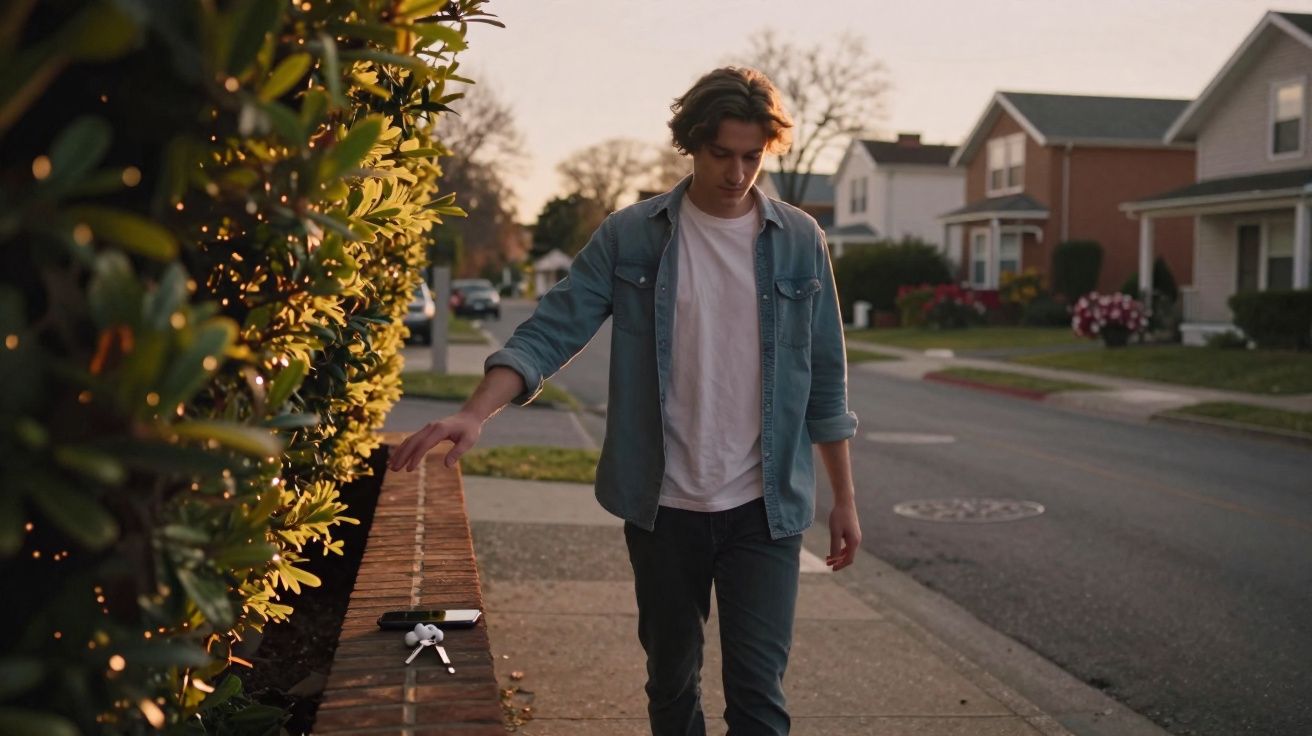
The street has almost fallen silent by the time you finally shut your laptop.
You sling on your headphones, step outside, and reassure yourself that this walk is “for your mental health”. Dusk is settling in, shopfronts glow softly, and commuters are drifting towards home. It ought to feel calming. Somehow, it doesn’t.
Your head is still whirring: emails, tense conversations, unread messages. Without realising it, you pick up speed. You run the day back in your mind, then leap forwards into tomorrow’s problems. You tell yourself you’re decompressing, yet your jaw is tight and your shoulders are practically up to your ears. The walk finishes, you come home… and your thoughts are louder than before.
It’s easy to pin it on the workload, the city, the stress. What you rarely question is the ritual you’ve built around the evening walk itself. And there’s a small, everyday detail in that routine that can quietly fuel your anxiety rather than drain it.
It’s hiding in plain sight.
The “relaxing” evening walk that secretly ramps up anxiety
Many of us picture an evening walk as a gentle switch-off at the end of the day. In practice, modern walks often resemble a mobile command centre. Phone in hand. Notifications flaring. Podcasts on 1.5x. Steps logged live. Your body may be moving through quiet streets, but your attention is locked inside a glowing rectangle.
It sounds harmless: “I’ll clear my head while I catch up.” That phrasing is the trap. Your feet follow a familiar route, yet your mind never properly arrives. There’s no real gap between “work mode” and “home mode”-just the same mental noise, relocated to the pavement.
What you label a break is often only a new stage for the same anxiety.
Imagine this: Emma, 34, a project manager, goes out every evening “to decompress”. She leaves work, puts in her earbuds, and opens Slack on her phone “just to check one thing”. By the first set of traffic lights she’s replying to a late message. By the park entrance she’s listening to a productivity podcast while scrolling Instagram. By the time she gets home, she’s checked her steps, answered two emails, compared her life to a dozen strangers, and mentally rewritten tomorrow’s to-do list twice.
On paper, Emma has walked 3,000 steps. She’s done the “healthy thing”. Her health app might even congratulate her. But internally, her stress response never really dropped. Her brain didn’t register the walk as rest-it registered more input, more decisions, and more reasons to feel behind.
When researchers discuss “recovery from stress”, they often highlight something many of these walks are missing: psychological detachment from work and demands. In a 2021 survey on work recovery, employees who regularly checked work messages during their commute reported higher anxiety in the evening and poorer sleep.
The specific length of the walk mattered less than what their mind was doing while walking.
Your brain doesn’t unwind simply because your legs are moving. It needs an unambiguous cue that it’s safe to shift gears. If your evening ritual is multitasking on foot, your nervous system stays in high gear: heart rate slightly raised, attention splintered, thoughts bouncing between apps and worries. The street scene becomes wallpaper for the real activity-anxiety feeding on fresh stimulation.
That’s how a habit meant to soothe you can turn into a daily appointment with stress.
Turning your evening walk into a genuine off-switch (no-phone rule)
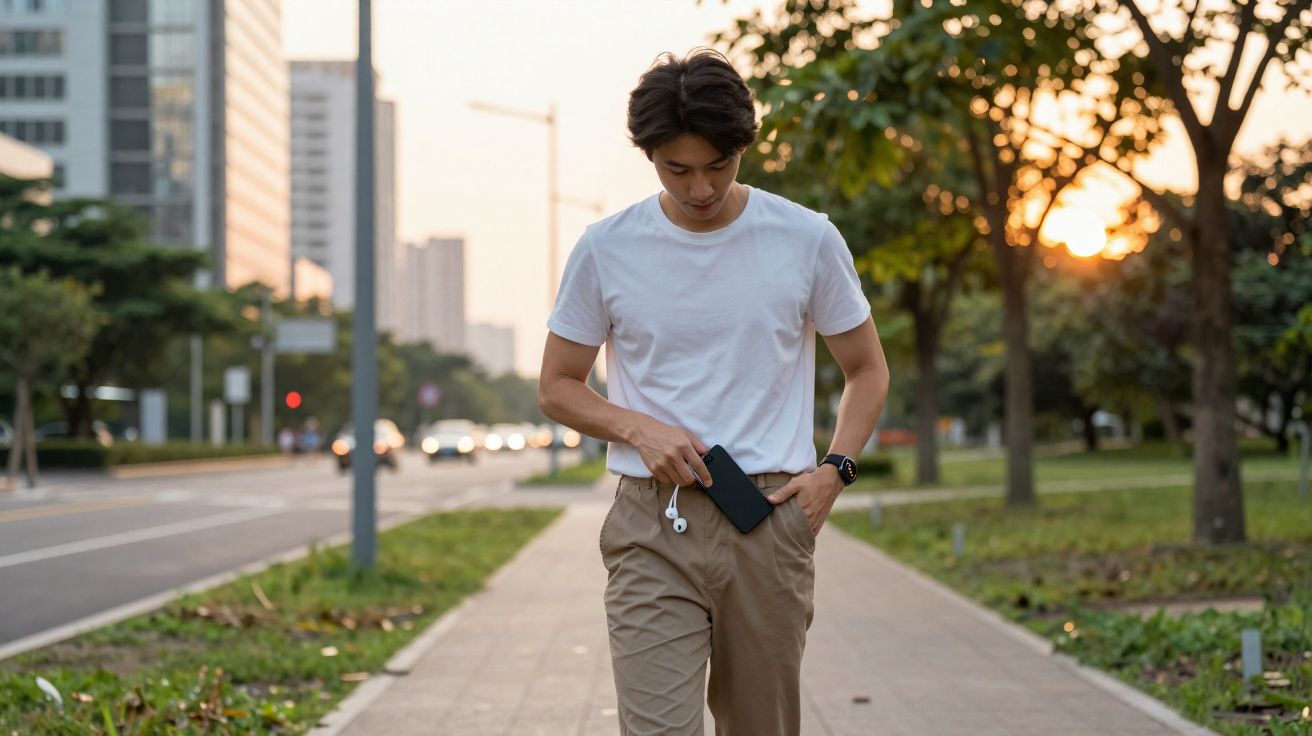
The change begins with one small, concrete boundary: make the first five minutes of your walk sacred no-phone time. Not “airplane mode but I’ll peek”. Not “just one quick check”. Put the phone in your pocket or bag, screen facing in, and walk as though it’s the 1990s. Choose one thing to actually look at-the sky, building fronts, how the light shifts on the pavement.
That tiny rule redefines the purpose of the walk. Instead of acting as a roaming office, it becomes a buffer zone: a decompression chamber between your day and your evening. If five minutes feels unbearable, that’s a useful signal of how overstimulated your brain has become. Start with two minutes, then build to five. Let the beginning of the walk be intentionally boring.
After that, decide what-if anything-you want in your ears.
A common misstep is swapping “stressful input” for “virtuous input” and calling it recovery. You step away from the inbox, then feed yourself a news podcast packed with crisis and conflict. You leave the work chat, then listen to a self-help voice listing everything you should optimise. It can feel productive. It rarely feels peaceful.
For a tired brain, even “useful” information can land like noise. On a walk intended to calm you, more content is still more content. If your nervous system has been “on” all day, heavy topics keep cortisol quietly humming in the background. That’s why you can come back from a long “relaxing” walk and still snap at the first minor irritation.
And at a human level, let’s be honest: nobody perfectly curates mindful, soul-nourishing audio every single evening.
The goal isn’t perfection-it’s making at least some walks radically simpler than the rest of your day.
A psychologist once put it to me like this:
“If your evening walk feels like another meeting-with your phone, with the news, with self-criticism-your brain will treat it as work, not rest.”
That hits because it names what many people sense but don’t say out loud. You believe you’re being “good” by keeping your mind busy. Often, your body is asking for the opposite: fewer inputs, a slower pace, and a softer, wider focus. A walk is one of the few places you can offer it that.
To make it practical, test what genuinely settles you with a simple comparison list:
- Take one evening walk with no audio, just the ambient sounds around you.
- Take another with light music, preferably without lyrics and without intensely nostalgic favourites.
- Take another with a comforting, low-stakes podcast (not news).
- Take one where you vent into your notes app, then close it and put the phone away.
- Compare how your body feels 30 minutes afterwards for each version.
This isn’t about being “perfectly mindful”. It’s about noticing which version drops your shoulders rather than winding them tighter.
Let the walk evolve with you (evening walk, mental health, anxiety)
The evening walk that reduces anxiety is rarely the most impressive one. It’s not necessarily the longest route, the fastest pace, or the one that sets a new step record. Often it’s the “nothing” loop round the block-especially the one where you leave your phone at home once a week. It’s the short wander where you let yourself glance at lit windows, trees, other people’s dogs, and think about nothing in particular.
On a high-stress day, the kindest version might be ten quiet minutes near your building. On an easier day, it could be a longer route where your thoughts roam without you checking anything. A walk can be reflective without tipping into rumination. The difference is subtle: reflection feels open and curious; rumination repeats the same worry like a stuck record.
Walking gives you a physical way to catch which one you’re doing-and to gently steer yourself out of the spiral when you notice it.
On a deeper level, this everyday habit raises a bigger question: do you allow yourself any moment that isn’t optimised? A walk can be one of the last low-pressure spaces in a life that measures and rates everything-steps, calories, productivity, sleep scores, screen time. Anxiety loves constant measurement. Your nervous system usually doesn’t.
One evening, try switching the tracker off and walking with a single aim: “out and back”. No perfect route. No target pace. Just you, the street, and the fading light. On a rough day you may feel restless or bored. On a better one, you might catch the smell of someone’s dinner drifting from an open window and notice your shoulders drop a centimetre without quite knowing why.
Two extra tweaks that make the off-switch easier
Choose your environment with the same care you choose your playlist. If you can, pick a route with fewer crossings, less traffic noise, and a bit of greenery-even if it’s only a small park or a tree-lined street. Your brain reads constant horns, bright signage, and hectic junctions as “alert mode”, which can make psychological detachment harder.
Also, use your body to tell your mind it’s safe. Every few minutes, check your posture: unclench your jaw, let your tongue rest, drop your shoulders, and lengthen your exhale slightly. You don’t need a full breathing exercise; even a couple of slower breaths can act as a physical cue that the day is over.
We’ve all had those tiny moments when the world goes quiet for no obvious reason. The skill is giving those moments enough space to arrive.
Your evening walk can still include podcasts, messages, even the occasional call. It doesn’t have to become a silent retreat. What changes everything is the default intention: is this walk a conveyor belt for more stimulation, or a gentle off-switch from the day? The answer has less to do with your legs than with what you allow into your head while they move.
| Key point | Detail | Why it matters for you |
|---|---|---|
| The phone-driven walk fuels anxiety | Constant notifications, news, and work apps keep your brain in “on duty” mode even while your body is walking | Helps explain why you don’t feel relaxed after a walk |
| Micro-boundaries change the habit | Making the first 5 minutes tech-free and choosing lighter audio creates real separation from the day | Offers simple, doable tweaks without rebuilding your whole routine |
| Flexibility beats perfection | Adjusting the walk to your stress level, and sometimes dropping goals and trackers | Gives you permission to walk in a way that genuinely calms you |
FAQ
Is it bad to listen to podcasts on my evening walk?
Not automatically. The key is intensity and timing. Heavy news, work content, or self-improvement shows straight after a stressful day can keep anxiety elevated. Softer, comforting audio later in the walk is often gentler on your mind.Do I have to leave my phone at home to relax?
Not necessarily. Even a few phone-free minutes at the start, or keeping it out of your hand on silent, can change how your brain experiences the walk. Some people prefer a “for emergencies only” rule.What if walking in silence makes me more anxious?
That’s common if you’re used to constant noise. Begin with very short silent sections on familiar, safe streets. Pair them with slower breathing or gentle music rather than jumping straight to complete silence.How long should an evening walk be to reduce anxiety?
There’s no magic number. Research often mentions 10–20 minutes, but attention quality matters more than duration. A calm 8-minute loop can soothe you more than a 40-minute doomscrolling march.Can walking replace therapy or medication?
For everyday stress, changing how you walk can help a great deal. For persistent, intense anxiety that affects sleep, work, or relationships, walking is support-not a substitute for professional care.



Comments
No comments yet. Be the first to comment!
Leave a Comment