
The noise starts early.
First there’s your phone alarm - except it hardly feels like an alarm, more like a meditation app reminder. Then the family group chat fires off a “GOOD MORNING” in capital letters, followed by a cascade of stickers. Your email buzzes. Your calendar pings. Your banking app warns about a “suspicious” transaction that was, of course, yours. In under 15 minutes, your brain has already run an invisible sprint. You’re still in your pyjamas, yet it feels as though you’re late for everything. As if a constant, silent siren is blowing right by your ear: hurry up, reply, react. In that haze of flashing signals, urgency is born, gathers momentum, and takes over the day.
The siren effect of notifications: when everything feels urgent
There’s a huge gap between something being urgent and simply seeming urgent. In a world packed with notifications, that line gets blurred until it almost disappears. Each vibration, every red badge on an icon, triggers a tiny internal alarm. Your body responds as though it’s dealing with an emergency - even when it’s just a meme in the work group chat. Over time, those small alarms stack up into a permanent state of readiness. Your heart rate ticks up, your mind jumps from tab to tab, and your attention splinters. Nothing catastrophic is actually happening, but it feels like it might if you don’t check right now.
From the brain’s perspective, that reaction isn’t an overreaction. Notifications are deliberately designed to punch through focus: bold colours, distinctive sounds, and vibrations engineered to cut across whatever you’re doing. They tap into reward pathways and the fear of missing out. A flashing icon can set off the same anxiety circuitry as a real deadline approaching. The pressure isn’t logical - it’s sensory. When you receive a steady stream of alerts, even trivial ones, they create a sense of diffuse threat: something’s happening, you need to know, you might be falling behind. At that point, urgency stops being a property of tasks and becomes the atmosphere of the environment.
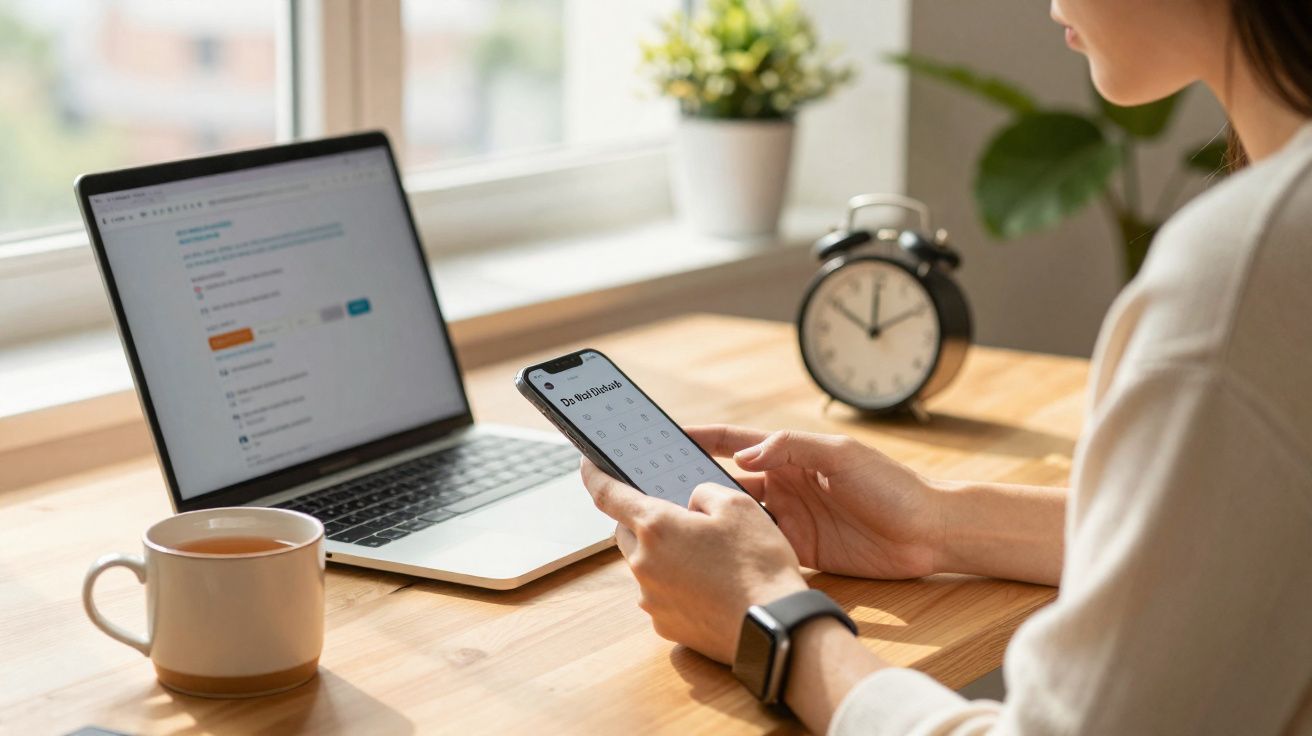
Picture a straightforward scenario: you’re working from home, trying to concentrate on an important presentation. Within 30 minutes, WhatsApp pings five times, email sends three alerts, a delivery app pushes a voucher, your bank suggests a new card, and Instagram announces “someone has started a live”. Each interruption looks harmless on its own, yet together they add up. After an hour, you’ve barely moved the main task forward, and it feels as though you’ve been putting out one fire after another. Most of us know the moment you glance at the clock and think, “How is it this time already and I’ve done nothing?” The urgency didn’t come from the clock; it came from the flood of signals demanding your attention.
A quick note on expectations (and why urgency spreads)
One reason the siren effect intensifies is social: once rapid replies become normal in a team or family chat, silence can be misread as neglect. If you can, it helps to set expectations explicitly - for example, “I check messages on the hour” or “call me if it’s urgent”. That small bit of clarity reduces the imagined consequences that make notifications feel like emergencies.
It also helps to remember that “urgent” is often a label we inherit from apps and group norms, not a fact. When every platform is allowed to interrupt you, they all get the same priority level - and your brain can’t tell the difference between a true emergency and an attention-grabbing prompt.
How to slow down without disappearing from the world
A practical way to turn the volume down on urgency is to build “islands of silence” into your day. You don’t need to become a digital monk. Simply choose 30- or 45-minute blocks when no notifications are allowed to cross your mental doorway. That means switching off sounds, disabling vibrations, and closing tempting tabs. It isn’t dramatic; it’s more like a personal experiment: what happens if, for less than an hour, nobody can poke you through a screen? When the block ends, you decide to check everything in one go. The dynamic flips: instead of being interrupted constantly, you choose when to step back into the stream of alerts. It may sound modest. For your brain, it’s a substantial relief.
Many people feel guilty even considering muting notifications - as if it’s a lack of commitment or a sign they don’t care about others. Let’s be candid: nobody can reply to everything the second it arrives, not even the people who insist they can. More often, the opposite occurs. Trying to keep up in real time leaves you scattered across ten conversations, missing important messages, and replying quickly but poorly. Urgency becomes a lifestyle rather than an exception. A common trap is telling yourself, “I can handle it; I just need to organise myself better,” when the issue isn’t only organisation - it’s an environment that keeps shouting. Tweaking notifications isn’t fussiness; it’s mental hygiene.
As one digital behaviour researcher put it: “It isn’t that the world became more urgent - it’s that our alerts became louder.”
Another workable approach is to deal with notifications by category rather than one by one. Ask yourself: what truly deserves to interrupt me in real time? Personal emergencies? Critical work? Everything else can wait. A simple breakdown helps:
- Notifications that can interrupt: only what is genuinely urgent.
- Notifications that can pile up: social media, promotions, newsletters.
- Notifications that can disappear: games, apps you don’t even remember installing.
When you put each alert in its proper place, you send a quiet message to your own brain: not everything deserves siren status. Some things can knock and move on.
Living with fewer alarms and more choice
When your surroundings are full of flashing cues, feeling urgent isn’t a character flaw - it’s a sensible response. Nobody stays calm in a room where ten doorbells ring in rotation all day. Change begins by noticing that without turning it into self-blame. Instead of “I’m too anxious”, a more accurate framing may be “my environment keeps demanding reactions”. Small choices - muting the group chat that only shares jokes, reviewing an app’s permissions - create pockets of calm across the day. The goal isn’t to run away from the world; it’s to choose the volume at which you want to hear it.
| Key point | Detail | Value for the reader |
|---|---|---|
| Notification-heavy environments create artificial urgency | The brain responds to sounds, colours and vibrations as if everything is top priority | Helps explain why the day feels rushed even without many critical tasks |
| “Islands of silence” reduce the constant alert state | Short blocks without interruptions restore focus and a sense of control | Offers a simple method to lower anxiety without fully disconnecting |
| Filtering notifications by category changes your relationship with your phone | Decide what may interrupt, what can wait, and what should be removed | Lets you shape a digital environment that works for you, not against you |
FAQ
Question 1: Why do I feel behind even when I start the day early?
Because your brain switches into response mode with the first notifications, bouncing from one stimulus to the next. The “I’m late” feeling comes from fragmented attention, not just the time on the clock.Question 2: Won’t muting notifications make me miss important things?
Not if you choose carefully what stays enabled. Keep genuine alerts (such as calls) active, and leave promotions, social platforms and non-urgent messages for set check-in times.Question 3: I rely on my phone for work all day - can I still use this?
Yes, by adapting the method. Instead of long offline stretches, use very short interruption-free windows and switch on work-specific focus modes.Question 4: How many notifications per day is “too many”?
There’s no magic number. If you notice you can hardly finish a task without checking your phone several times, the volume has already gone beyond what’s healthy.Question 5: What if I feel anxious when my phone is on silent?
Start with very short periods - 10 or 15 minutes - and build up gradually. The adjustment is incremental, and the anxiety usually eases as you test it and see that nothing falls apart.





Comments
No comments yet. Be the first to comment!
Leave a Comment