
The coffee has already gone tepid by the time the squabble kicks off. One parent by the swings insists their children get “20 minutes of educational apps, maximum.” Another, half-laughing under their breath, admits Bluey has more or less brought up their toddler for the last six months. Behind them: a row of pushchairs, a steady chorus of notification chimes, and a cluster of small faces washed in the glow of tiny rectangles. Nobody looks wholly pleased with themselves. Nobody looks wholly mortified either.
Somewhere between doom-laden headlines and the “anything goes” free-for-all, a quieter pattern is taking shape in family life.
We’re designing modern parenting around digital babysitters… and most of us would rather not say that bit out loud.
The quiet bargain worn-out parents strike with screens and digital babysitters
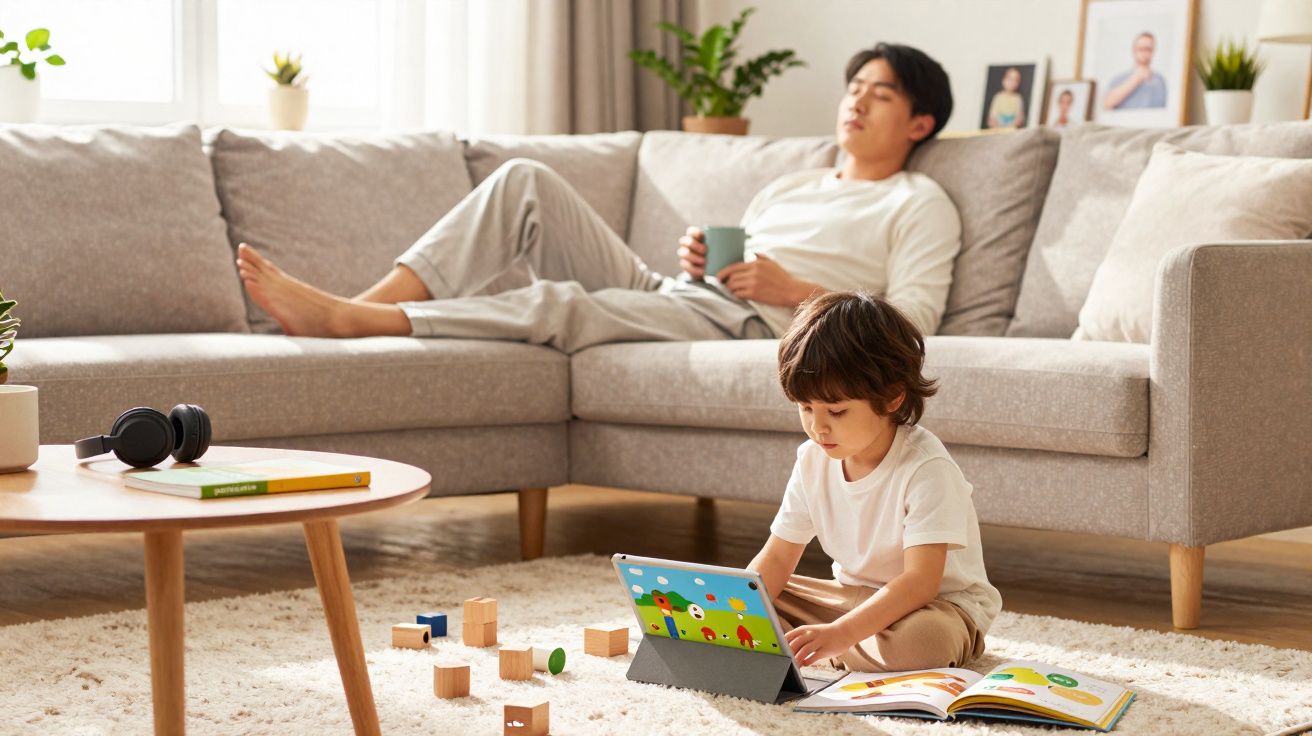
Step into a typical living room at about 7 p.m., and you can almost sense the unspoken arrangement. The adults are fuelled by five hours’ sleep and last night’s reheated tea. The children are loud, sticky, and brimming with questions that begin with “why” and never seem to finish. Then the telly goes on, or the tablet appears, and the house drops into silence. Not the wholesome, wooden-toy, Montessori kind of calm-just the sort of quiet you need to get through the evening.
In that moment, screens aren’t a mistake. They’re survival.
Ask enough parents and you’ll hear the same admission dressed in different accents. A mum in London says she “lost the battle” and now lets her four-year-old watch cartoons so she can finish work emails. A dad in Toronto calls his son’s tablet “the third parent”, laughing and not laughing at the same time. A 2023 Common Sense Media survey reported that American tweens average close to five hours a day of entertainment screen time, and teenagers nearly eight. Parents see those figures and wince.
Then they look at their own child-content, transfixed, and keeping dinner from burning-and that familiar knot of guilt tightens again.
The loudest story says too much screen time is melting children’s brains. On the ground, it’s messier. Modern life has torn up the old support structures: fewer grandparents around the corner, thinner communities, higher living costs, two parents working (or one parent doing everything). The distance between what we’re told “good parents” do and what real parents can realistically keep up has rarely felt so wide.
So screens quietly move into the space where extended family, neighbours, and flexible jobs used to sit. We’re not raising digital zombies; we’re plugging holes in a frayed social safety net with Wi‑Fi and cartoons.
From guilty scrolling to intentional screen parenting
One small change in perspective can shift everything: stop fixating on “Is screen time bad?” and start asking, “What job is this screen doing right now?” That reframe turns the tablet from a shameful secret into something practical you can manage. Is it helping your child decompress after nursery, giving you 20 minutes to shower, supporting letter learning, or simply filling a bored half-hour? Each purpose calls for a different boundary.
Once you can name the job, you can set the limit. Screens stop feeling like a vague looming danger and become a specific helper with a clear finish line.
Parents who seem unusually relaxed about screens often aren’t stricter-they’re just clearer. One couple sets a kitchen timer everyone can see for after-school “cartoon time”. Another family keeps tablets literally zipped into a pouch by the front door and only brings them out for flights, long drives, and adult calls that truly can’t be interrupted.
Children adjust more quickly than adults expect. The meltdown is not always about the device itself. Often it’s about rules that keep shifting because the grown-ups are exhausted, conflicted, or quietly scrolling too.
Researchers return to the same theme again and again: context matters more than raw minutes. A child watching something daft with a parent nearby-who occasionally laughs, comments, and shares the moment-experiences something very different from a child alone, endlessly flicking through short videos at midnight. This isn’t a morality test; it’s logistics. When parents pour all their energy into counting minutes, they rarely have any left to consider content, timing, or their own screen habits.
And let’s be frank: almost nobody tracks every single second of their child’s screen time with perfect consistency. A more workable approach is to build a handful of sturdy routines-and accept that, on some days, getting through the day matters more than doing it flawlessly.
One helpful add-on (especially when you’re tired) is to set the defaults once, rather than relying on willpower. Age ratings, app approvals, bedtime downtime settings, and a simple home-screen layout can reduce arguments before they start. It’s not about being controlling; it’s about making the “easy option” the one you can live with.
It also helps to plan for the handover. When screens are doing a clear job-and you know it-a short “two-minute warning”, a timer, or a predictable next activity (snack, bath, story) can soften the landing. You’re not negotiating with a villain; you’re ending an activity your child is enjoying.
Using digital babysitters without letting go of your values
A practical approach that works in many households is to create “green, yellow and red” screen zones. Green zones are no-guilt: Saturday morning cartoons while you drink your coffee, a learning app while you cook, a gentle programme after an overstimulating birthday party. Yellow zones are “only if we truly need it”, such as late evenings or moments when your child is already overtired and wired. Red zones are non-starters: during meals, just before bed, and alone in the bedroom.
You don’t need a colour-coded chart on the fridge. Just keep the concept in mind. It shifts the decision away from emotion and towards a simple check-in: “Which zone are we in right now?”
Most parents stumble into the same pitfalls. Screens become a last-resort bribe at bedtime-then everyone wonders why sleep falls apart. Or a new “no more YouTube” rule is declared overnight, turning screens into forbidden sweets that taste even better. Guilt drives extremes: total bans that collapse, or constant access that feels impossible to rein in.
Screens tend to work best when they’re dull in their predictability: similar times, similar places, broadly consistent rules. Children push back at first, then settle because they can see the pattern. Parents settle too. And yes, we’ve all had that moment in the supermarket when you hand over the tablet purely to stop the screaming down the cereal aisle. That doesn’t “ruin” your child. It means you’re a person.
“Parents are not failing because they use screens,” says one paediatric psychologist I spoke to. “They’re failing when screens become the only way to soothe, entertain or connect. The goal isn’t no screen time. It’s many ways to be together, with screens as just one of them.”
Start with the non‑negotiables
Decide what’s fixed: no screens in bedrooms, no devices at family meals, and nothing after a set time. Strong anchors let everything else bend without turning into chaos.Choose a few ‘approved’ screen moments
After nursery, while you’re cooking, and on slow Sunday mornings. When children know when the “yes” is coming, they argue less when the answer is “no”.Curate, then loosen your grip a little
Pick a small bank of shows and apps you’re comfortable with, then stop torturing yourself over each individual episode. Perfection is a dreadful parenting target.Use screens as a bridge, not a barrier
Sit alongside them sometimes. Ask which character they like most, copy a silly dance, or pause to chat about a scene.Guard your attention as well
Children notice when we demand they log off while we keep scrolling. Put your phone down occasionally-not because you “ought to”, but because it feels better for both of you.
What digital babysitters tell us about parenting in 2026
The panic around children and screens often covers something more tender: grief for the parent we imagined we’d be. The one with homemade snacks, limitless patience, and children happily stacking wooden blocks while you bake sourdough. Instead you get Minecraft music, half-built Lego towns, and a tablet balanced on a cereal box while you answer a Slack message.
Screens didn’t destroy that fantasy. They simply made the gap impossible to ignore.
Look closely and digital babysitters are less a monster and more a mirror. They reflect overloaded schedules, thinner communities, and workplaces that don’t flex. They highlight how much care has been pushed onto individual parents-especially mothers-without any meaningful structural backup. They also expose our strange double standards: many of us will accept two hours of structured childcare TV without blinking, yet feel awful about the exact same cartoon in our own lounge.
The glowing rectangle is an easy culprit when the deeper issue is that no one can do this alone any more.
Families who make peace with screens are rarely “doing it perfectly”. They’re simply candid about the trade-offs. They can say: “Yes, my child watches more than I pictured. Without that, I’d shout more, sleep less, and enjoy them less.” They may still feel a flicker of doubt when another parent posts about screen-free weekends. But they’re noticing other truths too: children are resilient, connection can happen over a silly clip, and values are shaped more by how we speak and behave than by how long a tablet stays on.
The question isn’t whether digital babysitters are good or bad. It’s what sort of family life we’re building around them-and whether that life leaves any space for tired, imperfect humans.
| Key point | Detail | Value for the reader |
|---|---|---|
| Reframe screen time | Ask what job the screen is doing (calming, entertaining, teaching, buying you time) instead of treating all minutes as identical | Eases guilt and supports realistic, flexible rules that fit day-to-day life |
| Use predictable routines | Set clear “yes” and “no” moments, plus a few non‑negotiables such as no screens in bedrooms or at mealtimes | Fewer arguments, calmer children, and boundaries that exhausted parents can actually hold |
| Focus on connection, not perfection | Watch together occasionally, talk about what they’re seeing, and let go of the fantasy of perfect, screen‑free parenting | Protects your relationship with your child and safeguards your own mental health |
FAQ
- Question 1: Is screen time always harmful for young children?
- Question 2: How many hours per day counts as “too much” screen time?
- Question 3: Are educational apps and programmes genuinely better?
- Question 4: What if my child has a meltdown every time I switch the screen off?
- Question 5: How do I handle judgment from other parents about screen use?





Comments
No comments yet. Be the first to comment!
Leave a Comment