
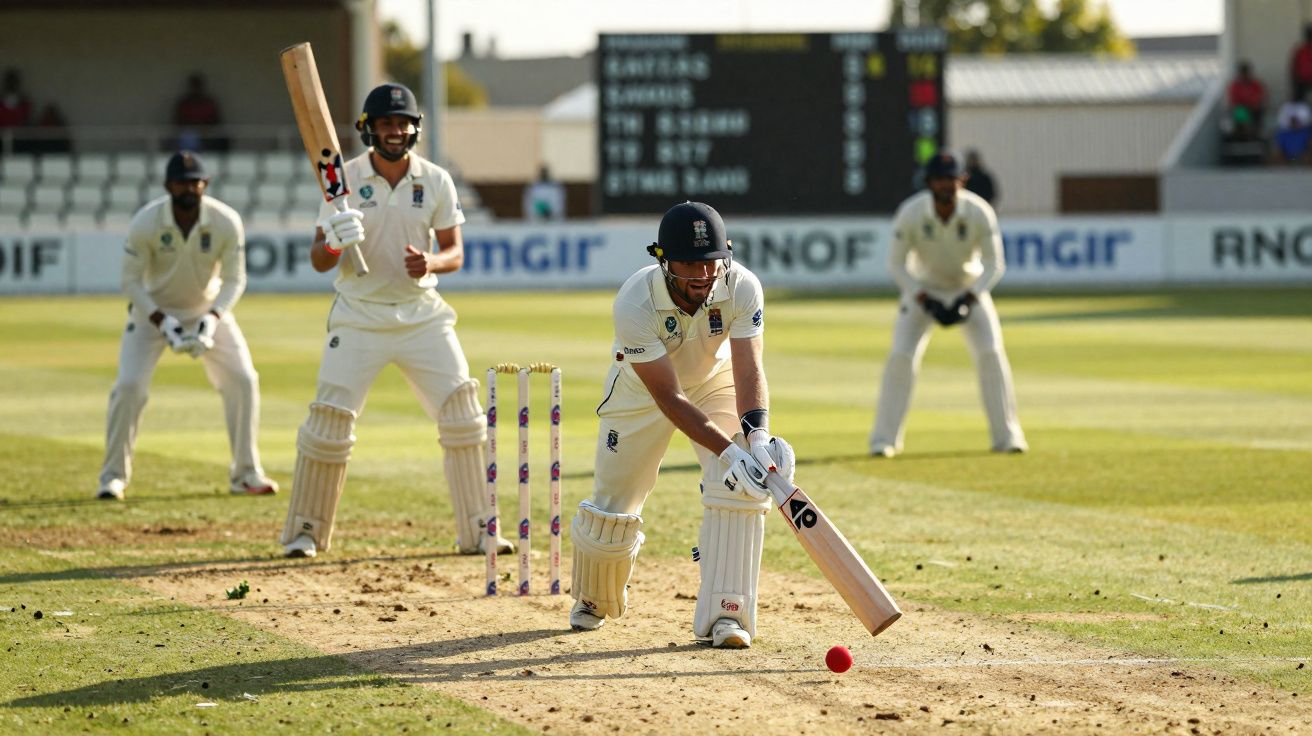
The first thing that hit you was the noise. Not the genteel hum you expect at a Test, but a low, swelling roar that becomes almost tangible when one side is properly on top. Beneath a pale, milky English sky, Sri Lanka’s batters wandered out with faces that grew more confused by the over, while England’s close fielders edged in until they looked close enough to feel the drift and dip in the air.
At the centre of it all was Joe Root: sleeves pushed up, fingertips chalked white, dropping mischievous off-breaks into the rough and watching the pitch do the talking. At slip, Harry Brook wore a grin and clapped with such force you could almost hear the sting. This was not England simply ticking through a session; it felt like a side rediscovering exactly what they are when the red ball starts to bite-quietly, gleefully, and with an obvious appetite for the disorder they were causing.
Root’s quiet demolition, Brook’s loud delight: Joe Root and Harry Brook at full tilt
Joe Root didn’t charge in; he floated. Little steps, a serene expression, that deceptively relaxed tempo that makes you think nothing is about to happen. Then the ball would dip, grip, and a Sri Lankan batter would be left glaring at the surface as though it had double-crossed them.
Around him, England crackled with energy. Brook, stationed close, kept talking-flicking the ball between his hands, eyes fixed on the splice, always ready for the faintest error. It was the perfect blend of old-school control and new-school edge, and it turned Sri Lanka’s innings into a slow, unavoidable slide.
One passage captured the whole mood. Root tore through the middle order on a pitch that, at first glance, looked as harmless as a village green. A batter pressed forward, beaten by drift, and the ball feathered the edge to Brook, who caught it with the nonchalance of someone pocketing a set of keys. A handful of overs later, the same script ran again-almost a carbon copy. The stands responded in kind: big smiles, quick high fives, and the sense that England weren’t only winning overs, they were owning the day.
The most striking element was the reversal of roles. Root, the classicist, became the chief wrecking ball with the ball; Brook, the young dasher, revelled in the graft-close catching, sharp movement, constant noise. Sri Lanka’s batters arrived expecting to navigate Jimmy Anderson and the seamers, only to be tied in knots by Root’s flight and guile instead. England turned a fairly ordinary pitch into a minefield, not with raw pace or intimidation, but with rhythm, patience, and a plan that never loosened. The more Root tightened the net, the more Brook’s body language said the quiet part aloud: Sri Lanka were in real trouble.
How England put Sri Lanka in a spin
From the seats, it all looked almost too straightforward. Root gave the ball just enough air to tempt the drive, aimed relentlessly at stumps and pads, and trusted the men around the bat. Fielders crowded the danger areas, catchers ringed the edges, and every dot ball was met with a burst of encouragement.
Brook added a mischievous edge that made the pressure feel personal. He chivvied bowlers, chatted between deliveries, and hovered on the brink of turning tension into panic. England weren’t hunting for “magic balls”; they were happy to squeeze, and squeeze, and squeeze again.
Look closer and you saw the craft in the micro-adjustments. Ben Stokes nudged a fielder squarer after a thick inside edge. Root dragged his length back by a fraction once the sweep appeared. The slips shuffled half a metre finer as Sri Lanka’s hands started to prod rather than play. Everyone knows the feeling: a job that seemed manageable suddenly becomes overwhelming, and small errors begin to snowball. That’s what this Sri Lankan effort resembled-tiny misreads that Root and Brook converted into serious damage. The run rate crawled, but the match accelerated.
On days like this, spin isn’t primarily about mystery; it’s about repetition, clarity, and a fielding unit that refuses to drift mentally. Root delivered long, uncomplicated spells, content to ask the same hard question ball after ball until Sri Lanka finally blinked. Brook’s delight summed up the wider vibe: England weren’t enduring a grind-they were hunting.
The surface, the rough, and the red-ball basics
A subtle subplot sat in the footmarks and scuffed patches outside off stump. As the session wore on, Root targeted the rough with increasing confidence, using drift to pull batters across before letting the ball straighten just enough to threaten the outside edge. It wasn’t extravagant turn; it was just enough variation-combined with relentless accuracy-to make every defensive prod feel risky.
England’s discipline with the basics mattered too. Over after over, they defended the “bad-ball” areas, resisted the temptation to get cute, and made sure the scoreboard pressure never went away. When a side keeps you pinned like that, even a modest hint of grip can feel like a trapdoor.
Lessons from a dominant display
A small detail in Brook’s fielding said plenty about England’s mindset. Before each delivery, he reset early-feet set, eyes already tracking Root’s hand, prepared for the faintest nick or miscue. That routine turned half-chances into clean takes.
Root’s method was equally tidy: the same run-up, the same release, only minimal tweaks to pace and flight. No fuss, no theatrics-just a calm, repeatable action that let the skill do the work. It looked effortless from a distance, but it was clearly built on hours of discipline.
Sri Lanka, by contrast, fell into a familiar trap. Rather than committing to one plan, they kept switching mid-innings: sweep, then block, then charge-never fully trusting any single option. England did the opposite. They stayed with what worked, then nudged it only when the surface or the batter forced their hand. Brook’s willingness to enjoy the ugly parts-hard stops, awkward close catches, relentless chatter-is exactly what many players avoid. The simple truth was there for all to see: the team that embraced the grim work was the team smiling at stumps.
Root, with a shrug and his familiar understatement, put it plainly afterwards: “I just tried to bowl in the right areas and let the pitch do a bit. The lads around the bat were brilliant-guys like Brooky give you confidence to toss it up.”
- Root’s rhythm: A repeatable, low-drama action that keeps control high and ego low.
- Brook’s energy: Constant vocal support, sharp reactions, and a willingness to stand where the ball can sting.
- Stokes’ field craft: Smart, subtle shifts that turned half-chances into likely outcomes.
- Collective buy-in: Everyone accepting their role in the squeeze rather than chasing headlines.
- Pressure over time: Not one miracle delivery, but a steady drumbeat of small wins Sri Lanka couldn’t escape.
What teams can borrow from England’s approach
Even if you don’t have a Joe Root, the blueprint is transferable. Clear plans, tight catching positions held for long enough to matter, and a shared commitment to dot-ball pressure can create wickets without needing extravagant movement. Equally, fielding intent is contagious: one close catcher setting early, talking constantly, and moving sharply raises the standard for everyone around him.
For batters, the counter-lesson is just as practical. Under sustained spin pressure, survival often comes from choosing a method and sticking to it-leaving well, playing late, and accepting quiet spells-rather than searching for a release shot that ends up feeding the trap.
What this means for England – and for Sri Lanka
Sessions like this leave a mark on a series. For England, seeing Root back at the centre of things with the ball-and Brook thriving in the heat of close combat-will pour confidence into the next match the moment a pitch offers even a hint of grip. For Sri Lanka, it was a blunt reminder that English conditions are not only about swing and seam; they can be just as ruthless when a clever “part-time” spinner is backed by a clear plan and total trust.
By the end, the psychological swing was obvious: one team joking between overs, the other trudging off with stiff shoulders and restless eyes.
The broader theme, though, is identity. England have spoken for years about playing in a more aggressive, expressive way, yet the best of this display was built on quieter virtues-patience, faith in the process, and a shared enjoyment of the grind. Sri Lanka will discuss technical adjustments before the next Test, but the harder task is mental: can they absorb pressure, endure the dry spells, and deny Root and Brook that sense of inevitability? This match won’t define either side’s future, but it did shine a bright light on who was ready to lean into the hard sessions-and who looked away when the ball began to bite.
| Key point | Detail | Value for the reader |
|---|---|---|
| Root’s spin impact | A controlled, attacking spell that dismantled Sri Lanka’s middle order | Shows how a “part-time” bowler can change a match with discipline and clarity |
| Brook’s fielding presence | High-energy close catching and constant pressure on batters | Underlines the power of body language and intent in elite sport |
| England’s collective plan | Tight fields, repeatable plans, trust in each role | Offers a template for building dominance without relying on freak brilliance |
FAQ
- Question 1: Why was Joe Root so effective against Sri Lanka in this match?
His accuracy, subtle changes of pace and flight, and attacking fields turned good deliveries into constant threats, forcing mistakes from both set and new batters.- Question 2: What made Harry Brook stand out during England’s dominant display?
Beyond his batting reputation, his close catching, relentless energy, and clear enjoyment of pressure moments sharpened England’s edge around the bat.- Question 3: Did the pitch heavily favour spin from the start?
Not dramatically; it offered just enough grip and variation, but England’s consistency and planning made it appear far more dangerous than it first looked.- Question 4: How did Sri Lanka struggle tactically against England’s spin and pressure?
They kept switching methods and never fully committed, which allowed England to dictate terms and build long, suffocating spells.- Question 5: What does this performance suggest about England’s prospects for the rest of the series?
If they continue to combine Root’s control, Brook’s intensity, and smart captaincy, they will back themselves to dominate on similar surfaces.






Comments
No comments yet. Be the first to comment!
Leave a Comment