
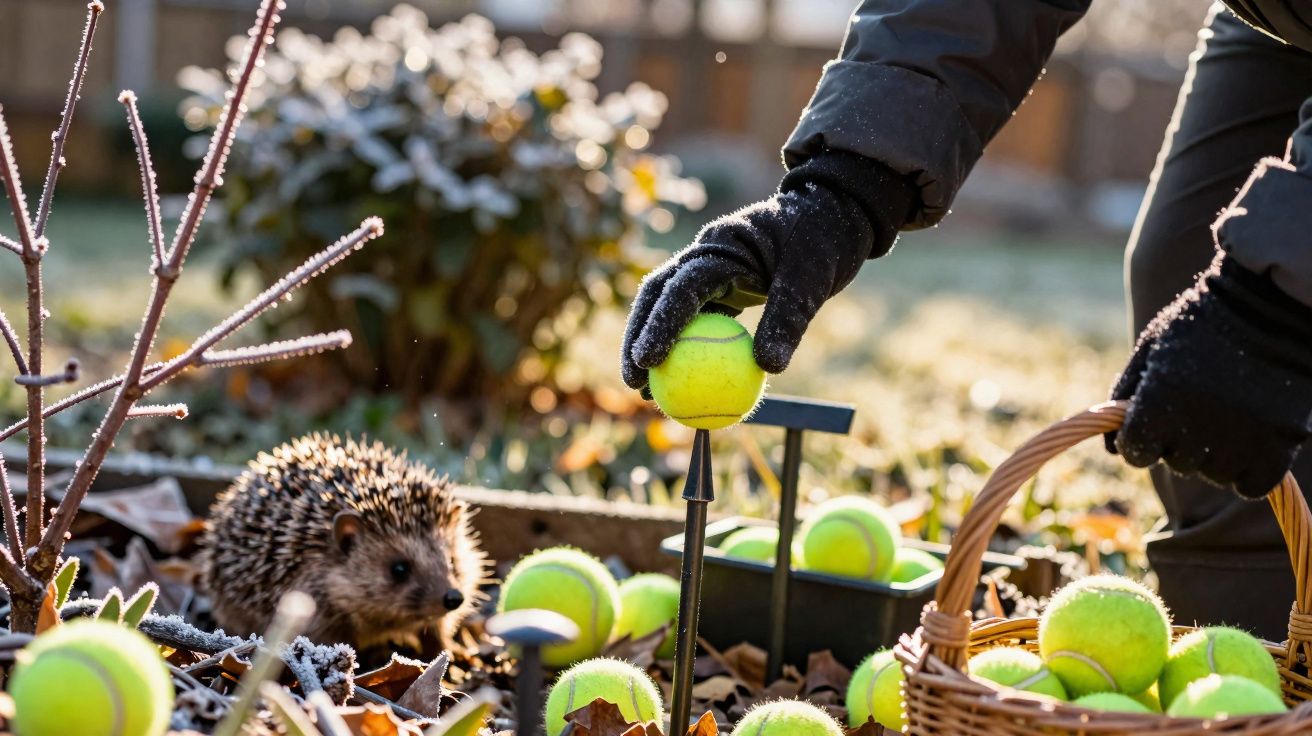
Putting tennis balls in your winter garden can sound like yet another Pinterest “hack”: faintly cute, faintly pointless. Yet those small green spheres can be the difference between life and death for hedgehogs, toads and exhausted birds when cold weather turns ordinary gardens into silent hazard zones. Winter rain, frost and our own “useful” setups-water butts, buckets, tarpaulins, steep-sided ponds-can combine to create drowning traps with no way out. So why tennis balls, of all things?
Hidden death traps in your winter garden
A typical back garden in January looks calm enough-bare, perhaps, but not dangerous. The risks only show up when you pay attention to the details: an uncovered rainwater butt, a deep builder’s bucket half full, a pond with sheer sides glazed with ice, or a wheelbarrow that’s become a rain collector.
For a hedgehog or a toad moving slowly after dark, that “clutter” can function like a pitfall. They slip in, can’t get traction on smooth plastic or frozen edges, and use up what little energy they have left trying to stay afloat in near-freezing water. By morning the garden still looks tidy; it’s only the missing movement that tells the story.
Wildlife rescue centres in the UK and across Europe describe the same bleak winter pattern. Animals arrive hypothermic and waterlogged after being pulled from ponds, buckets and water butts-often by pure luck. Many are never found. One British hedgehog charity has warned that thousands die each cold season in avoidable “garden accidents”: no poison, no cruelty, just everyday objects left in the wrong state.
Our winter routines can make things worse. We stack, cover and secure the garden as if we’re battening down a ship before a storm. For a blackbird searching for a drink when puddles are frozen, a neat, accessible water butt can be both a help and a hazard. For a mouse hunting shelter, a tarpaulin stretched over a sunken frame can create a hidden “moat” where water gathers. We tend to treat gardens as dormant in winter; wildlife does not. It keeps moving quietly at night, looking for water, warmth and a route through.
Two other winter hazards are worth mentioning because they often appear alongside water traps. First, netting and loose mesh can snag birds and small mammals-keep it taut, raised off the ground, or stored away until needed. Second, blocked gutters and downpipes can overflow into deep, narrow containers (or create slick sheets of ice), so a quick check after storms can prevent both flooding and new puddle-traps forming.
Why tennis balls become a lifeline for hedgehogs and other wildlife
Imagine the same garden, but with one simple change: a scuffed tennis ball floating in each open water butt, a few drifting near the edges of the pond, another bobbing in the forgotten bucket by the shed. The layout hasn’t changed, yet the garden is suddenly less lethal.
If a hedgehog falls into a barrel, it still faces a serious struggle-but it now has something to grab. The fuzzy felt gives grip where smooth plastic offers none. Because the ball floats and moves with wind and ripples, it stays reachable instead of sitting uselessly in one corner.
Wildlife rehabilitators have used versions of this idea for years-sometimes with pieces of wood or purpose-made floating platforms. Tennis balls work especially well because they are cheap, easy to spot even in murky water, and slow to rot or splinter. Their constant bobbing can also disrupt thin surface ice and leave small weak points or gaps for longer. It won’t keep an entire pond ice-free, but it can provide crucial breathing space and buy time.
From an animal’s perspective, the mechanics matter. A hedgehog cannot climb a smooth, vertical wall; it needs texture and leverage. A branch might roll away, and hard plastic balls can be too slippery to help. The felt on a tennis ball provides “purchase” even for small claws and cold, tired limbs.
The ball does not need to be new or perfectly round. It only has to add one more option besides “slide, panic, drown”. In freezing conditions, that small advantage can be everything.
How to use tennis balls in your garden this winter (tennis balls, winter garden safety)
Start by walking your garden as if you were small, low to the ground and moving at dusk when edges blur into shadow. Look for anything that can hold water and is deeper than a hand’s breadth: buckets, trugs, old plant pots, water butts, children’s toys, wheelbarrows, troughs, deep trays and decorative barrels.
Then keep it simple:
- Drop one or two tennis balls into each small-to-medium container.
- In larger ponds or barrels, use a small cluster of three so at least one is likely to drift close to an edge.
- For long troughs, space balls along the length to create multiple “grab points”.
For steep-sided ponds, treat tennis balls as an emergency float-not a complete solution. Pair them with at least one solid exit route, such as:
- a rough plank secured at one end,
- a ramp made from stacked bricks,
- a section of rigid mesh sloping into the water.
The balls help an animal stay afloat and keep trying; the ramp gives a reliable way out. This does not need to be decorative. Think of it as basic safety equipment, not a show garden feature.
Reality check: you can place a dozen balls in November and still forget about them later. Wind shifts them. Children “borrow” them. Dogs steal the best ones. Nobody maintains garden safety perfectly every day.
Instead, tie it to routines you already have. When you top up feeders or put out food scraps, take 20 seconds to scan your “lifeline” spots. If a ball has drifted away from the pond edge, nudge it back. If a bucket has filled to the brim, empty it-or add another ball so there is always something floating at the surface.
Some people worry tennis balls will look untidy. In practice, you stop noticing them after a few days. And there’s something quietly reassuring about spotting one drifting near a frozen rim: a small sign that someone has considered the smallest visitors too.
“We see the same sad accidents again and again,” says a volunteer at a UK hedgehog rescue. “The difference between life and death is often something as basic as a piece of wood or a floating ball. People don’t realise how powerful small, slightly clumsy kindness can be.”
This is also an easier lesson for children than a lecture about biodiversity. Turn it into a “rescue mission”: find water traps, drop in tennis balls, sketch a simple map of “animal exits”, or even name the balls. It builds the habit that a garden is shared space, not solely ours.
Quick checklist
- Use older, slightly rough tennis balls rather than brand-new ones that feel slick.
- Put at least one ball in anything deeper than 10–15 cm that can collect water.
- Combine tennis balls with ramps/bricks/mesh in ponds so animals can actually climb out.
- Check and reposition after storms, strong winds or heavy snow.
- If you have a dog, keep a separate “wildlife set” of balls that are not for play.
From trivial gesture to a quiet winter habit
There is something almost disarmingly modest about floating tennis balls in water. It is not activism in the banner-waving sense, and it is unlikely to impress anyone online. It is a private, almost invisible agreement with the animals that cross your patch of ground while you sleep.
That modesty is exactly what makes it stick. On a dark December evening, taking the recycling out in old slippers, you notice a lime-green circle rocking on black water and remember that somewhere nearby a hedgehog is nosing along a hedge line in the rain, burning precious energy just to find a drink.
Most of us have experienced the helpless feeling: a bird strikes a window, or you find a shivering animal on the pavement, and you wish you could rewind time by two minutes. Tennis balls cannot prevent every collision, storm or road. But they can remove a handful of the most absurd, preventable endings-and that is not nothing.
In a world where environmental issues can feel vast and abstract, low-tech habits like this are grounding. They ask little, and they return a sense of agency at home. Perhaps a neighbour copies you; perhaps they assume you have forgotten to tidy up the dog toys.
Either way, the hedgehog does not care how it looks. A garden frog clinging to a bobbing, fuzzy island in icy water does not care whether the idea came from a gardening blog or a wildlife carer. It only cares that, when the sides were too steep and the water too cold, there was something-anything-to hold on to.
Key points at a glance
| Key point | Details | Why it matters to readers |
|---|---|---|
| Where to place tennis balls | Float balls in ponds, water butts, buckets, animal troughs, deep trays and any container that can hold more than a few centimetres of water. | Helps you check your garden systematically so you don’t miss hidden danger spots that can trap wildlife. |
| How many balls to use | Use one ball in small buckets or pots, two in medium containers, and three to five spread around larger ponds or long troughs. | Gives a clear rule of thumb so the effort is effective without wasting money or cluttering the view. |
| Pairing balls with escape ramps | Add a rough plank, stacked bricks or sloping mesh into ponds and deep features so animals can climb out after grabbing the ball. | Turns a floating “lifebuoy” into a complete rescue set-up, greatly improving survival chances. |
FAQ
Do tennis balls really make a difference for wildlife?
Yes. Rescuers often report that animals found alive in water had something to cling to or brace against. Tennis balls float reliably, provide grip, and keep moving, which can be enough to prevent an exhausted animal from drowning.Can I use something else instead of tennis balls?
Yes. Untreated wood, cork blocks, or other floating objects with a non-slippery surface can work. Tennis balls are simply common, visible, durable and easy for many people to source.Will tennis balls harm the water or fish in my pond?
Older tennis balls are generally fine in ornamental ponds. If you keep sensitive fish or manage a carefully balanced wildlife pond, rinse the balls first and avoid any that are crumbling or shedding fibres.How often should I check the balls in my garden?
A quick weekly look in winter is usually enough, plus an extra check after heavy rain or strong winds. You mainly want to confirm the balls are still floating near edges where an animal can reach them.Is this useful in very cold areas where ponds freeze solid?
Yes, although the effect is limited in deep freezes. Moving balls can slow the formation of a continuous ice sheet and keep small weak points open for longer, but they work best alongside partial de-icing or other wildlife-friendly measures.




Comments
No comments yet. Be the first to comment!
Leave a Comment