
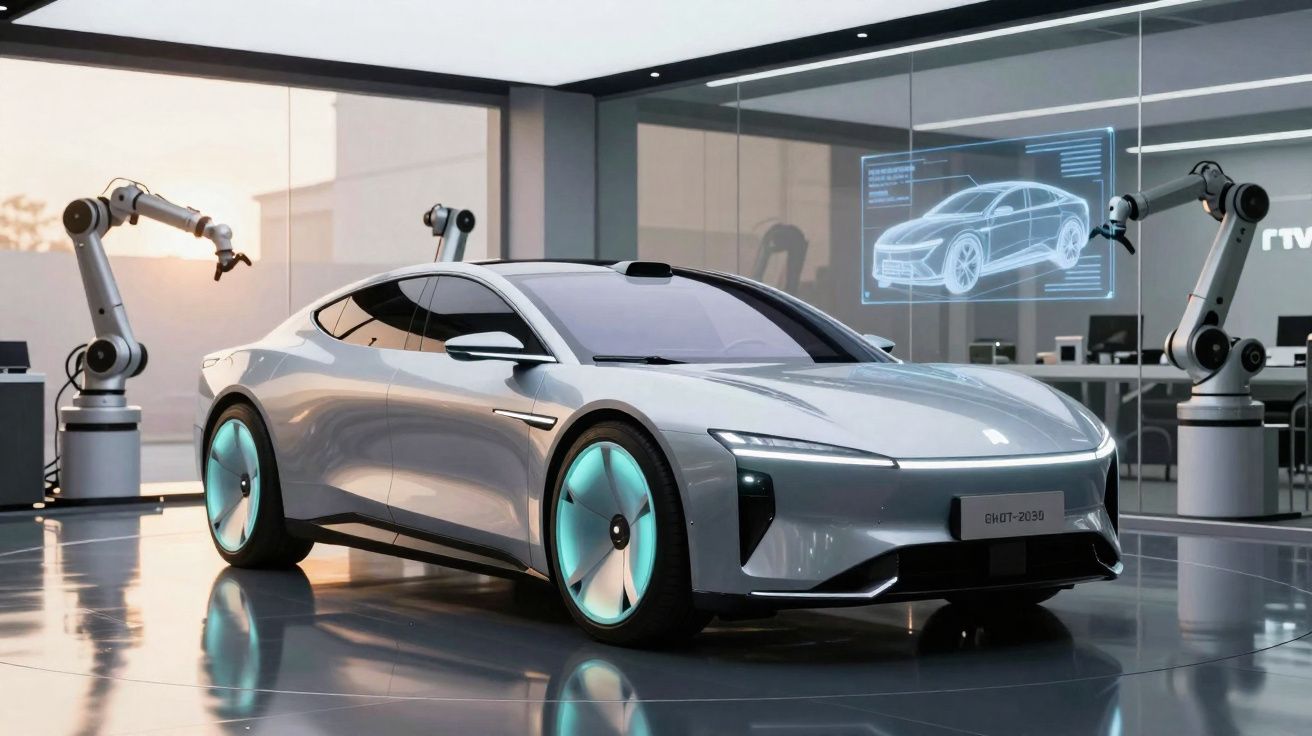
The factory doors are left unlocked overnight. Not for shift workers-there aren’t any-but for the robots. Inside, orange robotic arms slide along rails while laser welders throw off sparks that briefly sketch constellations in the dark. Driverless carts drift between racking with the quiet purpose of clockwork insects following a flawless route. There’s no shouting, no canteen rush, no argument over overtime at the clocking-in machine. Just the low whirr of servers and the sharp exhale of compressed air.
Chinese engineers increasingly describe this as the “normal” state of manufacturing before 2030: a staff-free car factory turning out thousands of vehicles each day with no permanent human presence on the shop floor.
China’s countdown to the first ghost factory
Step inside a contemporary Chinese car plant now and the direction of travel is obvious: people are receding from the physical work. In one area, a small group of young engineers in hoodies watch the line from behind glass, coffee beside laptops. Elsewhere, the heavy lifting is handled by machines moving with an almost choreographed precision.
China’s sprint is happening in the space between those two worlds.
Across Guangzhou, Shanghai and Hefei, a single idea comes up repeatedly in meetings and corridor conversations: the ambition for a fully staff-free factory. Officials increasingly talk about it as an inevitability, not a sci-fi talking point.
Several electric-vehicle leaders already promote lights-out workshops, where assembly cells operate in near darkness because no human eyesight is required. Nio, BYD and Xiaomi Auto have showcased areas where roughly 98% of tasks are completed by robots and software. The remaining 2%-the awkward work such as detailed inspection, improvising around defects and dealing with rare edge cases-is precisely what manufacturers want to eliminate before 2030.
The urgency is not just about novelty. In long-range national planning, the ghost factory is treated as a competitive instrument. Decision-makers see an ageing population, rising wages and relentless global rivalry in electric vehicles. A plant that runs 24/7 with minimal staffing offers lower costs, tighter standardisation and an industrial robustness that doesn’t request sick leave or sit through union negotiations.
In that context, a fully staff-free car factory isn’t merely a technology trophy. It is a route to securing an advantage in the biggest automotive shift in a century.
How a staff-free car factory actually works with a digital twin
From outside, a near-future ghost factory could look unremarkable: a large grey box by a dual carriageway, not unlike a distribution centre. Inside, however, it is closer to a live performance with no visible performers.
At the top sits a digital twin-a complete virtual replica of the factory, updated in real time on high-performance servers. Every robot, conveyor and tool continuously feeds data back into the twin, effectively acting like nerves reporting to a central brain.
On the floor, hundreds of industrial robots take on the core work: welding, stamping, painting and final assembly. Between stations, fleets of AGVs – automated guided vehicles shuttle doors, battery packs and dashboards as if they were hotel staff delivering to rooms on schedule. Overhead, camera systems track parts and movements with millimetre accuracy.
When a robotic arm detects a tiny misalignment, it doesn’t summon a supervisor. It calls an algorithm. The AI adjusts torque, repositions the part, records the anomaly and updates the model so the same issue is less likely next time. In truth, few factories achieve this end-to-end every day without human oversight at present-but that is the target state.
The least glamorous barrier is also the most stubborn: maintenance and exceptions. Jams, worn components, dust on sensors, and a slightly warped panel that matches no known pattern-these are the moments when humans still re-enter the story in hard hats and high-visibility clothing.
To keep people off the shop floor, Chinese firms are investing in predictive maintenance, self-diagnosing equipment and remote control towers where a small number of technicians oversee several plants through screens. The aim is for the factory to behave like software: something you monitor, patch and optimise, rather than a place where you sweat with a spanner.
One additional complication sits behind the scenes: this kind of automation increases reliance on constant connectivity and clean data. A ghost factory can be physically resilient while becoming digitally fragile if networks fail, suppliers’ systems go down, or data quality drifts. The practical response is redundancy-backup servers, parallel networks, spare sensors and robust fallbacks-because a plant that never sleeps also cannot afford “minor” outages.
What this means for workers, cities, and you
If a car plant no longer needs thousands of people in overalls, where do the jobs go? One concrete approach being tested is to move employment upstream and downstream. Instead of hiring large teams to tighten bolts, companies employ people to train AI models, label video from test lines, manage digital quality systems or run the logistics network feeding the ghost factory.
In places already building EV clusters-such as Changzhou and Ningde-technical colleges are quietly being redesigned around this shift. The pattern is easy to summarise: one fewer traditional factory role, several more roles in data infrastructure and automated operations.
On the ground, the tension is personal. A production-line worker in his 40s knows he will not become a machine-learning engineer overnight-and he is right. Retraining can look inspiring in a slide deck, but learning Python after a 10-hour shift is another reality altogether.
Many people recognise the familiar sting: being told “the future is coming, just adapt” while the mortgage and school fees remain stubbornly present. Ghost factories promise efficiency, but they also strain the old industrial bargain-steady wages, predictable routines and the pride of pointing to something tangible and saying, “I helped make that.”
Officials are not blind to the risk, even when it is discussed in careful language. They talk about “manufacturing upgrading” and “high-quality employment” to soothe concerns. In cafés near industrial parks, the phrasing is less polished: robots don’t buy flats, robots don’t raise children, robots don’t keep local restaurants busy.
“Factories used to lift whole towns out of poverty,” a local union representative in eastern China told me. “Now new plants arrive with more robots than buses. We’re told this is progress. Maybe it is. But progress for who, exactly?”
- For younger workers - the opportunity shifts towards tech, software and robot maintenance, but the pathway is narrower and more competitive.
- For smaller cities - ghost factories may increase tax receipts, yet employ far fewer people per square metre of industrial land.
- For drivers worldwide - staff-free plants could push EV prices down sharply, increasing pressure on manufacturers well beyond China’s borders.
A second, less discussed impact is security and trust. As production becomes more software-driven, questions grow louder about cyber resilience, data governance and auditability. If the “craft” moves from hands to code, then assurance also moves: to logs, sensor records, model validation and independent inspection regimes that can verify what the factory did and why.
Are we ready to live with ghost factories?
Stand outside one of these near-future Chinese car plants and it’s easy to feel two narratives collide. One is the story of progress: precise robots, cheaper electric cars, less waste and fewer injuries on harsh factory floors. The other is the older story of work as identity-clocking in together, locker-room chatter, friendships formed along the line.
A staff-free factory cuts cleanly through that second story, like a cold software update.
There is also a subtler psychological shift. When a car is made entirely by machines, our relationship with it changes slightly. Branding becomes less about craftsmanship and more about software quality, server uptime and supply-chain resilience. The heroes move from the shop floor to algorithm teams working in office towers.
Most of us won’t dwell on that when we book a test drive on a phone. Still, it sits in the background-almost as invisible as the data centres that keep our navigation and music working.
China’s first fully staff-free car factory, widely expected before 2030, will be more than a corporate milestone. It will act as a mirror for everyone else. How much are we willing to trade human hands for robotic precision? And what do we want work to provide beyond a payslip?
The next time you pass a silent industrial estate at night and spot a single building glowing like a spacecraft, you may find yourself wondering: is anyone in there at all-or is this the future, working while we sleep?
| Key point | Detail | Value for the reader |
|---|---|---|
| China targets ghost factories before 2030 | EV giants are racing to build fully staff-free car plants using AI, robots and digital twins | Helps you anticipate where global car prices, brands and jobs are heading |
| Robots reshape factory work | Most manual tasks move from the line to data, software and remote supervision roles | Clarifies which skills may stay relevant in a heavily automated world |
| Social and local impact is real | Fewer jobs per factory, more pressure on training systems and smaller cities | Offers a lens to judge future policies and corporate promises about “upskilling” |
FAQ
Will a fully staff-free car factory really have zero humans inside?
Not entirely. The goal is no permanent staff on the shop floor, but technicians, cleaners and auditors will still enter from time to time for inspections, upgrades and emergencies.Why is China leading this ghost factory race?
China combines enormous EV demand, dense supplier ecosystems, strong state backing and a political drive to offset ageing demographics through automation.What happens to workers when robots take over the line?
Some transition into higher-skilled roles in maintenance, logistics and data. Others risk being left behind if retraining and social safety nets do not keep pace.Will ghost factories make cars cheaper for consumers?
That is the wager. Lower labour costs, fewer defects and round-the-clock production should reduce prices, particularly for mass-market electric vehicles.Could this model spread outside China?
Yes, although the pace will differ. Countries with stricter labour rules or stronger unions may move first towards hybrid approaches, pairing high automation with negotiated human roles.






Comments
No comments yet. Be the first to comment!
Leave a Comment