
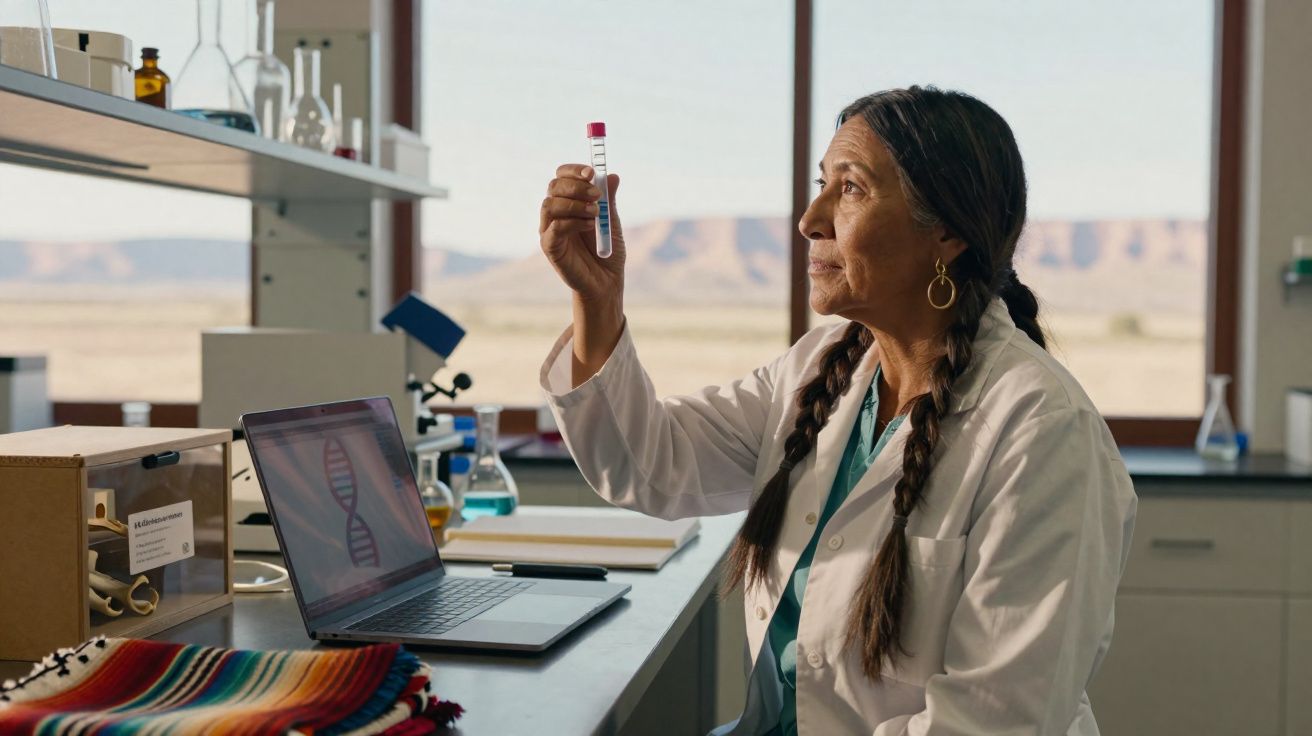
On a sweltering July afternoon at a community centre in New Mexico, the scrape of folding chairs across linoleum echoed as families queued for free DNA kits. Older relatives stood near the back with folded arms and guarded expressions while younger people swabbed their cheeks, trying to laugh off their nerves. A teenage boy in a Phoenix Suns top grinned and said, “Bet it’ll come back saying I’m, like, 30% Viking.” His grandmother didn’t smile. Her eyes stayed locked on the small plastic tubes, as though they might lash out.
A volunteer talked the group through the basics: the samples would be compared against ancient genomes recovered from human remains buried centuries before Columbus was even part of anyone’s imagination.
Nobody voiced it, yet everyone could feel it.
What happens when a test tries to tell you who you “really” are?
A quiet revolution in the lab
In a temperature-controlled laboratory in Copenhagen, a researcher wearing blue gloves lifts a sliver of bone from a tray with a label. It could pass for a bit of grit you might kick aside on a walk. But this fragment-taken from a skeleton discovered in northern Alaska-now sits inside a scientific story that unsettles older, overly tidy narratives about Native Americans.
During the past ten years, scientists have processed hundreds of similar samples: extracting DNA, sequencing it, and matching it against other ancient and modern genomes. Together, these results are producing a far more detailed genetic map of the Americas-one that doesn’t neatly match the simplified version many people were taught at school.
A major shift arrived in 2013 with the sequencing of a 12,600-year-old child discovered in Montana, widely referred to as the Anzick child. For years, fringe theories and conspiracy-minded books had insisted Native Americans were not truly “from” the Americas, or that they had “replaced” some earlier, lost population. The Anzick genome changed the conversation.
Researchers found that the child’s DNA is closely connected to living Native American peoples across the continent. Not an outsider. Not evidence of a vanished race. A direct relative-an ancient burial quietly aligning with what many Indigenous communities had long maintained: their connections to this land run back further than most people can easily picture.
As additional genomes were added-from Arctic regions down to Patagonia-another pattern became clearer. The first people entering the Americas were not a single, simple trickle. They arrived as complex waves of populations who mixed, separated, and adapted across thousands of years. Some carried genetic traces of ancient Siberian ancestors; others showed signals consistent with coastal movements that followed the Pacific shoreline.
For many communities, none of this replaces origin stories or spiritual teachings. Instead, it stretches the historical frame around them. In this arena, science is often arriving late-bringing measurements and datasets to support what communities have protected and repeated for generations: “We have always been here.”
How DNA tests collide with Native Americans’ identity
In Oklahoma, 32-year-old Jessica sat on her sofa staring at her DNA results on her phone, her thumb hovering uncertainly over the screen. She had grown up with a family refrain about a great-grandmother who was “part Cherokee”, a story brought out at reunions like a treasured photo. The report in front of her, however, described ancestry that was largely European, with a small segment labelled “Indigenous Americas-North.”
The figure felt sterile-almost impolite. How could a handful of coloured bars and percentages carry the weight of ceremonies, stories, kinship obligations, and tribal politics? She closed the app and let the quiet sit with her.
Versions of Jessica’s experience are now commonplace. Commercial DNA tests have turned kitchen counters and coffee tables into miniature genetics stations, and many customers are searching specifically for Native American ancestry. Some want to check a family legend. Others, more bluntly, are looking for a shortcut to belonging that their everyday lives have never truly reflected.
Tribal leaders have been watching this surge with mixed emotions. A representative of the Cherokee Nation has said publicly that thousands of people contact them each year, arriving with print-outs from DNA websites and asking how to “join”. For communities that endured forced removals, boarding schools, and the criminalisation of ceremonies, this sudden enthusiasm can feel deeply complicated.
The straightforward reality is this: DNA can suggest where some of your ancestors may have lived, but it cannot grant you a people.
Geneticists themselves often emphasise that “Native” percentages are calculated using limited reference panels and broad continental groupings. They do not identify specific tribes or nations. Citizenship or enrolment in a tribal nation is tied to history, documented lineage, community relationships, and political recognition. A saliva sample cannot stand in for those things.
Where DNA can genuinely help is in revealing breaks in family stories-sometimes helping adoptees, or families separated by displacement, reconnect with missing branches. The strongest value is often not a new label, but better questions about who raised us, who we descend from, and who we choose to stand with now.
A practical note on privacy and downstream use
One aspect that rarely gets equal attention is what happens after the swab. Commercial DNA companies may store samples and genetic data for years, and policies on sharing, research access, and law-enforcement requests vary widely. Even when participation is optional, the fine print can be difficult to interpret.
If you are considering a test, it is worth checking (1) whether you can delete your data, (2) whether your sample is retained, and (3) how the firm handles third-party access. These questions matter for anyone-but especially in communities with long histories of extraction, surveillance, and research carried out without meaningful consent.
Walking the line between science and respect
If you choose to explore this subject-whether as a reader, a student, or someone with Indigenous roots-an important first move is to separate curiosity from entitlement. That begins with your sources. Seek research programmes built with Native nations, rather than projects conducted about them. Pay attention to whether an article includes Indigenous scholars and community leaders, not only laboratory spokespeople.
A simple habit helps: whenever you see a dramatic DNA headline, stop and ask, “Whose voice isn’t here?” That one question can reshape how you understand the entire debate.
A frequent misstep is to treat new genetic findings like a scoreboard, as though science can permanently “confirm” or “deny” someone’s identity. Statistics can feel firmer than lived experience, but identity-particularly for Native communities-is intertwined with treaties, discrimination, land theft, and strategies for survival. It is never just molecules.
If you are not Native, it is also worth stepping back from phrases such as “We’re all a bit Indigenous” or “I found out I’m 2% Native.” Many Native readers experience those lines as abrasive, flattening centuries of trauma and political struggle into a novelty fact.
Geneticist and anthropologist Jennifer Raff has made the point plainly: ancient DNA can illuminate the deep population history of the Americas, but it cannot determine whether an individual is Native American. Only Native nations have the authority to define their people.
Listen to Native voices
Look for podcasts, books, and social media from Indigenous scholars, writers, and activists who discuss DNA, history, and identity.Support community-led research
When a new discovery is reported, check whether tribal councils, cultural committees, and local historians are credited as partners-not merely treated as “informants”.Question how headlines are framed
If a story claims DNA “rewrites” Native history, ask whose version of history was centred before, and who gains from that storyline.
Repatriation, consent, and why some remains are not “available”
Alongside data sovereignty, many Native nations connect genetics to wider struggles over repatriation and stewardship. Human remains and cultural items taken for research have often been removed without consent, and communities have pushed back against the idea that scientific interest automatically outweighs cultural and spiritual responsibilities.
This is why some samples are no longer open to study-even when laboratories are eager. For many nations, the key question is not whether a project is technically impressive, but whether it is ethical, requested, and governed by the people most affected.
A story still being written in blood and memory
The further scientists dig into ancient DNA across the Americas, the more layered the picture becomes. There are signs consistent with early movement along a Pacific coastal route; unexpected genetic links between some Amazonian groups and distant populations; and evidence of ancient population bottlenecks followed by rebounds. Read together, it can feel like an epic journey recorded in code.
Yet these findings do not exist on their own. They sit beside origin stories about emerging from the earth, travelling alongside animal nations, or being placed on specific lands by Creator. For some people, these ways of knowing collide. For others, they coexist-like two different maps of the same range of mountains.
What is changing-quietly but decisively-is who controls the narrative. Many Native nations now insist on data sovereignty: the right to govern how genetic samples from their ancestors and communities are collected, stored, used, and interpreted. In practice, this means certain remains are no longer treated as available to whoever wants to sequence them. It also means more Indigenous scientists are leading studies themselves, setting the questions and the boundaries.
This DNA story is not only about distant history. It is also about power now.
So the “truth” DNA is revealing about Native Americans cuts both ways. On one side, it supports a deep, ancient presence in these lands-reaching back at least 15,000 to 20,000 years, and possibly further. On the other, it is pushing the scientific world to acknowledge what many Native communities have argued for decades: research conducted without consent is simply another kind of extraction.
The next time a startling DNA headline spreads online, you may feel a pause. You may wonder whose ancestor is in that tube. And you may ask whose story is being told-along with who finally gets to reply.
| Key point | Detail | Value for the reader |
|---|---|---|
| DNA confirms deep Indigenous roots | Ancient genomes such as the Anzick child indicate continuity between early inhabitants and present-day Native peoples | Challenges older myths and strengthens Native claims of long-term presence |
| Genetics ≠ tribal identity | DNA tests cannot assign tribal membership or replace community ties and political recognition | Helps readers avoid misusing results or making insensitive claims |
| Respect and consent are central | Data sovereignty and community-led research are reshaping how studies are designed and governed | Offers an ethical lens for judging new “discoveries” and the media narratives around them |
FAQ
Question 1: Can a DNA test prove I’m Native American?
No. DNA tests can point to ancestral connections with broad Indigenous populations, but they cannot confirm that you are Native American in a legal, political, or community sense. Only tribal nations define their citizens.Question 2: Why do some tribes reject DNA as a basis for enrolment?
Because tribal citizenship rests on treaties, kinship, community connection, and documented lineage-not commercial genetic categories. Many nations view DNA-only claims as disregarding sovereignty and lived history.Question 3: Do ancient DNA studies support Indigenous origin stories?
They often align with the idea of very long-term presence on the land, but they speak in different timelines and terms. Many Indigenous people treat genetics as one tool among many, not the final authority.Question 4: Is it disrespectful to take a DNA test in the hope of finding Native ancestry?
Curiosity is not automatically disrespectful. Problems begin when people use tiny percentages to claim an identity or seek benefits, instead of listening to Native voices and understanding the political context.Question 5: What does “data sovereignty” mean for Native communities?
It means Indigenous nations assert control over how genetic and health data about their people and ancestors is collected, stored, shared, and interpreted-so research does not repeat older patterns of exploitation.






Comments
No comments yet. Be the first to comment!
Leave a Comment