
The studio was nearly silent, broken only by the gentle hum of the air conditioning and the occasional squeak of trainers against rubber flooring.
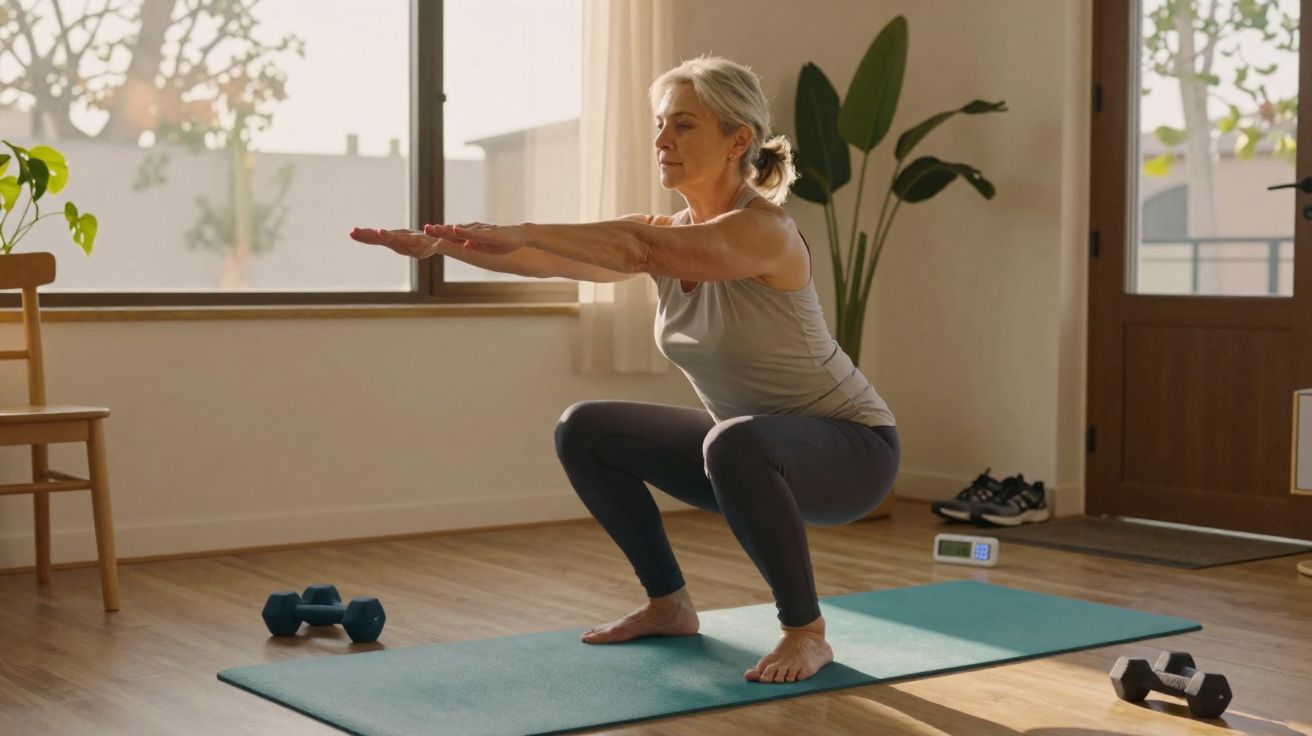
Three women in their sixties stood in a relaxed circle, hands on hips, studying the instructor with equal parts curiosity and doubt. She didn’t tell them to jog. She didn’t steer them towards the treadmill. Instead, she sank into a deep, unhurried squat and stood back up again as though it were the most ordinary thing in the world.
“This? That’s all?” one of them chuckled, giving her stomach a quick pat. “You’re honestly saying this burns more belly fat than an hour of walking?”
The trainer simply smiled. “Do ten. Then we’ll talk.”
Ten minutes later, thighs trembling and breathing noticeably quicker, that same woman wasn’t laughing. She was looking at her reflection, caught off guard by how awake and energised she felt.
Something was happening that a steady walk had never quite switched on.
The underestimated movement beating walking after 60
The movement that quietly outperforms long walks for abdominal fat after 60 is the simple squat. No barbell. No gym membership. Just your bodyweight, your legs, and gravity working together. Squats bring the body’s biggest muscle groups online-thighs, glutes, hips-and, importantly, the deep core muscles that help firm the waistline.
For a long time, the prevailing advice has sounded reassuringly gentle: once you reach 60, walk more, eat a little less, and wait for the belly to reduce. The problem is that with age, hormones shift and muscle mass naturally declines. Walks that once changed your shape can start to act more like upkeep than a real reset. Squats-even the most basic version-change the equation by recruiting muscles that walking barely challenges.
On paper, a squat can look unremarkable. In practice, it acts like a metabolic match. Each time you bend and straighten your legs, your body has to call on large muscle fibres, stabilise the spine, and engage the abdomen to keep you steady. That combination costs energy. When you repeat the movement in short bursts, you can also create a small “afterburn” effect-your body continues to use extra energy even after you’ve finished, whether you’re sipping water or sitting down at home. It’s one quiet exercise that sends a much louder signal to your metabolism.
Consider Paul, 67. He’d walked for an hour every morning for years: same park, same bench, same loop. His GP was pleased with his step count, but his waistline wasn’t shifting. The frustration felt almost tangible. Then his daughter, a physiotherapist, suggested a straightforward experiment: “For three weeks, keep the walks. But every time you get home, do 3 sets of 10 slow squats while holding the kitchen worktop.” He rolled his eyes-then gave it a go.
In the first week, his legs complained, and so did his pride. In the second week, stairs felt easier and his thighs felt more capable. By the third week, he pulled his belt one notch tighter. He hadn’t changed what he ate and he hadn’t added extra walking. The only difference was that irritating little movement that left him slightly short of breath. He began to feel as though his body was finally working with him again rather than resisting him.
Stories like Paul’s aren’t unusual-they’re just not the ones people tend to share. Walking is popular because it’s familiar, gentle, and comforting. Squats feel a bit too close to “exercise”, the very word many people quietly dread. But short squat sessions drive a different kind of adaptation. As we get older, we lose muscle-particularly in the legs and core. Less muscle means fewer calories burned at rest and a greater tendency to store fat around the middle. Squats target precisely where that loss is most pronounced.
By making large muscles contract against gravity, squats encourage the body to maintain and rebuild muscle tissue. That’s the understated lever: more muscle-even a modest increase-nudges your metabolism upwards across the whole day. Around 60 and beyond, that small advantage compounds week after week. Walking keeps you active; squats help change what your body does with energy.
How to turn squats into your secret fat-burning ally (squats after 60)
So what does this look like in a real home-no polished gym floor, just a normal kitchen and perhaps a chair that wobbles slightly? Start with the kitchen worktop squat. Stand facing the worktop and hold it lightly with both hands. Place your feet about shoulder-width apart, toes turned out slightly. Send your hips back as if you’re about to sit on a low stool, bend your knees, keep your chest lifted, and keep your heels down. Only lower as far as feels safe and stable, then press through your heels to stand.
Begin with 2 sets of 8–10 slow repetitions, three times per week. Rest for a full minute between sets. The aim is not speed-it’s control. As you lower, gently draw your belly button towards your spine, like fastening a pair of snug trousers. That subtle brace is where your abdominal muscles properly join in. Over time, add a third set, or hold for two seconds at the bottom of each squat to make the work more intense. Done this way, it takes under 10 minutes, yet it challenges your legs, glutes, and core far more efficiently than a casual stroll round the block.
At a human level, the toughest part usually isn’t the squat itself-it’s sticking with it. Some days the sofa has a louder voice than any fitness plan. On other days your knees feel stiff, your back grumbles, and you start thinking, “Maybe walking is enough.” This is where adapting rather than stopping changes everything. Shorten the range of motion. Hold the back of a solid chair. Do 5 slow squats instead of 10. It still counts.
Many people also recognise the emotional side: that moment when you avoid the mirror from the side because you’re tired of seeing the curve of your belly. This isn’t laziness-it’s exhaustion from effort that doesn’t pay off. Squats can interrupt that cycle not by punishing you, but by reminding your body it still has strength. One small win-getting a little deeper than last week-can start rebuilding trust that years of disappointing diets have worn down.
Let’s be honest: almost nobody does this perfectly every day. Life gets busy. The practical trick is to make squats light and non-negotiable, like brushing your teeth: quick, simple, and woven into the background of your routine. You don’t need perfection; you need repetition. If you miss a session, skip the guilt-don’t skip the next day.
“After 60, the battle against belly fat is less about enduring longer workouts and more about engaging the right muscles in a smarter way,” says a sports doctor who works with older adults. “A well-executed squat stimulates the metabolic system in a way that walking alone rarely achieves.”
That’s the quiet shift: this movement doesn’t only slim your outline-it changes how your body ages from the inside. To keep it simple, here are a few small adjustments that make a basic squat routine easier to live with and more effective:
- Tie squats to an existing habit: before you brush your teeth at night, do 10 squats.
- Use a chair as a safety net: lightly tap it with your hips at the bottom of each squat.
- Say the number out loud on every rep: it keeps you focused and stops you rushing.
Two extra checks that make squats safer and more effective
Before you start, take 60 seconds to warm up your joints: march on the spot, circle your ankles, and gently bend and straighten your knees a few times while holding the worktop. It can make the first few repetitions feel smoother, especially if you tend to feel stiff.
Also pay attention to breathing. Aim to inhale as you lower and exhale as you stand. A steady exhale can help you brace your core without holding your breath, which is particularly helpful if you’re managing blood pressure or feel light-headed with exertion.
Rethinking ageing, one slow squat at a time
There’s something quietly radical about discovering, after 60, that your body can still surprise you. Not by becoming a marathon runner, but by learning a simple movement that firms the waist, strengthens the legs, and makes stairs feel less like a climb. Squats don’t care what your fitness history looks like. They ask one question: “Will you try one more today?” And that question alone can reshape how you feel when you catch your reflection.
Walking remains a brilliant ally for your heart, your mood, and your joints-keep it. Think of it as steady background music, while squats are the short, intense solo that wakes everything up. Put the two together and you get the consistent rhythm of daily movement plus the metabolic jolt of strength work. Abdominal fat that once felt stuck around the waist can begin to loosen its hold-slowly, almost unnoticed at first. Then one morning, your top hangs slightly differently.
That’s the power of an underestimated movement like the squat. It doesn’t demand attention like a crash diet or a punishing programme. It slips into your week in three short sets and gradually changes how your body uses energy. Over weeks, then months, each effort builds on the last. You stand a touch taller. You breathe a bit deeper. You may still walk the same route-but you feel as though you live in your body differently. And perhaps you end up sharing this simple secret with someone else who’s tired of walking in circles, literally and figuratively.
| Key point | Detail | Benefit for you |
|---|---|---|
| The squat activates large muscle groups | Thighs, glutes and the core work together on every repetition | Increases energy use and indirectly targets abdominal fat |
| Short but consistent routine | 2–3 sets of 8–12 squats, 3 times per week, with support if needed | Easy to fit into everyday life without replacing walking |
| Adaptable after 60 | You can reduce depth and use a chair or kitchen worktop for support | Allows safe progress even with sensitive joints |
FAQ
Isn’t walking enough to lose belly fat after 60?
Walking is excellent for health and worth keeping, but on its own it often doesn’t offset age-related muscle loss. Adding squats supports muscle mass and increases your daily calorie burn, which typically reduces abdominal fat more effectively.What if my knees hurt when I squat?
Start with a shallow squat while holding a chair or kitchen worktop, and stop before pain. Focus on pushing your hips back and keeping your weight through your heels. If discomfort continues or worsens, speak to a physiotherapist or GP before carrying on.How soon will I notice changes around my waist?
Many people feel stronger within 2–3 weeks, and may see small visual changes in 4–8 weeks if they combine squats with regular walking and sensible eating habits.Do I need weights for squats to work after 60?
No. Bodyweight squats are enough to begin rebuilding muscle and stimulating metabolism. You can add light weights later if you feel stable and confident, but they’re not essential for results.How many days per week should I do squats?
Two to three days per week is usually ideal. Leave at least one rest day between sessions so your muscles can recover and come back stronger.
Comments
No comments yet. Be the first to comment!
Leave a Comment