
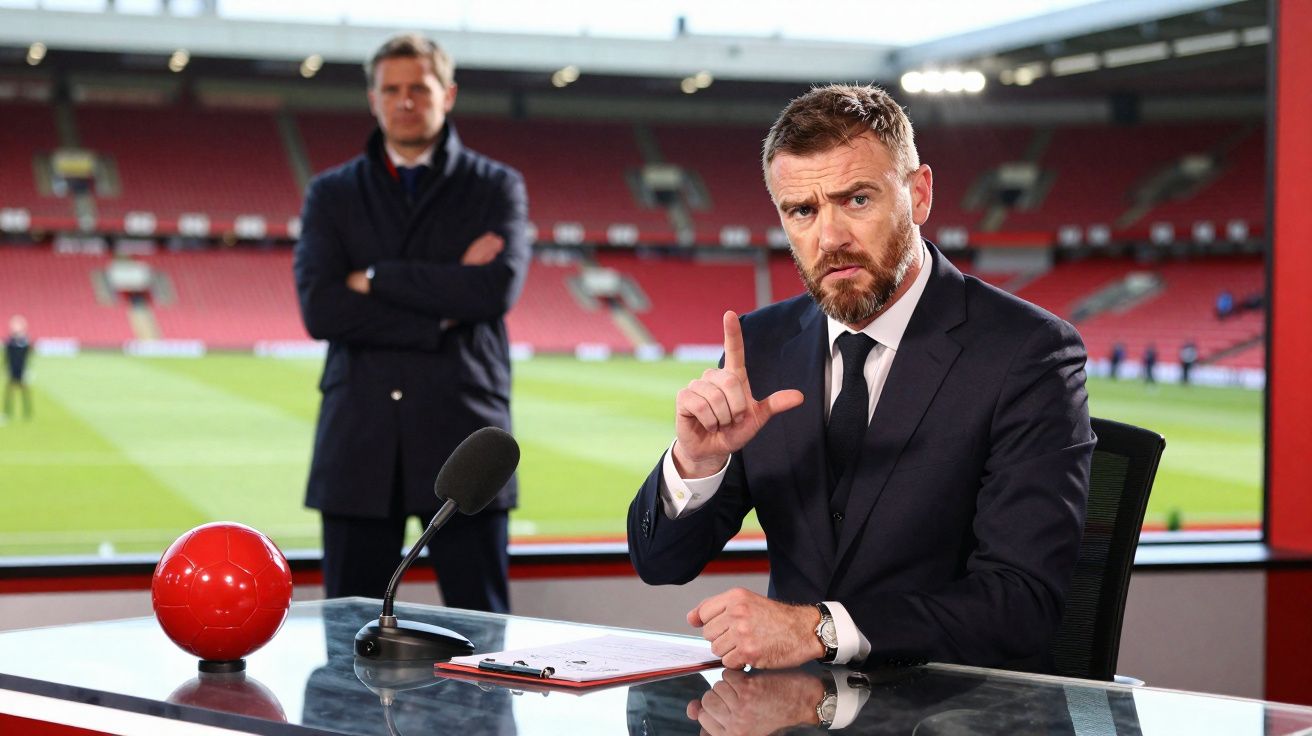
The camera swung to Roy Keane, and the mood in the Sky Sports studio seemed to cool instantly. Manchester United had just come through a match with Michael Carrick providing calm, low-key direction from the dugout, and the familiar interim question surfaced again: should he be given the job for good? Keane’s expression barely changed. No grin, no hesitation, hardly a shift in posture. Then he delivered the two-word verdict that ricocheted around social media within minutes: “Absolutely not.”
The phrase hit with the force of a hard, perfectly timed tackle.
For a fanbase craving something to cling to, that sort of bluntness lands differently.
Roy Keane, Michael Carrick and the Manchester United job: a quiet audition meets a cold verdict
You didn’t need the sound turned up to understand Keane’s body language. Arms crossed, jaw set, that recognisable blend of irritation and worry in his eyes. The panel discussion had begun drifting towards positivity-towards the notion that, perhaps, Carrick could be the answer to United’s relentless managerial churn. Keane cut through that optimism with words that felt like an icy splash of reality.
This wasn’t framed as a personal swipe at Carrick. It came across as a standards check from someone who lived the Manchester United demands from the inside.
To see why Keane reacted so sharply, it helps to look at the pattern since Sir Alex Ferguson stepped away. United have swung from one approach to the next: David Moyes, Louis van Gaal, José Mourinho, Ole Gunnar Solskjær, Ralf Rangnick, Erik ten Hag. Each early upswing produced the same refrain: give him the job-he understands the club.
Ole is the clearest cautionary tale. He started as interim, rode a remarkable run, and “Ole’s at the wheel” turned from chant to meme-before it eventually became a warning label. When results tailed off, deeper issues reappeared, and what felt like a feel-good call began to look painfully sentimental. Supporters remember that now, even if it’s uncomfortable to say out loud. Carrick’s composed spell on the touchline triggered the same sense of déjà vu.
Keane has little time for what he sees as nostalgia-driven decision-making. In his view, Manchester United should not be a place where a manager learns the job in public. For him, a short-term bounce under an interim coach does not erase structural disorder, recruitment problems, or the psychological fragility that has surfaced repeatedly over the past decade.
From that perspective, Carrick’s positive reviews and a brief period of steadier results weren’t sufficient. You don’t award one of the biggest jobs in world football to someone simply because they’ve steadied a wobbling ship for a handful of matches. Keane’s “Absolutely not” was bigger than Carrick-it was a protest against United repeatedly falling for short-term solutions.
Why Roy Keane doesn’t buy the “nice guy” fix
Keane’s position comes from a specific belief: United require a proven, hard-edged, battle-tested figure-rather than another popular former player who feels like a safe pair of hands. Carrick is held in high regard by ex-team-mates, respected for his football intelligence, and regularly praised for his calm demeanour on the touchline. For Keane, that calmness is precisely the concern.
In Keane’s mind, United have become too soft-and soft characters don’t reverse that slide. He wants someone who can enter that dressing room, shift big reputations if necessary, and re-establish standards without flinching. Promoting someone largely because he feels familiar doesn’t match that template.
It’s understandable why supporters warm to Carrick. He represents something reassuring: a link to the last truly dominant United side, a recognisable face who doesn’t trade in soundbites or stir drama. When he stepped in as interim, the atmosphere visibly settled-players looked a bit more organised, the background noise from the dressing room quietened, and it was easy to picture a clean, sensible handover.
Most people recognise that moment: when the straightforward option feels “right” largely because everything else looks chaotic. Carrick’s period as Middlesbrough boss has also strengthened the storyline-progressive football, respectable results, and the sense he is a coach “on the up”. It’s simple to weave that into a neat fairytale. Simple-and dangerous.
Keane’s directness strips away that emotional padding. In his eyes, United don’t merely need a coach who can set up a tidy shape or gently calm a fractured squad. They need somebody with the authority to challenge the structure above them, ride out media storms, and keep the dressing room aligned when results inevitably wobble.
And, frankly, very few people can do that day after day at the required level without years of being tested-and scarred-by elite jobs. That is the unspoken sentence underpinning Keane’s reaction. His “Absolutely not” is less a dismissal of Carrick the person and more a rejection of the idea that United can fast-track their way out of a decade-long identity crisis with another hopeful promotion.
Between nostalgia and necessity: what Manchester United actually need
If you strip out the emotion, a simple principle sits at the heart of Keane’s view: keep affection separate from assessment. He can admire Carrick, value his playing career, and still believe he is not the right choice to become permanent manager at Manchester United. That’s a useful discipline in a sport where narratives travel faster than clear thinking.
For fans and pundits, the temptation is to connect dots that suit a comforting plot: former player, understands the club, good run of matches-give him the job. Keane works the other way around: ask what the role demands when everything is going wrong, then decide who is genuinely equipped for that version of the job.
The repeated mistake at Old Trafford is confusing short bursts of competence with long-term suitability. A caretaker wins a few matches and suddenly he’s presented as Ferguson’s natural successor. The club rides the buzz, social media magnifies it, and before anyone pauses to take a breath, the contract is ready.
There is also a form of kindness in wanting Carrick to thrive at United-but it can become a trap. He could end up being the next former player pushed into the furnace too soon, carrying the scars of a role he was never properly positioned to own. Keane’s refusal to indulge the sentiment may sound harsh, yet there’s something protective in it as well.
One additional complication is that the modern Manchester United manager is not just a first-team coach. The role involves navigating executive politics, managing recruitment influence, shaping culture, and acting as the public shield when things unravel. Even a highly intelligent coach can be overwhelmed if the club’s structures and responsibilities are unclear-or if expectations exceed the support provided behind the scenes.
Equally, saying “not yet” does not have to mean “never”. Carrick’s work at Middlesbrough can still be part of a sensible pathway: building a track record across full seasons, handling promotion pressure, dealing with setbacks, and developing a clear style under scrutiny. For many coaches, that broader apprenticeship is what turns promise into the kind of authority Keane believes United must prioritise.
“Absolutely not,” Keane said, when asked if Carrick should be a permanent solution. “You need a top, top manager. Michael’s a good lad, but this is Manchester United we’re talking about.”
- Separate emotion from evaluation: appreciating Carrick’s calm presence does not mean he is ready for the biggest job of his life right now.
- Respect the scale of the role: United are not “just another club”; the scrutiny, pressure and internal politics can wreck underprepared managers.
- Learn from past experiments: Ole’s arc is the warning-interim glow, permanent deal, then a painful unraveling that damaged his legacy.
- Value experience in chaos: United’s internal storm demands someone used to managing egos, boards and media hurricanes at the same time.
- Protect the ex-players: sometimes the kindest option is “not yet”, rather than pushing a beloved figure into an impossible role.
The uneasy truth Manchester United supporters are grappling with
Keane’s “Absolutely not” points to a larger question: what sort of club do Manchester United want to be over the next five years? One that leans into nostalgia and comfort, or one that accepts the discomfort of tough decisions and unpopular appointments? The easiest choice is usually the familiar face-the former player who speaks warmly about the badge and says the right things about “culture”.
The harder truth is that comfort and competence are not always the same thing. For some supporters, Carrick symbolises a gentler, steadier United-a bridge back to better days. For Keane, that gentleness is exactly what needs to be challenged.
| Key point | Detail | Value for the reader |
|---|---|---|
| Keane’s blunt rejection | “Absolutely not” captured his belief that sentiment must not drive the next managerial call. | Helps supporters step back from emotion and weigh the real demands of the job. |
| Pattern of interim hype | Previous experiences with Ole and others show how dangerous it can be to overreact to short-term form. | Adds context to judge Carrick’s candidacy with caution rather than wishful thinking. |
| Need for proven authority | Keane argues United need a seasoned, ruthless figure, not a coach still developing. | Reframes the debate around experience, standards and long-term stability. |
FAQ:
- Why did Roy Keane say “Absolutely not” about Carrick as permanent boss? Keane believes the Manchester United job is too big and too chaotic for a relatively inexperienced coach, regardless of how respected or likeable he is.
- Does Keane dislike Michael Carrick personally? There’s no evidence of that. He has repeatedly spoken well of Carrick as a player and as a person; his issue is the principle of another emotion-led, short-term appointment.
- Has Carrick actually done a bad job as a coach? No. His interim spell at United was steady, and his work at Middlesbrough has drawn praise. Keane’s argument is about the scale of the United job, not Carrick’s ability.
- Are United fans split on the idea of Carrick managing the club? Yes. Some are drawn to the romance of a former player returning as manager; others fear repeating the cycle that followed Ole’s appointment.
- What’s the deeper message behind Keane’s comments? He’s warning that United must stop making decisions based on emotion, insist on proven top-level authority, and protect both the club and its former players from another painful experiment.





Comments
No comments yet. Be the first to comment!
Leave a Comment