
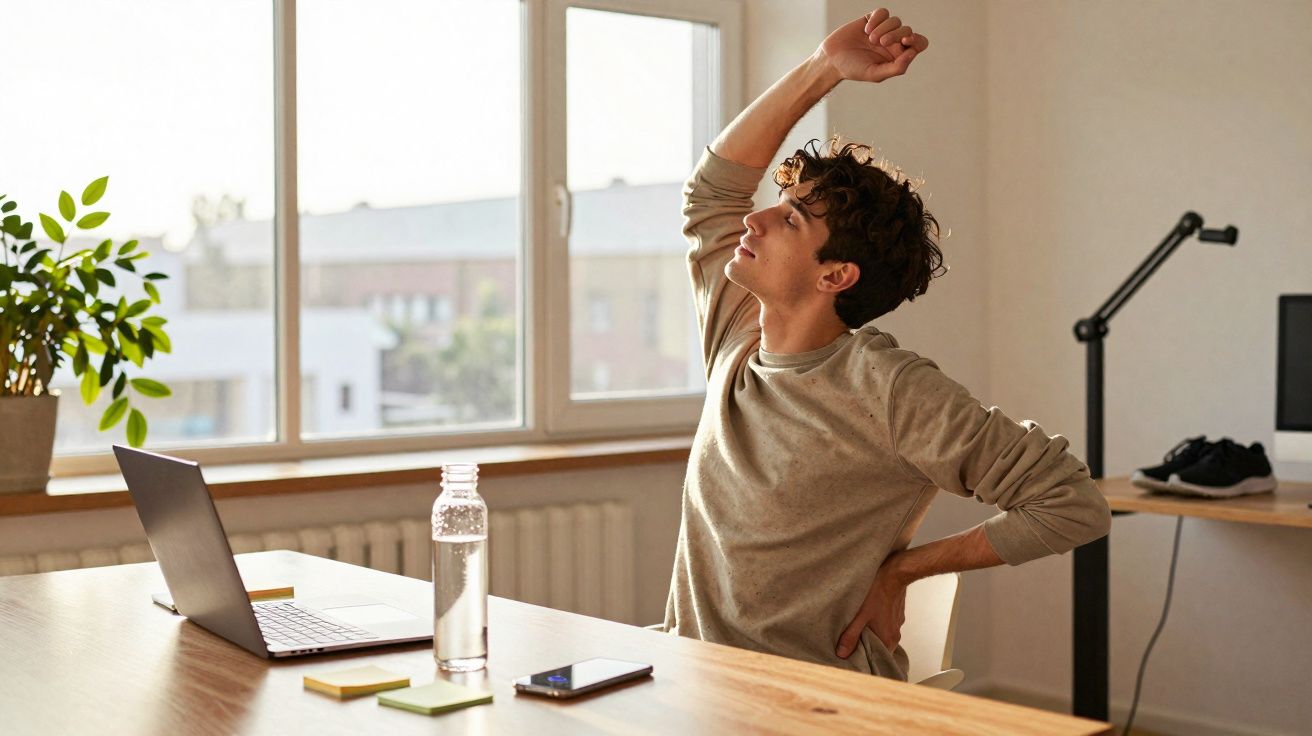
The office had fallen silent, apart from the steady whirr of computers and the soft rattle from the vending machine.
Tom, 42, sat with his legs crossed, eyes fixed on his monitor, barely moving for the third hour running. His smartwatch buzzed: “Time to stand up.” Without thinking, he hit “Dismiss” the way he closes an on-screen pop-up. He told himself he’d make up for it later with a long walk after work. That would sort it, wouldn’t it?
When he finally got home, his shoulders felt tight, his lower back was sore, and his calves had an odd, leaden heaviness. He forced himself out for a 40‑minute walk, mentally ticked off “exercise”, and went to bed with the nagging sense that something still didn’t add up. By morning, his legs felt as though he’d spent the night folded into a cramped aeroplane seat.
Here’s the uncomfortable part: the evening walk wasn’t the issue. The real culprit was the amount of time he’d spent sitting absolutely still.
Why standing up beats a single long walk for your blood flow
Watch any busy co‑working space for an hour and you’ll notice a curious routine: coffee is topped up, fingers dance across keyboards, heads dip and rise - yet bodies stay locked in almost the same position. Knees bent, hips fixed, feet doing next to nothing. It looks peaceful. Physiologically, it isn’t.
Your circulation has to move blood from your feet back to your heart, working against gravity with every heartbeat. Normally, your calf muscles help by acting like a pump. When you sit and don’t move, that “pump” essentially goes offline. Veins relax and widen, fluid starts to collect in the lower legs, and the whole system becomes sluggish. Get up for just 60–90 seconds and the so‑called “second heart” in your calves switches back on.
What matters isn’t only how many steps you total by the end of the day. It’s how often you clear the traffic jam.
Research from Australia looking at office workers found a stark pattern: long, uninterrupted sitting was linked with poorer markers of blood sugar and circulation, even among people who racked up similar step counts to colleagues. In other words, a 45‑minute walk in the evening didn’t reliably undo eight or nine hours of statue-still sitting.
In day-to-day life, you can feel this slowdown. The deep sock indentations around your ankles by late afternoon. The pins-and-needles sensation when you stand after a long meeting and your feet seem to “come back online”. A London GP has even noted more patients who don’t smoke, aren’t overweight and do walk regularly - yet still report heavy legs and swollen feet that track back to desk-bound days.
We’re drawn to big, bold efforts: the long run, the gym session, the 10,000‑step streak. But the body often responds best to small, repeated prompts.
Circulation is not a daily scoreboard you can correct with one heroic burst. If you stay seated for hours, blood flow to the legs drops, the inner lining of your blood vessels (the endothelium) receives less stimulation, and muscles behave as though they’ve clocked off. Extended stillness tells your cardiovascular system: “Low demand.”
Regular standing breaks reverse that message. Your calves contract, your heart rate lifts slightly, and your blood pressure pattern shifts. The veins in your legs get the gentle squeeze that helps stop them becoming lax and over‑stretched. Tiny movements, done repeatedly, outperform one late‑day, all‑or‑nothing effort.
That’s why a person who stands and moves for a minute every half hour can end up with better circulation than someone who sits all day and then does a brilliant, sweaty 60‑minute walk at night.
How to use micro‑stands to reboot your circulation
Treat your working day as a chain of 30‑minute blocks. In each block, “pay” your blood vessels a minute or two. The simple method is this: after every 30 minutes of sitting, take 1–2 minutes of standing or gentle movement. No special kit. No changing clothes. No gym bag by the door.
Stand up and fully straighten your legs. Shift your weight from one foot to the other. Rise onto your toes 10–15 times. Circle your ankles. Let your knees soften rather than locking them. If you’re on a call, stroll slowly while you speak. These actions reawaken the calf pump and help push blood back towards your heart.
It can seem laughably small. That’s precisely the advantage - it’s realistic enough to repeat, which is where the benefit comes from.
Many people try to overhaul everything in one go: a new standing desk, ambitious step targets, and a half-serious vow to “never sit for more than 20 minutes again”. A fortnight later, the standing desk has become a paperwork shelf and they’re back to three-hour sitting marathons. Let’s be honest: almost nobody keeps the extreme version going every day.
Make it easier by setting fewer rules. Choose three “anchor moments” you already have - your first coffee, lunch, and the mid‑afternoon slump. At each one, stand for two minutes and move your ankles and calves. When that becomes routine, slot in one additional standing moment between them.
On hectic days - back‑to‑back calls, a looming deadline - keep expectations minimal. If all you do is stand up and straighten your legs, it still counts. The win is breaking the sitting spell, not performing something worthy of social media.
“Your circulatory system doesn’t do well with extremes,” says a London‑based cardiovascular physiologist. “What it responds to is rhythm - frequent, repeated changes in posture and muscle activity. That’s why lots of small movements across the day can beat a big workout bolted onto hours of total stillness.”
Micro‑stands, hydration and workspace cues (for healthier circulation)
To make micro‑stands easier to stick to, design your environment so it nudges you. Keep a glass (not a large bottle) on the desk so you naturally get up to refill it. If you work from home, place your printer, notebook or even your charging cable a few steps away so you’re prompted to stand without “losing time”.
Also pay attention to what’s compressing you. Tight socks, restrictive trousers and the edge of a chair pressing into the backs of your thighs can make your legs feel heavier by late afternoon. Comfortable clothing, a chair set to the right height, and a foot position that lets you move your ankles freely can make your standing breaks more effective.
One practical way to keep your movement rhythm going is to make it visible and mildly game-like:
- Set a discreet reminder: a phone vibration (not a blaring alarm) every 30–45 minutes.
- Link standing breaks to habits you already do: sending an email, making a coffee, going to the loo.
- Use a rule of thumb: “No two meetings in a row fully seated” - stand for at least one.
- Keep a glass at your desk so you refill more often.
- If you wear a smartwatch, treat the stand prompt as a non‑negotiable health metric rather than an irritation.
These aren’t productivity tricks. They’re physical cues that help your blood move more like it did before daily life became chair-centred.
The quiet shift when you live a “standing‑up” day
On a packed commuter train, you can often pick out the people whose legs have had enough: shifting from foot to foot, stretching their calves against the floor, rolling their ankles to find relief. Beneath the surface, their circulation is trying to make up for hours of enforced stillness.
Compare that with someone who’s fitted 15–20 micro‑stands into their day. They tend to report small but specific changes: feet that feel lighter, fewer deep red sock marks, and less of the evening urge to lie down and prop their legs up. Their step count may be similar to everyone else’s. The movement pattern is not.
We don’t talk much about movement patterns - yet they shape how your blood flows hour by hour. And it’s at that level that long‑term health quietly strengthens, or quietly declines.
| Key point | Detail | Why it matters to you |
|---|---|---|
| Micro‑stands beat isolated long walks | Standing for 1–2 minutes every 30–45 minutes restarts the calf muscle pump. | Helps explain why a small, regular action can protect your legs and your heart. |
| The body responds to movement pattern, not just totals | One big walking block does not cancel out hours of complete immobility. | Encourages you to shape your day rather than feeling guilty about “missed steps”. |
| Simple rituals support day-to-day circulation | Tie standing to fixed moments: calls, coffees, emails. | Makes change more sustainable without turning life into a bootcamp. |
FAQ
Do I really need to stand up every 30 minutes?
Not with stopwatch precision. Where possible, aim for a short standing or movement break every 30–45 minutes. The goal is to prevent long, unbroken stretches of sitting, not to micromanage your day.Are long walks still useful if I stand regularly?
Absolutely. Walking trains your heart, lungs and muscles in ways micro‑stands can’t. Think of standing breaks as daytime maintenance for your blood vessels, and walks as your more substantial workout.What if I have a job where I can’t leave my chair?
Even small adjustments help. Straighten your legs under the desk, flex and point your feet, and do gentle calf squeezes while seated. Stand up between calls or tasks whenever you spot even a short gap.Can standing too much be bad for circulation?
Yes - standing still for hours can also cause pooling in the legs. Movement is the key: shift your weight, walk a little, or bend and straighten your knees. Alternating sitting and standing tends to work best.Is a standing desk enough to fix my circulation?
Not by itself. A standing desk can help, but if you stand motionless, blood flow can still stagnate. The best approach is to mix sitting, standing and short movement breaks throughout the day.





Comments
No comments yet. Be the first to comment!
Leave a Comment