
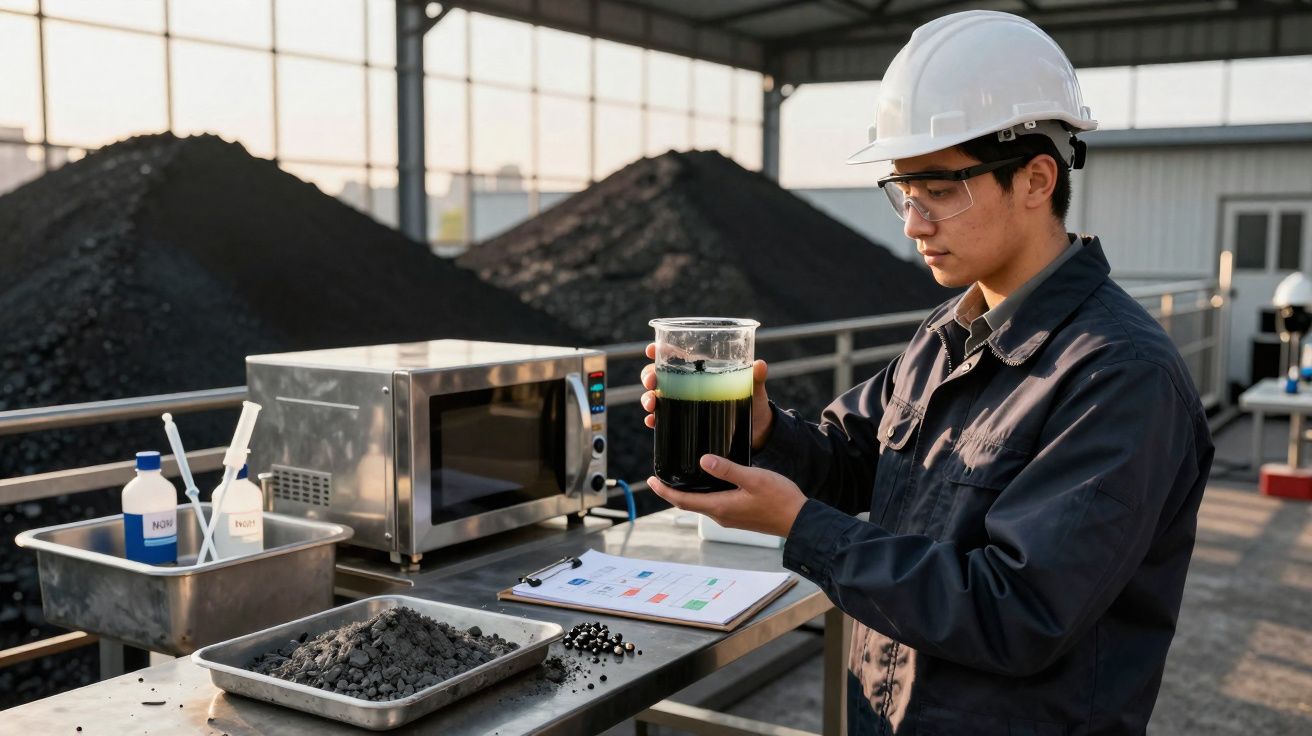
As governments race to secure new mineral deposits, a quieter front is drawing attention to an unlikely place: vast mounds of long-forgotten waste.
For decades, stockpiles of industrial tailings were treated purely as an environmental liability and an ongoing maintenance cost. Now, evidence suggests that some of this “waste” could be one of the most strategically important assets in the technology transition: a meaningful source of rare earths and other critical metals used in mobile phones, electric cars, wind turbines and high‑precision military equipment.
Rare earths from coal waste: from toxic spoil to strategic resource
So‑called rare earths are not especially scarce in the Earth’s crust. The difficulty lies in extraction: it is expensive, disruptive, and heavily concentrated in a small number of countries-creating geopolitical dependence. Under that pressure, researchers have started revisiting an old material with fresh eyes: coal waste.
In the United States, coal waste deposits in Pennsylvania alone could contain up to 137,000 tonnes of economically recoverable rare earths. This material comes from processing coal before it is burned in power stations and industrial facilities. What was once dismissed as worthless residue is increasingly being framed as a strategic mineral stockpile.
The very wastes that fill entire valleys and drive environmental concern could become one of the most important urban sources of critical metals.
The persistent barrier has been technical. The rare earths are present, but effectively “locked” inside a complex mineral matrix-almost as if cemented within clay and silicate structures. Conventional acid leaching can dissolve some of these metals, but typically with poor recovery, high cost and substantial generation of harsh effluents.
How an alkaline NaOH bath and microwave heating change the game for rare earths
A research team at Northeastern University in the US has developed a process aimed directly at the mineral “padlock” that traps rare earths. Rather than simply applying acid to the tailings, the approach begins with an alkaline treatment using sodium hydroxide (NaOH), followed by rapid heating using microwaves.
This opening step reshapes the crystalline structure of key minerals. A central example is the conversion of kaolinite-a common clay in these wastes-into a phase known as hydrosodalite, which has a more porous and reactive structure.
By re‑engineering the minerals from within, the process creates routes that allow acid applied later to reach hidden critical metals far more easily.
Tests on industrial samples found that this alkaline pre‑treatment-carried out at around 180 °C with a 5 M NaOH solution under microwave heating-followed by digestion with nitric acid, nearly triples rare earth extraction yields compared with conventional routes.
What happens inside each grain of coal waste
As kaolinite dissolves or converts into hydrosodalite, the solid becomes more porous. Internal surface area increases and channels and voids form. This makes it easier for acid to penetrate and release elements such as neodymium and cerium, which are essential for high‑performance permanent magnets used in electric motors and hard drives.
Spectroscopy and X‑ray diffraction analyses confirmed these mineralogical changes. Another important finding is that some of the uranium present in the waste dissolves during the alkaline stage, which can help reduce radiological risks during the subsequent acidic attack.
The data also indicate that rare earths are often associated with elements such as magnesium, calcium and iron. This suggests that many of these metals share the same mineral “home”, reinforcing why targeted disruption of alumino‑silicate phases is crucial to liberate the full bundle of metals of interest.
From lab bench to industrial plant: the real‑world hurdles
The technical promise is clear, but turning the method into a production line is not straightforward. The economics and environmental balance still have to add up. Reagent use, the energy demand of industrial‑scale microwave heating, and the handling of alkaline effluents must fit a competitive business model-ideally one integrated with other industrial value chains.
Coal waste composition varies between mines, and even between different layers within the same deposit. That variability forces careful tuning of parameters such as NaOH concentration, microwave exposure time, temperature, the solid‑to‑liquid ratio, and the number of treatment cycles.
- Reagents required: concentrated NaOH solution and nitric acid
- Energy: an industrial‑scale microwave heating system
- Process control: continuous adjustment to match the mineralogy of each waste batch
- Effluent management: treatment and/or reuse of alkaline and acidic solutions
- Permitting: environmental compliance and monitoring of radionuclides such as uranium
The most efficient extraction scenarios-such as those using low liquid volumes relative to solids or multiple cycles of chemical attack-can generate large volumes of spent solutions that also need treatment and, preferably, recycling.
Industrial success depends on embedding this route into a wider chain, where today’s reagent becomes tomorrow’s input-cutting both cost and environmental impact.
A further practical consideration, especially relevant in a UK context, is site selection and community impact. Legacy coal regions may already host spoil tips, ash lagoons and other historic waste stores; adding processing infrastructure requires careful planning around traffic, noise, water abstraction, odour control and long‑term monitoring. Securing a social licence to operate can be as decisive as the chemistry.
A new move on the mineral security board
Governments and companies are searching for ways to reduce reliance on a small number of global rare earth suppliers. Recovering these metals from existing wastes offers three potential wins: it reduces pressure to open new mines, helps clean up degraded sites, and strengthens supply security for strategic sectors-from renewable energy to defence.
In practice, countries with a history of coal mining or other resource‑intensive industries may be sitting on a dormant archive of waste that could become a critical asset. Large tailings impoundments, ash deposits and stockpiled materials can be reassessed specifically for rare earths content.
In the UK, this aligns with wider industrial strategy goals around circularity, domestic resilience and higher‑value manufacturing. While the cited deposit estimates are US‑based, the underlying urban mining logic-treating legacy residues as feedstock-maps onto UK discussions about critical raw materials, supply‑chain risk and the clean‑energy rollout.
| Source | Advantages | Challenges |
|---|---|---|
| Conventional mines | High, concentrated volumes | Environmental impact; lengthy permitting |
| Coal waste | Existing infrastructure; dual benefit (clean‑up and extraction) | Variable composition; need for new technologies |
| Electronic waste | High metal content per tonne | Complex collection, sorting and disassembly |
Key concepts worth clarifying
The term rare earths refers to a group of 17 chemical elements, mostly lanthanides, including lanthanum, neodymium, praseodymium, dysprosium and terbium. They are considered critical to modern technology because they offer magnetic, optical and catalytic properties that are difficult to replace.
Meanwhile, urban mining describes the approach of recovering valuable metals from industrial, electronic and municipal wastes instead of relying solely on natural ores. The NaOH‑and‑microwave process fits squarely within this thinking, bringing a more mineralogically sophisticated pathway to tailings re‑use.
One additional aspect that becomes important at scale is lifecycle performance. If electricity for microwave heating is sourced from low‑carbon generation and if NaOH and acid streams can be regenerated, the overall footprint can improve markedly; if not, energy and chemical inputs may erode both the environmental and commercial case.
Future scenarios and risks in play
One plausible next step is to build pilot plants in regions with substantial coal waste deposits. Compact units could trial different combinations of temperature, reagent concentration and microwave residence time, adjusting the process batch‑by‑batch to match local mineralogy.
The risks span both environment and markets. If energy prices rise sharply or rare earth prices fall too far, projects can become uneconomic. Equally, poor handling of alkaline and acidic solutions could create new liabilities-the opposite of what this technology is intended to achieve.
For those working in energy planning, green industrial policy or the circular economy, the issue is increasingly strategic. Wastes that currently take up space and worry local communities could, within a few years, be regarded as critical reserves. The competition may not only be about who owns the richest mine, but also about who can design the best chemical process to extract value from what has already been discarded.






Comments
No comments yet. Be the first to comment!
Leave a Comment