
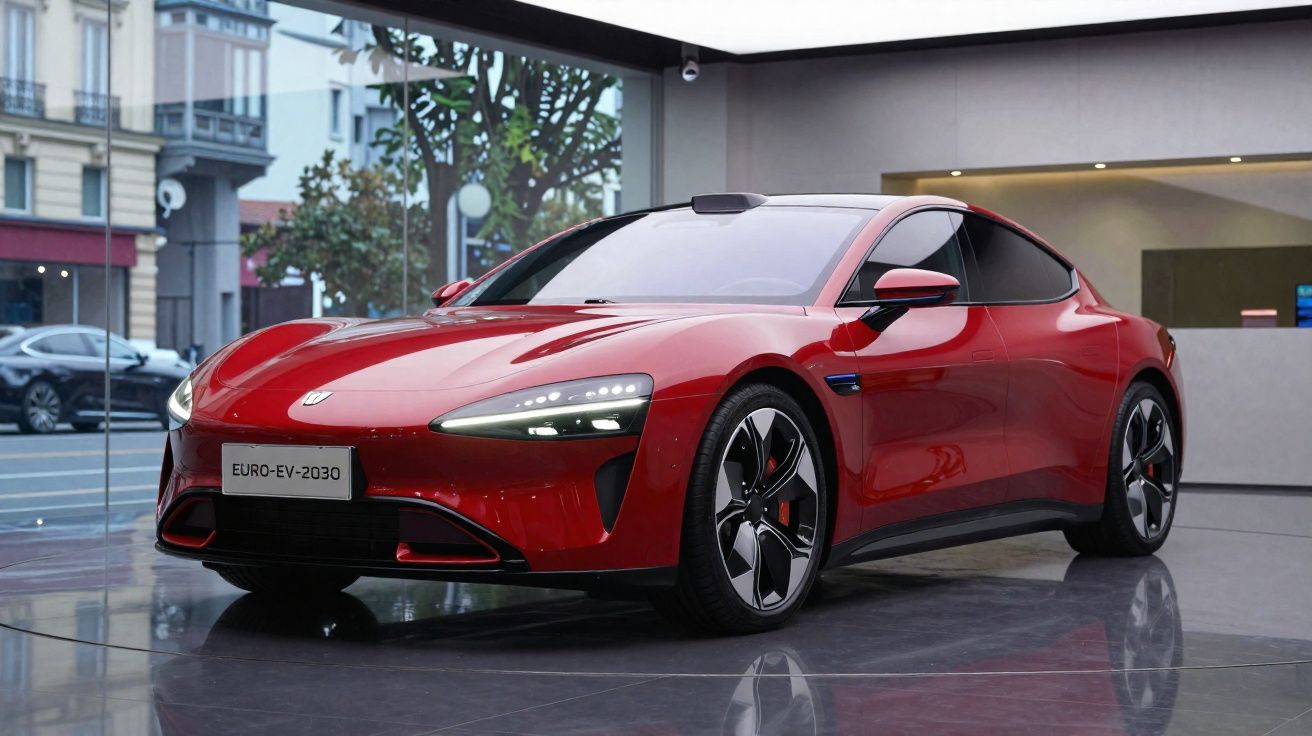
On a damp Tuesday in Lyon-the sort of morning when scooters whisper over slick tarmac-a small white BYD Seagull glided into a bay that not long ago would have held a diesel Renault. The driver, a 29-year-old nurse, climbed out balancing a coffee in one hand and her phone in the other. She gave a quick, matter-of-fact shrug. “Honestly, it was this or no car at all.”
A few metres away, two Renault workers on their break watched with arms folded. One tipped his chin towards the little EV. “That,” he said under his breath, “is my job going past me.”
At the same moment, a green city councillor cycled by and flashed a smile at the Chinese electric runabout: fewer fumes, less noise, one more internal-combustion engine off the streets.
Same vehicle. Three interpretations.
So who’s right?
Chinese EVs in Europe: cheap, quiet, and suddenly everywhere
Stroll through any major European city today and you’ll spot them almost immediately: unfamiliar badges, crisp design, and-inside-screens so large they border on theatrical. MG, BYD, Nio, Ora. Brands that barely registered with most Europeans a few years ago now appear in traffic as routinely as app notifications.
They don’t trickle in politely. They arrive in volume-like a tide Europe assumed it still had time to plan for. And you can read the score on the road.
In Valencia, Javier, a 43-year-old mechanic, says a sizeable chunk of his day is spent walking customers through a question that would have sounded strange not long ago: how can a “dream EV from China” cost less than a used Clio? “A family comes in,” he explains, “they see a compact electric car for under €20,000 (roughly £17,000), and the old names suddenly feel like antiques.” He once made his living replacing exhaust systems; now he’s fitting home chargers and poring over Chinese spec sheets at the back desk.
Across the continent, the sales tables are reshuffling in real time. Chinese-built EVs-including models from Western marques manufactured in China-have moved from niche to meaningful share in just a handful of years: a broad front of metal crossing oceans, and a European “old guard” that looks briefly stunned.
Why Chinese EVs are so affordable (and why the sticker price tells the story)
A large part of the explanation is uncomfortably straightforward. Chinese manufacturers spent years-plus billions in investment and extensive state support-constructing an EV ecosystem end-to-end. Batteries, chips, software, and even entire “EV cities” oriented around a single objective: scale. While Europe debated targets and timetables, China built factories. The gap now appears, in plain sight, on the price label.
European carmakers counter that they’re squeezed by higher wages, tougher environmental rules, and energy costs. They argue Beijing’s subsidies distort competition, and Brussels has launched investigations. Yet none of that nuance fits neatly onto a dealership window. What most buyers see is simpler: a polished electric car they can finally afford-and, in the background, a local factory that feels a little less secure than it did last year.
The overlooked pinch point: servicing, parts, and the promise of a warranty
One detail that rarely makes the headlines, but matters on real driveways, is what happens after the purchase. New entrants must build parts pipelines, technician training, and reliable warranty handling across dozens of countries. For drivers, cheap monthly payments lose their shine if a minor sensor fault means weeks waiting for a component-or a specialist appointment 80 km away. For independent garages, the shift brings both opportunity (high-voltage work, diagnostics, charger installs) and friction (proprietary software, locked-down systems, unfamiliar supply chains).
This aftersales layer won’t decide the transition alone, but it can accelerate-or quietly undermine-trust in any badge, whether it says BYD, MG, or a long-established European brand.
Jobs on the line, or CO₂ out of the air?
Sit with workers outside Stellantis in Turin or VW in Wolfsburg and the anxiety is tangible. Cigarettes disappear quickly, voices sharpen, and each fresh memo about an “electrification strategy” can sound like a euphemism for “we’ll need fewer of you”. An electric car contains far fewer moving parts than a diesel. Even before imports became the headline, many employees could already read the writing on the wall. Add a wave of cheaper Chinese EVs, and the threat feels like it has doubled.
They aren’t only racing towards the future. They’re racing towards a future manufactured elsewhere.
Consider the Belgian port of Zeebrugge, now one of Europe’s key entry points for Chinese EVs. Lots that once held mostly EU-built vehicles are increasingly lined with long, uniform rows of models made in Shanghai, waiting to be dispersed by lorry and rail across the continent. Dock workers describe a strange contradiction: throughput is booming, ships keep growing, but the value created on European soil feels thinner.
At the same time, officials in cities from Amsterdam to Milan point to air-quality charts finally edging in the right direction. Winter coughs that ease. Fewer days when nitrogen dioxide bites. Whether politicians like the origin label or not, the Chinese EV surge shows up in those graphs. In climate statistics, a combustion engine removed from the road looks the same whichever country assembled its replacement.
Another constraint Europe can’t ignore: charging capacity and the daily reality of range
There is also a practical bottleneck that cuts across ideology: charging. Affordable EVs only become mass-market if home, workplace, and kerbside charging expand fast enough-especially for renters, flat-dwellers, and anyone without a driveway. Grid upgrades, planning permission, and reliable public rapid charging (with transparent pricing) matter as much as vehicle price. If charging remains patchy or expensive, the debate about tariffs and industrial policy risks becoming detached from the lived experience of drivers trying to get to work on a cold Monday morning.
The green dilemma: fast decarbonisation, messy supply chains
For climate campaigners, the moment contains an awkward twist. They’ve argued for years to phase out fossil engines by 2035. Now an affordable way to speed that shift exists-yet it arrives from a country with coal-heavy electricity, supply chains that can be difficult to audit, and a government whose human-rights record is frequently criticised.
Do you celebrate the fall in tailpipe emissions and grit your teeth about everything upstream? Or do you slow the pace to shield European industry, accepting higher emissions for longer?
Politicians face the same bind. Hit Chinese imports with tariffs and you may protect some jobs-at least temporarily-but risk slower EV take-up and potential retaliation. Let the flood continue and you could meet climate goals sooner, while granting Beijing significant leverage over Europe’s mobility future. The blunt truth is that every option comes with a bill, and few leaders want to say-out loud-who should be expected to pay it.
What Europe can realistically do next
In private meetings, industrial strategists repeat a simple warning: catch up, or get used to being a market rather than a maker. The most practical route doesn’t run through speeches in Brussels so much as workshops and production lines in places such as Douai, Tychy, and Zwickau. Europe needs domestic battery plants, genuinely affordable small EVs, and software that doesn’t feel five years behind what a Shenzhen dashboard makes normal.
Some manufacturers have started to respond. Renault is working towards a low-cost electric Twingo. VW continues to tease a €20,000 (around £17,000) EV. Stellantis is pushing more electric Fiats. These are not vanity projects. They are instruments of survival.
Policy advisers love headline announcements, but the quieter mechanisms matter more: rules that advantage vehicles actually built in Europe without slamming the door completely; funding that retrains engine specialists into battery technicians rather than leaving them with slogans about “green growth”; timelines that survive elections rather than fantasy roadmaps that collapse every few years.
Most people don’t read 300-page transition plans each day. What they experience is the gap between ambition and reality-and with EVs, that gap is being carried by mid-career factory workers, young buyers squeezed by rent, and small suppliers who never expected to learn the basics of lithium refining.
Within ministries, there is a growing acceptance that “ban petrol and let the market sort it out” is not a strategy. A senior EU official, speaking privately, put it bluntly:
“The choice is not between Chinese EVs or no EVs. The choice is whether Europe shapes this transition or just pays the bill for it.”
To move beyond slogans and towards something workable, three themes keep resurfacing:
- Protect some space for European-built models using smart, targeted trade tools rather than an all-out tariff war.
- Pour real money into gigafactories, retraining, and genuinely cheap urban EVs, not endless pilot schemes.
- Tell the truth about the social cost of the shift, so workers learn about it before-not after-their plant shuts.
On paper it looks straightforward. In politics, it’s explosive.
A fight playing out in driveways and ballot boxes
Stand on a suburban street in Poland, France, or Portugal on a Sunday morning and the clash becomes visible in miniature. A worker polishing a ten-year-old diesel he worries won’t be allowed into city centres much longer. A young couple returning from the supermarket in a compact imported EV that finally fits their budget. A neighbour scrolling headlines about tariffs, climate deadlines, and strategic autonomy, trying to reconcile them with the bills on the kitchen table.
They don’t talk in trade-law language. They talk in months left on a finance agreement, years until retirement, and how their children’s lungs sound in winter.
China’s cheap electric cars didn’t merely arrive at European ports. They sailed straight into Europe’s unresolved contradictions: green commitments versus industrial pride; open markets versus fear of dependency; short-term relief at the charger versus long-term leverage on the geopolitical chessboard. Each new registration plate is, in its own quiet way, a vote in that undeclared referendum.
The real question isn’t only whether these vehicles are costing jobs or saving the planet. It’s who gets to define “job” and “planet” in the first place-a worker in Zaragoza, a planner in Beijing, a minister in Berlin, or a nurse in Lyon signing a finance contract on a rainy Tuesday.
This story isn’t finished. It’s parked outside.
| Key point | Detail | Value for the reader |
|---|---|---|
| Chinese EVs undercut prices | State-backed scale and lower-cost production allow brands such as BYD and MG to sell below many European rivals | Explains why these cars suddenly feel “too cheap to ignore” |
| Jobs feel directly threatened | Engine plants, suppliers, and traditional factories see EVs and imports as a double blow | Shows why unions and workers respond with anger, not just abstract worry |
| Climate gains are real but uneven | Cleaner urban air and lower tailpipe CO₂ sit alongside questions about batteries, coal-heavy power, and hard-to-audit supply chains | Offers a more candid view than simple “green” versus “dirty” labels |
FAQ
Are Chinese electric cars really that much cheaper in Europe?
Often, yes-particularly in the small and mid-size categories. Lower labour costs, aggressive pricing, and substantial state support enable many Chinese brands to undercut European competitors by several thousand euros per vehicle.Do these imports actually threaten European car jobs?
They intensify pressure on an industry already being reshaped by the EV transition. Risk is highest for engine plants, traditional component suppliers, and regions heavily reliant on a single large factory.Are Chinese EVs worse for the environment overall?
It’s mixed. Tailpipe emissions in Europe fall sharply, but manufacturing may rely on more carbon-intensive electricity, and supply chains can be more difficult to audit.Can European brands catch up on affordable EVs?
Yes, but it requires time, investment, and political backing. Several €20,000–€25,000 (about £17,000–£21,500) models are planned, yet matching Chinese price–technology combinations remains a serious challenge.What could change this balance in the next few years?
EU tariffs or incentives, new European battery factories, tighter supply-chain rules, and any slowdown or change in China’s own EV subsidies could all reshape the landscape.






Comments
No comments yet. Be the first to comment!
Leave a Comment