
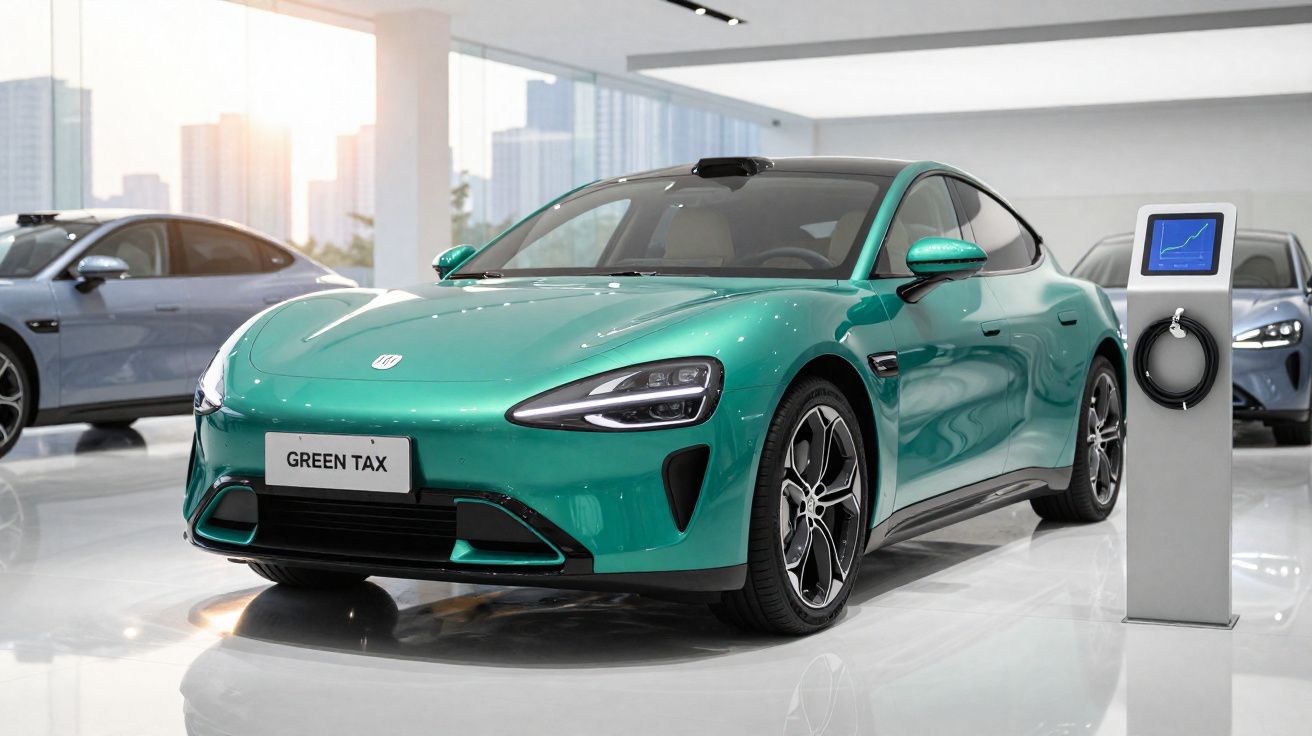
In front of me stood a man in his mid‑50s: company car, brand‑new EV. Beside us, an older diesel clattered away; its driver had only popped in for a couple of bread rolls-and looked pretty pleased with himself. We ended up chatting. The EV driver ran through grant applications, home charger costs, and electricity bills that never seemed to stop creeping up. Then he said, quietly: “Sometimes I wonder if I’ve brought an expensive trap home with me.”
Over the last few months I’ve heard variations of that line constantly-from neighbours, colleagues, and in reader emails. The mood is shifting: not loudly, but unmistakably. And, oddly enough, 2025 could be the year it really bites.
Electric cars and the green tax trap: why 2025 becomes a reality check
Anyone shopping for a new car today can hardly avoid the promise of a “greener future”. For years it came wrapped in incentives: purchase support, cheaper company‑car tax treatment, and various nudges to get a charger fitted at home. It often felt like a one‑way ticket into electric motoring. In 2025, many drivers may find that confidence brought sharply back to earth.
More and more commentators are talking about a green tax trap-not a single new bill landing overnight, but a slow closing of the gap as support fades, new charges appear, and everyday running costs shift. You do what you believe is the right thing: cleaner air, lower emissions, quieter streets. Then the rules change. Grants disappear, tariffs rise, and fees creep in via the back door. Suddenly, the old internal‑combustion cars stop looking like dinosaurs and start looking like the quietly advantaged option in a system that’s hard to read.
This is the sort of thing people discuss cautiously in fleet circles and industry briefings. One scenario keeps resurfacing: petrol and diesel becoming relatively more attractive on the balance sheet, while EV owners shoulder higher fixed costs. It sounds backwards-until you look at the numbers being debated for 2025 onwards.
The 2025 cost reality: incentives fade, fixed costs show up
Picture a typical family outside a city: two children, a house, one main car. A couple of years ago, the sums could look persuasive: a headline purchase incentive (where available at the time), local schemes that helped with a home charger, and sometimes an employer contribution if the car was on a salary‑sacrifice or company‑car arrangement. Public charging was often cheaper too, and energy prices-while never stable-were less punishing than they became.
Now the arithmetic looks different. Broad, easy purchase support has largely gone in the UK, and electricity prices have proved volatile. Rapid charging on a motorway corridor can cost dramatically more than it did in the early 2020s, to the point where “cheap electric miles” stop being a given-especially if you can’t charge at home.
On top of that, some councils and private operators are openly reviewing parking and charging‑bay pricing. What starts life as encouragement can turn into something that feels like an add‑on tax: higher fees for the convenience of a charging space, penalties for overstays, or tiered tariffs that punish peak‑time charging. Meanwhile, the diesel driver next to you pays plenty at the pump-but doesn’t need a wallbox installed, doesn’t pay monthly app subscriptions to access certain networks, and doesn’t juggle a stack of charging accounts.
A particularly sensitive pressure point is tax. From April 2025, the UK is set to bring EVs into Vehicle Excise Duty (VED) in a way that ends the “zero‑rate by default” era for many models. That change alone won’t make an EV pointless-but it reinforces the broader message: electric cars are becoming normalised as everyday products, and normal products get taxed.
Company cars and fleets: where the numbers can flip fastest
Another area where advisers speak in lowered voices is the company‑car market. For years, electric company cars have been a tax sweet spot: low Benefit‑in‑Kind (BiK) rates, strong “green” signalling, and lease offers that could look very competitive once tax was factored in.
But the risk from 2025 is not that EVs suddenly become “bad”-it’s that a few small levers move at once. Adjust BiK bands, tweak allowances, reduce ancillary support, and the calculation changes. In some use cases, a modern plug‑in hybrid (used as intended) or a very efficient petrol/diesel can start to look calmer financially than a fully electric company car reliant on expensive public charging.
And fleets feel these changes first, because they run on spreadsheets: total cost of ownership, downtime, residual values, charging infrastructure, and policy risk.
Why governments reach for new levers (and why it feels like a trap)
From a Treasury point of view, the logic is straightforward. Fuel duty and motoring taxes are huge revenue streams. As more drivers move away from petrol and diesel, those receipts fall. So the question becomes: where do you rebalance?
That’s where the green tax trap idea comes from. The “support” doesn’t necessarily vanish; it can be replaced by different mechanisms-electricity taxation, network charges, road pricing conversations, city charges, higher parking fees, or targeted levies to fund grid upgrades. What begins as a reward can end up as a new cost block, just packaged in a cleaner wrapper.
The sober reality is that EVs are not only an environmental project; they’re also an infrastructure and taxation project. Every kilowatt-hour has to be generated, moved through the grid, managed at peak times, and paid for. If, one day, 70–80% of vehicles are electric, it’s unrealistic to assume they’ll remain permanently privileged in the tax system. Roads still need resurfacing; bridges still need maintenance; the grid still needs reinforcement. And, by 2025, that horizon is becoming clearer than many people expected.
Don’t panic-do the sums (properly)
None of this means you should bin the idea of an electric car in 2025. It does mean the decision needs less ideology and more arithmetic.
Start by pricing the whole picture, not the showroom sticker. Include insurance, servicing, tyres, home charging installation, electricity tariffs, public‑charging costs on longer trips, and plausible future extras such as parking premiums, workplace charging fees, or city charges. Many UK motoring organisations now provide TCO calculators that at least give you a sensible direction of travel. And often the gap between a frugal combustion car and an EV is smaller than glossy brochures suggest-especially if you’re funding the home setup yourself.
Next, look hard at your real‑world routine. If you mainly do short trips, have off‑street parking, can fit a home charger, and rarely rely on motorway rapid chargers, an EV can still make excellent sense even under a more “normal” tax regime. If you’re dependent on public charging, travel long distances for work, or live in a flat or terrace with no reliable charging option, a hybrid-or a genuinely efficient petrol/diesel-may be the steadier financial choice for years.
Two patterns keep tripping people up:
- “If the old incentives have ended, new ones will surely appear.” They might, but there’s no guarantee-and future programmes are often narrower, more conditional, and more complex to access.
- “Electricity will definitely become much cheaper.” It could. It could also go the other way once grid investment, peak management, and carbon pricing pressures are fully priced in. Hope is not a tariff.
Let’s be realistic: most households don’t sit down every Sunday night and build a 10‑year TCO forecast for the family car. Pretending otherwise doesn’t help. But an honest afternoon with a notepad, a few conservative assumptions, and a willingness to challenge your own bias can stop you stepping into obvious pitfalls.
“We’re watching a quiet shift: from the incentivised ‘car of the future’ to a normally taxed everyday product,” a mobility specialist told me recently. “Anyone going into 2025 assuming the state will keep rewarding them could be in for a nasty surprise.”
Two extra realities worth adding to your 2025 checklist
First, resilience and reliability matter more as the market matures. Public charging is improving, but it’s still uneven: broken units, blocked bays, inconsistent pricing, and app‑locked networks can turn “quick top‑ups” into time sinks. If your lifestyle depends on public charging several times a week, reliability is not a nice-to-have-it’s a cost.
Second, you can sometimes protect yourself with smarter energy choices rather than car choices. Time‑of‑use tariffs, scheduled overnight charging, and (where viable) solar plus a home battery can materially change the running costs of an EV. Those options don’t suit everyone, but in 2025 the difference between “EVs are cheap to run” and “EVs are expensive” can hinge on whether you can control when and where you charge.
What to do if you’re choosing a car in 2025
These points come up again and again in conversations with drivers, fleets, and advisers:
- Assume higher prices at rapid chargers-cost pressure won’t be limited to the pump.
- Expect fewer straightforward purchase grants, and more selective incentives or conditions.
- Plan to keep the car longer than you might have previously, and factor in battery warranty terms and degradation.
- Allow for future city charges, access restrictions, and parking fees-especially in busy urban areas.
- Compare company‑car taxation for petrol/diesel, hybrid, and electric in detail; small rate changes can swing the result.
We’re at a threshold where the promise of “cheap green driving” is being reorganised. The combustion engine won’t suddenly become the hero again-but in certain setups it may turn into the financially smarter underdog. And yes, that challenges the story many of us were sold.
The more openly people talk about it, the clearer it becomes: plenty of drivers are thinking the same thing; they’re just hesitant to say it out loud. Maybe 2025 is when the question stops being only “What is ecologically right?” and becomes equally “What is economically honest?” Those answers won’t always match-and that’s where the real conversation starts: in supermarket car parks, among friends, and around the family table.
| Key Point | Detail | Added Value for the Reader |
|---|---|---|
| Green tax trap | Withdrawal of incentives, new charges linked to electricity and infrastructure | Spot early that EVs may become less tax‑advantaged over time |
| 2025 cost reality | Higher charging prices, likely shifts in VED and company‑car treatment | Build a realistic total‑cost view instead of relying on yesterday’s perks |
| Individual usage profile | Differences between on‑street parkers, commuters, family cars and company cars | Choose the right powertrain for your life rather than following a trend |
FAQ
Question 1: What exactly do experts mean by a “green tax trap”?
Answer 1: They mean that technologies currently encouraged through grants or tax breaks-such as EVs-can later become less financially attractive as new taxes, charges, or withdrawn advantages are introduced, while petrol/diesel can look cheaper by comparison in some scenarios.Question 2: Is an electric car still worth it in 2025?
Answer 2: For many commuters with home charging, yes-particularly with lots of town driving and shorter trips. If you do frequent long journeys or rely heavily on expensive rapid charging, you should seriously include hybrids or efficient petrol/diesel cars in the calculation.Question 3: Are incentives for electric cars “gone for good”?
Answer 3: No one can promise new schemes won’t appear. What is clear is that the broad, generous purchase incentives of recent years have largely ended, and any future support is likely to be more targeted and tied to conditions.Question 4: Will petrol and diesel cars be banned from 2035?
Answer 4: The direction of travel in Europe and the UK is to end sales of new pure petrol and diesel cars by 2035, with policy details and exemptions continuing to evolve. This does not stop used cars being owned, sold, and driven afterwards-something that can increase their appeal as a “keep it longer” option.Question 5: How can I protect myself against the “green tax trap”?
Answer 5: Don’t decide on instinct alone: model a few realistic cost scenarios, prioritise flexible finance where possible, keep an eye on policy changes, and choose a setup that doesn’t leave you totally dependent on a single charging method or a single set of incentives.





Comments
No comments yet. Be the first to comment!
Leave a Comment