
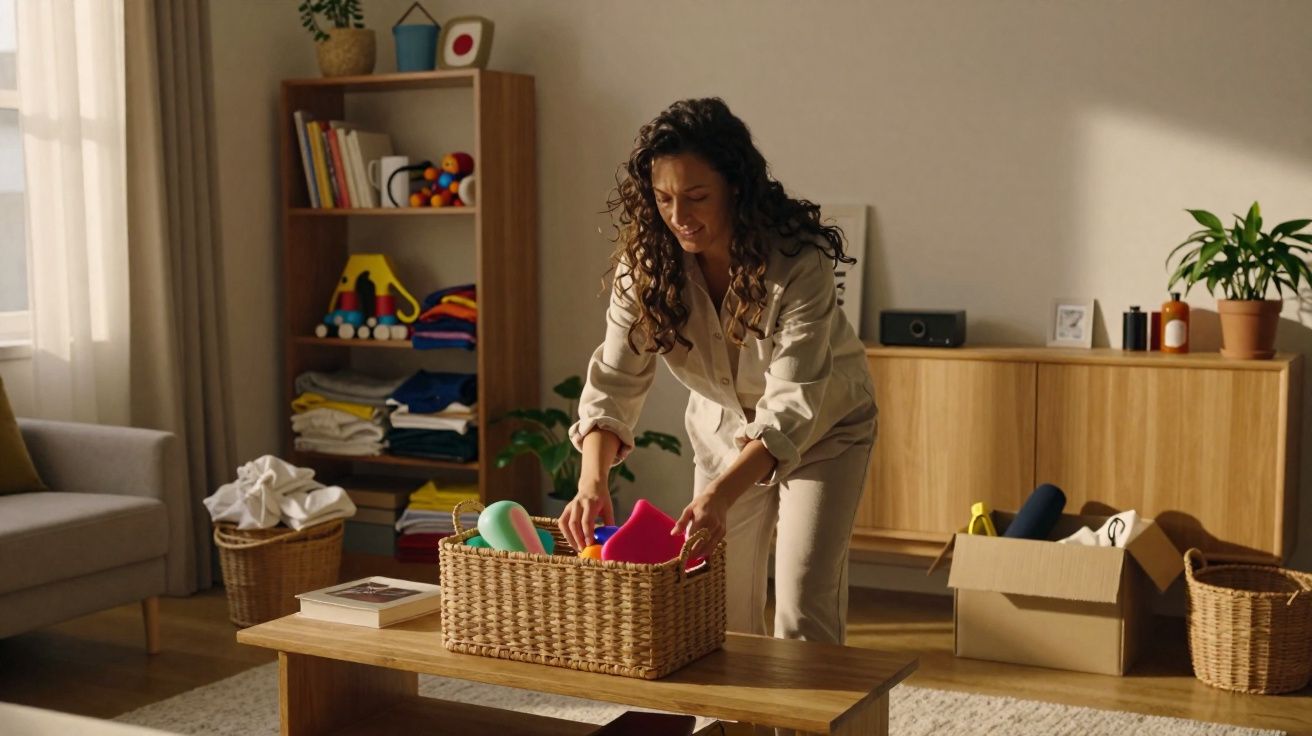
You make the bed, wash the dishes, and give the living room a quick wipe down.
Then you look around and think, “Hang on-why does it still look messy?” The pattern repeats itself: little piles of things that are “in use”, toys that never return to the same spot, cables, papers, handbags dumped on the dining chair. The place isn’t exactly dirty. It just always looks slightly out of place-like a house paused halfway through a move that never ends.
Most of us have stepped into someone’s home that isn’t especially tidy, yet somehow feels visually calm. And we’ve all seen the opposite too: spotless, fresh-smelling spaces that still look chaotic. Washing up, putting things away, wiping surfaces… it often misses a factor that matters more and more in a world full of stuff: visual pollution. That’s the real reason some homes look perpetually messy, even after a thorough clean.
When the house still “shouts” after you’ve tidied
There’s a quiet but important difference between functional disorder and visual disorder. Many people deal with what’s dirty, yet keep dozens of objects on display that compete for attention: skincare lined up by the sink, too many herbs and spices on the worktop, ornaments on every flat surface. The home may be clean, but it never feels restful. Your eyes don’t get a break-they keep jumping from one stimulus to another.
That kind of environment is tiring in a way you don’t always notice. You finish tidying and still feel as though “something’s missing”. It’s like trying to work while notifications keep pinging: nothing is specifically wrong, but nothing ever feels properly settled. In this scenario, the “mess” isn’t only on the floor or the table-it’s in the sheer amount of information your brain has to process with every step.
Take Ana’s flat, for example. She’s 34, has two small children, and splits a home-working setup with the living room. She spends Saturday cleaning everything. The floor gleams, the bathroom smells of eucalyptus, the kitchen has no dishes piled up. When she’s done, she looks around: toys in open baskets, school bags slung over chairs, stacks of books on the coffee table, a collection of “cute” mugs perched on top of the microwave. Nothing is dirty. Everything is simply visible. The overall effect? A constant sense of mess.
Ana isn’t an outlier. Environmental psychology research suggests that spaces with lots of items on show can increase the feeling of disorganisation-and even stress-despite being clean. The brain reads excess as an unfinished task. It’s as though the home keeps repeating: “too much stuff, too much stuff, too much stuff.” So even with real effort, the perception of disorder sticks.
Practically speaking, it’s more maths than morality. A home with 300 visible objects will look messier than one with 80, even if both are equally clean. What’s missing are doors, lidded baskets, workable cupboards, and clear surfaces. What’s left is clutter “in circulation”. And often it isn’t rubbish at all-it’s valued things: gifts, keepsakes, reminders. But all together, all at once, they push the home into visual pollution that no daily clean-up can solve.
Tidy less, hide better, own less (visual pollution in the home)
One of the most powerful ways to reduce the feeling of disorder has nothing to do with a mop and bucket. It’s about getting things out of sight. Not shoving everything into the nearest cupboard and pretending it’s handled-rather, building a habit of letting surfaces breathing become the norm. A mostly clear sink, a worktop with only a few fixed items, a table without being a permanent “parking area” for papers and handbags. When your eyes find empty space, your brain interprets it as calm and order-even if the rest of the home is still a work in progress.
A straightforward tactic is to pick one “reference” room-often the living room or kitchen-and set a visual limit. For instance: no more than three items on the kitchen worktop, no more than two decorative objects on the coffee table. Everything else either gets a hidden home or doesn’t need to live there every day. The impact is immediate: the same home, with the same belongings, feels lighter. It’s the difference between tidying that “holds” and tidying that evaporates 30 minutes later.
The most common mistake is assuming you can “tidy a home” purely by cleaning. A cleaner can come in, remove the grime, and leave everything sparkling-but the household keeps the same pattern: they get back from work and drop everything on the same chairs, shelves, and side tables. Then they blame themselves for “not being organised”. In reality, it’s a systems problem, not a character flaw. No one can re-organise 100 loose items every single day. Let’s be honest: nobody does that daily.
Another frequent stumble is trying to store too much in furniture that doesn’t really work: cupboards without dividers, deep drawers where everything disappears into a jumble, shelves that are too high to reach easily. So the items that should be put away end up left out. That’s when “clutter altars” appear-like the console table by the front door that collects keys, coins, post, medicines, earphones, all in the same spot. The fix isn’t stronger willpower. It’s fewer accumulation points and simpler solutions: wall hooks, lidded baskets, and trays that limit what can land there.
As a professional organiser once put it to me: “A tidy home isn’t a perfect home-it’s a home where every item has a likely place to go back to.”
- Reduce the number of visible items on the home’s main surfaces
- Create clear “homes” for everyday objects (keys, handbags, school bags)
- Choose lidded baskets and closed boxes over loose ornaments
- Reassess décor: fewer objects, greater visual impact
- Establish an “anchor room” that stays mostly in order
Two extra levers that make order feel easier (without more effort)
Lighting and colour choices can quietly amplify-or soften-visual pollution. Harsh, cool-white bulbs tend to highlight every object edge and surface detail, which can make clutter feel louder. Warmer lighting and a more consistent palette (even just within one room) often makes a space read as calmer, even before you change any storage.
It also helps to do a quick friction check: where do items naturally get dropped, and why? If the school bags always end up on dining chairs, it may be because the hook is too far from the door or too awkward to use one-handed. A small change-like a lower hook rail, a bench with a closed compartment, or a single lidded box-can reduce the daily “spill” that fuels visual disorder.
When mess reflects life-not just the house
There’s another piece that people rarely enjoy admitting: some homes look messier because they’re openly broadcasting the pace of life inside them. Double shifts, small children, little support, anxiety, chronic exhaustion. It’s hard to ask someone running on empty to become a model of minimalist organisation. In that context, clutter is almost a not-at-all-subtle diary of a family’s real priorities.
That’s why, before chasing magazine-level standards, many people are starting with a different question: “How do I want this home to make me feel when I walk in after a long day?” The answer isn’t always “perfect”. For some, it’s enough to have a clear sofa, an uncluttered kitchen worktop, and a bedroom where you can lie down without moving piles of clothes first. The sense of disorder drops when the home matches the household’s real routine-not an idealised Instagram image.
In the end, “Why does my home always look messy?” tends to open bigger questions. How much do I bring in without ever questioning it? How many objects are here simply because they ended up in my hands one day? What kind of home suits the way I live-not the way my neighbour lives, or the influencer of the moment? Perhaps the first step isn’t buying more organisers, but looking calmly at what greets you every day and deciding what you want it to say about you.
Some answers will feel uncomfortable; others can be freeing. And it’s striking how quickly the atmosphere shifts when you find the courage to remove things from your line of sight-and, sometimes, from your life. The home becomes quieter, less accusatory. Suddenly, tidying stops being constant fire-fighting and starts to feel like a form of self-care. The question to sit with is: what small adjustment today would make your home feel less chaotic to your own eyes?
| Key point | Detail | Value for the reader |
|---|---|---|
| Visual pollution | Too many exposed objects make the home look permanently messy | Explains why the feeling of disorder can linger even after cleaning |
| Surfaces breathing | Set limits for items on worktops, tables, and consoles | Offers a quick, practical step that changes the home’s appearance fast |
| A home that fits the routine | Organisation aligned with time, energy, and lifestyle | Reduces guilt and creates a more realistic, sustainable standard of order |
FAQ
Question 1: Why does my home look messy even after I’ve cleaned?
Because cleaning and organising aren’t the same thing. You can have a spotless home, but if there are lots of items on display, no clear “place” logic, and packed surfaces, your eyes read it as visual chaos.Question 2: Do I need to become a minimalist for my home to look more organised?
No. Small tweaks make a noticeable difference: store more in closed cupboards, reduce the number of ornaments, and set a fixed place for everyday items such as keys and handbags.Question 3: Where should I start if I’ve got loads of clutter and hardly any time?
Choose one high-impact spot: the coffee table, the kitchen worktop, or the bedside table. Clear it completely, put back only what’s essential, and keep that area as an “island of calm”. It changes the overall perception straight away.Question 4: How can I manage children’s toys without the house feeling like a chaotic playroom?
Use fewer open baskets and more closed boxes or toy chests. Keep a small selection out on rotation and store the rest away. Fewer toys in view equals less sense of mess.Question 5: What if the people I live with don’t help keep things organised?
Instead of trying to overhaul everything at once, agree simple rules for shared spaces (a fixed spot for bags, shoes, keys) and take control of one area that’s yours-something you can realistically maintain the way you want.






Comments
No comments yet. Be the first to comment!
Leave a Comment