
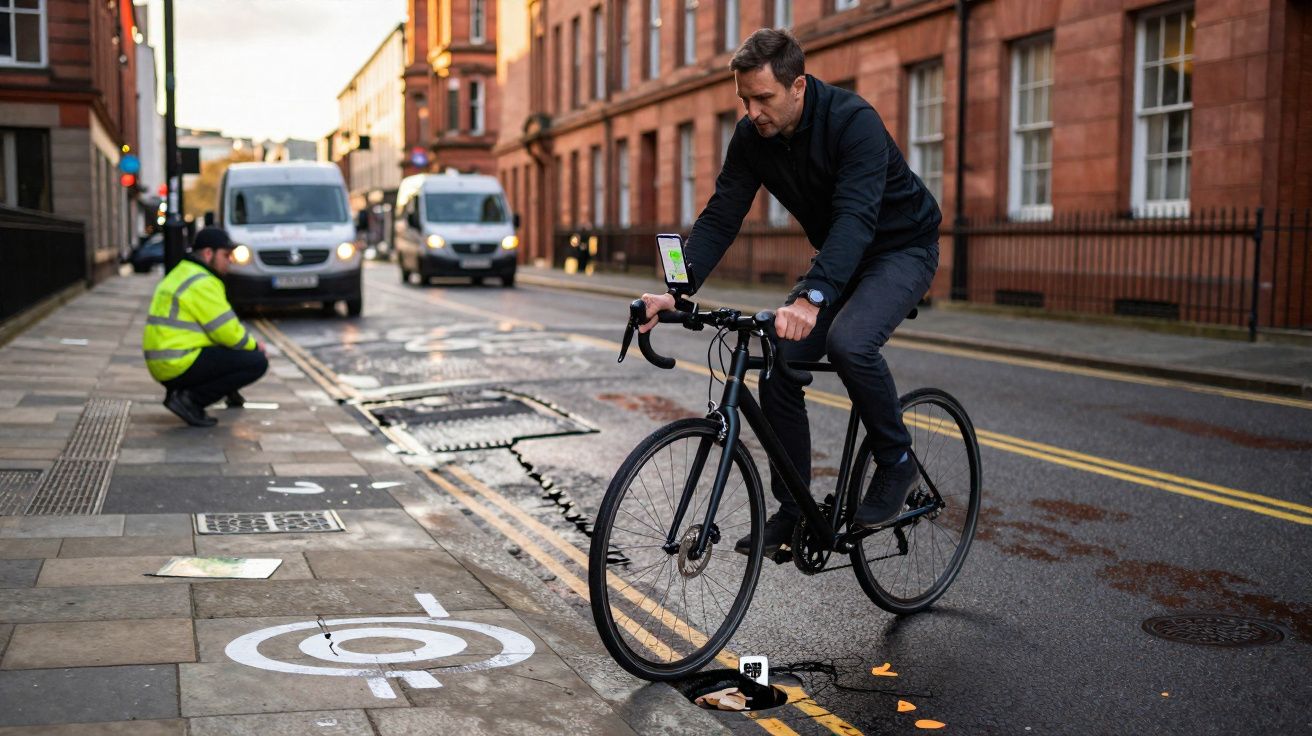
A man chose to stop grumbling and start measuring, cycling every street to create a living map the council could not dismiss. Somewhere along the way, that map unlocked an opportunity he never saw coming.
Glasgow’s rain was doing its finest misty work, the kind that slips under your cuffs without asking. A cyclist coasted to a junction in Maryhill, paused, tapped his phone, and glanced down as the handlebars trembled-like a drum skin-over a scar in the tarmac. A soft beep followed, a pin appeared on a map, and he let out a slow breath. Then he nodded, turned off, and vanished into a side street lined with double-parked vans and shining wheelie bins. He kept pedalling, one street after another, like a hummingbird tracing the city’s pulse. By nightfall he had more than aching legs: he had evidence. And evidence travels.
Every street, every bump - a Glasgow pothole map the council couldn’t ignore
The whole thing began with a stubborn question. Could a single person cycle every street in Glasgow and record exactly where the road surface breaks down? He sketched a rough grid onto a paper map and started that same week-first Partick, then Govan, then over the river into Calton and Dennistoun.
His rules were strict: no missing links, no skipping cul-de-sacs, no “forgetting” alleyways. Each time his phone’s accelerometer spiked, he logged it; if the hit felt worse than a normal jolt, he stopped and took a photo. After three weeks his body adjusted to the miles. His tolerance for crumbling roads did not.
On day 19 he found a cluster that forced him to pause. Along a school-run route near Pollokshields, there were three large holes within about 60 metres-each one deep enough to swallow a tyre and ruin a morning. He watched a parent steer a buggy out into traffic to avoid a puddle hiding a crater. That moment stuck with him as much as any chart ever could.
By the end of month two, his spreadsheet held 1,842 defect flags across roughly 1,770 kilometres of riding, labelled by severity and tagged with time and weather. It was untidy to look at, but the message was unmissable.
As the map filled in, patterns became hard to ignore. The roughest chains of potholes followed bus routes and freight cut-throughs, where heavy axles and braking loads chew stress lines into asphalt. Junctions tended to fail first, then tight corners, then old utility cuts patched and repatched over the years. When he overlaid public works schedules, he noticed how reactive repairs bunched towards the end of the financial year. Glasgow wasn’t “careless”; it was constrained. Budgets arrive in bursts, crews respond to complaints, and inspections are built to sample-not to see everything. His map did not replace the system; it simply lit up what fell between the cycles.
The method behind the saddle: phone accelerometer, photos, and repeatable logging
He kept the approach deliberately simple and easy to repeat. A mid-range Android phone, fixed to the handlebars, ran a logging app capturing speed, GPS and vertical acceleration at 50 Hz. A small action camera pointed at the road, taking still images every two seconds. Each evening he synchronised the files, using a Python script to match sensor spikes to locations within a three-metre window, then published the results as pins on a basic web map.
He set himself a practical riding rule: slow enough to feel what the surface was doing, quick enough to cover ground, and steady enough that the signal meant something. Block by block, he stitched the city together.
He also made errors he now warns others about. Riding too quickly smoothed out the data and missed shallow seams that later split open. Forgetting to recalibrate the phone after swapping a tyre created phantom bumps across an entire morning. Freshly gritted roads were another trap-the crunch and scatter confused the sensors. The fix was routine: tyres checked before dawn, phone reset on a flat stretch, and one clear photo for every flagged spot so a human could confirm what the machine thought it felt. Truthfully, almost nobody keeps that up day after day.
His cadence was consistent rather than heroic: 2–3 hours before work most weekdays, plus a longer loop at weekends. That regularity mattered, because repeat passes in different weather made the data more trustworthy.
A note on privacy and fairness (the part most people forget)
He was careful about what he captured and what he shared. The goal was road condition data, not a rolling record of people’s faces, car registrations, or where children cross near schools. Where images risked identifying individuals, he cropped or blurred before sending anything on, and he kept his public map focused on defects rather than footage.
He also learned to treat the map as a tool for prioritisation, not a weapon. Data can easily become ammunition-used to shame a neighbourhood or imply neglect without context. He framed his results around safety and access (schools, hospitals, bus stops), and he avoided “gotcha” language that would push the council into defensiveness.
What he tracked and how he kept it usable
- Phone accelerometer logging: free app, 50 Hz sampling, GPS enabled
- Regular cadence: 2–3 hours before work, plus one longer weekend route
- Data hygiene: nightly sync and manual spot checks using photos
- Safety lens: high-vis in low light; avoided side streets during school drop-off and pick-up times
- Storytelling: one simple web map link plus three bullet points per email
From citizen map to council workflow: what happened next, and why it matters
Instead of posting angry photos and hoping for the best, he emailed the council’s roads service a short weekly summary with clean links and a calm subject line. He highlighted clusters near schools, hospitals and bus stops first. About a month in, an invitation arrived: could he come in and demonstrate the dashboard? He cycled to that meeting as well.
“I didn’t want to be the bloke yelling at road workers,” he told me with a shrug. “I wanted to hand them something they could actually use between inspections. The map made that straightforward.”
Two weeks later, another message landed-one he genuinely did not expect. The council offered him a short-term contract to help formalise citizen-fed condition data for the roads asset team. It wasn’t a fairy-tale turning point; it was a practical one. Over six months he would refine thresholds, test the method on cargo bikes and buses, and compare his outputs with the council’s own inspection logs. The same legs that mapped the problem were now paid to help design a workflow that could scale it. Data changed his life before it changed the roads.
The larger lesson arrives quietly. One determined project built a bridge between lived experience and municipal process. His map did not demand a new budget line; it cut decision time by turning a fog of complaints into visible clusters, ranked by risk. That kind of nudge works because it respects the crews’ expertise while giving managers something concrete to act on. A map can open doors you never expected. Once that door is open, the conversation shifts from “why isn’t this fixed?” to “what’s the next small win we can deliver by Friday?”
If you’re tempted to try your own version, keep it local and manageable. Choose ten streets, go out on a calm morning, and log with patience rather than speed. If you don’t cycle, walk a loop and note where prams or wheelchairs are pushed into traffic. Present what you find in terms that help the person receiving it: precise location, severity, and context in three lines. He cycled every single street in Glasgow. You don’t have to. The aim is not heroics-it is signal over noise, delivered in a tone that invites collaboration rather than a fight.
| Key point | Detail | Why it matters to you |
|---|---|---|
| Riding every street reveals patterns | Junctions, bus routes and old utility cuts tend to fail first | Helps you spot higher-risk zones on your own commute |
| Simple tools can punch above their weight | Phone sensors, photos and a basic map built trust | Shows you don’t need expensive kit to make an impact |
| Tone and timing matter | Calm weekly summaries beat angry threads | Makes action more likely, faster |
FAQ
- How long did it take to cycle every street? Around ten weeks of focused riding: 2–3 hours on most weekdays plus longer loops at weekends, totalling roughly 1,770 kilometres according to his logs.
- What app did he use to detect potholes? A generic accelerometer logger on Android, plus a small script to match spikes to GPS; the brand mattered far less than consistent sampling and proper calibration.
- Did the council actually fix the flagged potholes? Many higher-risk clusters near schools and bus corridors were prioritised within existing schedules; the bigger win was faster triage with better context.
- Is this safe to do on busy roads? He rode early, used side streets where he could, and treated safety as the first dataset; never chase a reading if traffic feels wrong.
- Can you do this without coding? Yes. Start with photos, clear locations and a simple map link (or a FixMyStreet report); the craft is clarity, not code.






Comments
No comments yet. Be the first to comment!
Leave a Comment