
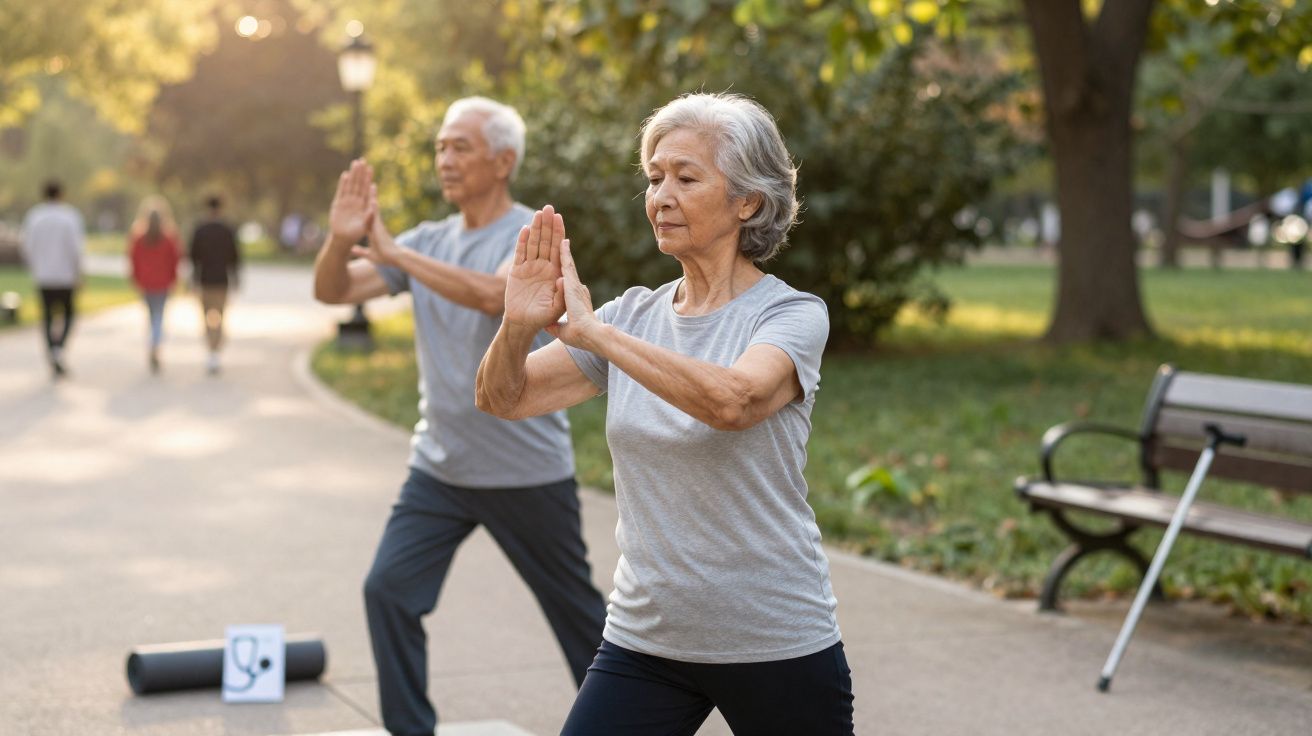
Physicians are increasingly encouraging older patients to trade the clatter of weight plates and the churn of pool lengths for something slower: tai chi. The evidence is consistent, aching joints often feel calmer, and the mind tends to loosen its grip. Dedicated gym-goers may fold their arms and mutter, “this feels like giving up.” The real issue is whether letting go of speed is the same as letting go of strength.
At first light on a London common, a small ring of silver-haired practitioners moves as one, as if following the breeze. Knees stay soft, hands drift, and the breath rises and falls like a gentle tide. On a nearby bench, a man in a fleece sits with a gym bag at his feet, caught between routine and curiosity. He used to chase times and reps; now a persistent shoulder niggle won’t settle, and his sleep has become patchy. His GP has handed him a printed sheet: Tai chi for balance, blood pressure, mood. He half-laughs at the idea of swapping deadlifts for “cloud hands” - and then he notices the steadiness in their faces.
A quiet question lingers: what if the slower option is the stronger one?
Tai chi after 60: the slow practice that keeps pace with real life
Clinicians aren’t recommending tai chi because it’s fashionable. They’re recommending it because research keeps landing on the same conclusion: after 60, this gentle, flowing practice trains exactly what starts to matter most. Balance improves. Blood pressure can settle. Knees and hips often feel less threatened by stairs and uneven ground. In studies tracking older adults, tai chi reduced falls by roughly a fifth - which can mean fewer broken wrists, fewer ambulance call-outs, and fewer months spent shrinking life to avoid risk. That isn’t “less than” weights or swimming; for many people, it’s simply more relevant. It meets the body where it is, not where a training plan assumes it should be.
Consider Margaret, 72, who used to show up faithfully to a Tuesday spin class. She replaced two cycling sessions with three tai chi mornings in the park. Within six weeks, she noticed fewer wake-ups in the night and a once-stubborn knee that stopped complaining. Her fitness watch wasn’t impressed at first - the dramatic heart-rate spikes disappeared - but the stairs told the truth. This is echoed in research: older adults practising tai chi often report better sleep scores and lower anxiety, and an Annals of Internal Medicine trial found tai chi could match physiotherapy for knee osteoarthritis pain and function. Most of us recognise the moment when the body asks for a gentler route. She took it.
What’s happening beneath the surface is more than “stretching slowly”. Tai chi combines micro-strength with whole-body control. Those deliberate, weight-shifting patterns load the ankles, hips, and core in ways gym machines rarely replicate. Breathing and attention help settle the nervous system, which can reduce pain sensitivity and support healthier blood pressure. Swimming remains excellent for heart and lungs, and weights are a direct route to muscle. But both can leave gaps when balance, joint position sense, and a steady, calm baseline are missing. Tai chi weaves those threads together. After 60, progress often looks like confidence you can feel in your ankles, not numbers on a barbell. The improvements may be quiet, but they accumulate each time you reach up to a high shelf without a wobble.
One overlooked advantage is that tai chi is easy to scale on difficult days. When fatigue, poor sleep, or a flare-up makes your usual workout feel like a negotiation, tai chi can be adjusted without losing the point of the session: posture, controlled shifting, and calm attention. That flexibility is one reason it sticks.
How to begin tai chi without turning your routine upside down
Start small: 10 minutes a day is enough to begin. Stand with feet about hip-width apart, soften your knees, and imagine the crown of your head being lifted by a thread. Breathe in through your nose and out through your nose, slow and even.
Try two foundational movements commonly taught early on:
- Commencement: let the arms float up to around shoulder height with relaxed elbows.
- Cloud hands: allow the hands to drift side to side while your weight transfers smoothly from foot to foot.
Move as though you’re pushing through honey - not to make it “hard”, but to make it controlled. A practical target many doctors recommend is three 30-minute sessions per week. If you want a simple extra, add a 10-minute daily top-up whenever you fancy an easy win.
If you’re unsure where to learn, prioritise safe, clear instruction over flashy choreography. A reputable health charity video can be a good starting point, and many areas offer local NHS-linked community classes. If you have complex health conditions, a class with an instructor experienced in adapting for older adults is worth seeking out.
Common sticking points (and how to avoid them)
The most frequent mistake is dropping too low too quickly. Your thighs are not auditioning for a squat rack. Choose a comfortable stance and keep it sustainable. Another common snag is tension in the shoulders - let the elbows hang heavy, like wet ropes. Don’t hunt for sweat or headlines about “intensity”; aim for steadiness. Let your breath set the pace.
If you’ve spent years lifting or spinning, your reflex is often “more”. Give that reflex a rest. Begin in socks at home if you feel stable, or practise near a wall or sturdy chair for reassurance. Let your gym mates roll their eyes now; they may be asking for your secret later when winter ice meets the pavement.
There’s also the gap between knowing and doing. Few people manage it every single day. Make it a tiny ritual instead: kettle on, three rounds of cloud hands, then tea. Tai chi is not the soft option; it’s the smart one. A GP in Manchester told me her patients over 70 who kept it up felt “less rushed inside their own skin” - and their readings, from blood pressure to steadiness, tended to agree.
“If you’re over 60, think of tai chi as strength training for your balance and your nervous system,” says Dr Patel, a community geriatrician. “It’s medicine you move.”
- Start simple: 10 minutes, three moves, three times a week.
- Use a video from a reputable health charity or a local NHS class.
- Park your ego: keep speed low and attention high.
- Add light resistance once a week for bone health if advised.
- Track what matters: fewer stumbles, calmer evenings, better sleep.
The longer, calmer life many people didn’t realise they could choose
This is not a call for swimmers to hang up their goggles or for lifters to sell the rack. It’s about what stays with you when the lights are low and the floor is slippery. Tai chi keeps the “lift” of attention running between feet and brain. It teaches patience in motion. Calm isn’t a luxury - it’s a physiological advantage. Stress hormones settle, breathing leads the movement, and blood pressure can find a kinder rhythm. People start noticing they can stand on one leg to put on socks without grabbing the wall. At 68, that sort of small freedom feels enormous.
There can be genuine cultural friction. Gym culture often celebrates noise, numbers, and a battle with yourself. Tai chi can look like opting out. It isn’t. It’s a change of metric. You still build strength - through controlled eccentric work and long time under low tension - but it won’t shout about it on your wrist. You still train your cardio, just in a steadier way, driven by posture and breath. The aim shifts from maxing out to moving well for decades. That isn’t surrender; it’s strategy.
And the results tend to show up in surprising places: shopping bags that feel steadier, fewer near-misses when the dog pulls on the lead, and mornings that aren’t quite so punishing after a broken night. One of the most striking messages I’ve received was from a 66-year-old who stopped taking the lift for a single floor because the stairs no longer felt like a gamble. Medicine cares about numbers, and meta-analyses support the practice - but lives are made from moments where risk shrinks and choice expands. Suddenly, that sunrise park session makes sense.
| Key point | Detail | Why it matters to you |
|---|---|---|
| Tai chi reduces falls | Meta-analyses show roughly 20% fewer falls in older adults. | Fewer fractures, more independence, less fear outdoors. |
| Comparable for knee pain | Trials report tai chi can match physiotherapy for osteoarthritis symptoms. | Gentle relief without flaring joints, better day-to-day function. |
| Mind–body calm with cardio benefits | Improves balance and breath control and can lower blood pressure. | A steadier heart, clearer head, easier sleep, and better daily stamina. |
FAQ
How often should I practise to notice a difference?
For many people, three 30-minute sessions per week changes how balance feels within about a month. A 10-minute daily top-up helps it stick.Can tai chi replace strength training entirely?
For joint comfort and balance, yes for many. For bone density and maintaining muscle mass, keep some resistance work if your clinician advises it.I love swimming - do I have to stop?
No. Keep swimming for fitness and enjoyment. Add tai chi to cover balance, joint control, and nervous-system calm.Is it safe if I have arthritis or osteoporosis?
Often yes, because it’s low-impact and adaptable. Start small, avoid deep knee bends, and get tailored guidance if you have specific restrictions.Will I sweat or lose weight with tai chi?
It’s not a high-burn session. Expect improvements in posture, balance, and calm first. Weight can shift when sleep and stress improve - and tai chi supports those foundations.


Comments
No comments yet. Be the first to comment!
Leave a Comment