
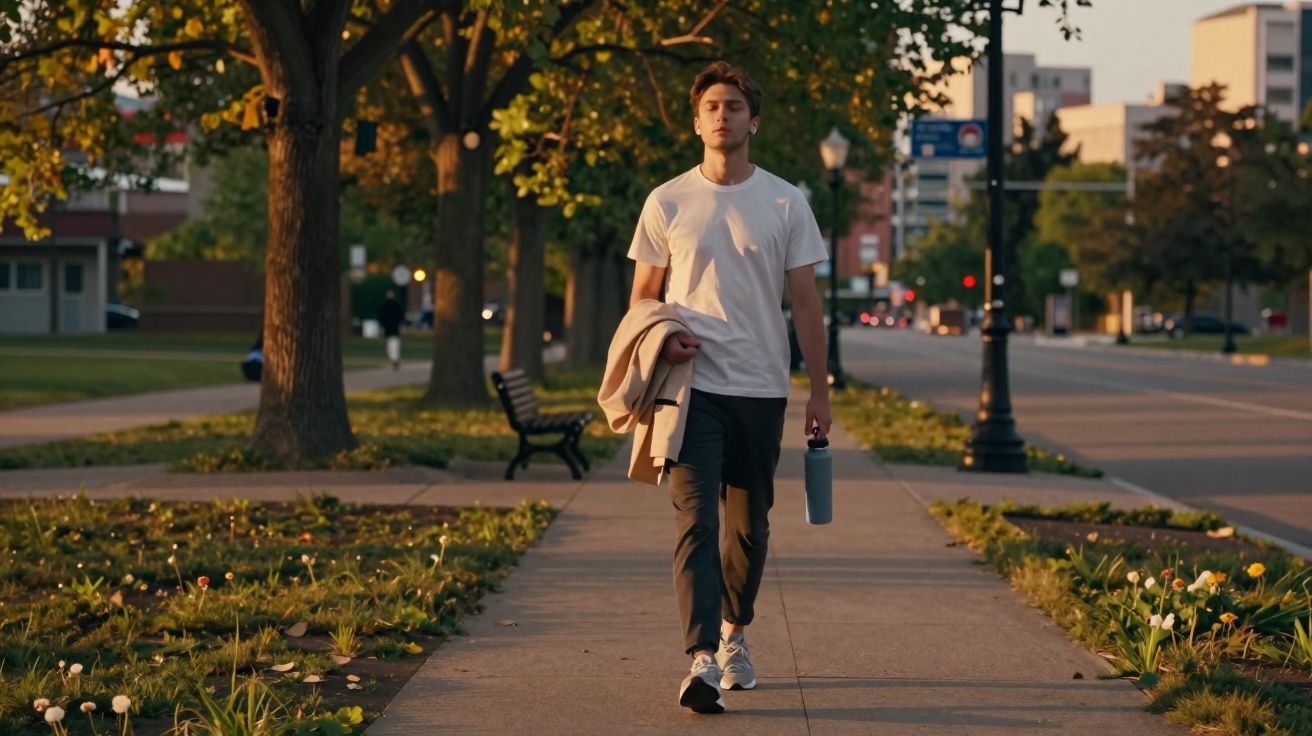
An evening walk done deliberately, without rushing to get anywhere, can become a gentle handover from the day’s pressure to the calm you keep meaning to find. That short daily gap changes the way your brain handles stress, using movement, daylight and steady tempo rather than one more tense session of phone scrolling.
Why an evening walk affects stress in a different way
By the time work finishes, many people’s nervous systems are still primed. Notifications, deadlines, traffic noise and hours of screens leave the brain stuck in a kind of “threat scanning” setting. It rarely powers down on its own; it needs an unmistakable cue.
A 20‑minute evening walk provides that cue. Your pulse lifts a little, your breathing naturally deepens, and your senses shift from artificial lighting and enclosed rooms to fresh air and wider sight lines. Together, those changes act like a reset button for your stress response.
An evening walk won’t remove your problems - but it can change the way your body carries them.
Physiologists usually highlight three key mechanisms:
- Movement: gentle to moderate walking can reduce stress hormones such as cortisol.
- Rhythm: repeated steps and regular breathing help settle the autonomic nervous system.
- Environment: outdoor light and natural sound cues draw attention away from tight, repetitive thinking.
Timing is part of the magic. Evening is close to when your brain should begin easing towards sleep. Instead, many people keep “day mode” going with extra work, more screen time and more caffeine. An evening walk creates a clear boundary your body can recognise.
The science behind walking off the day
What your brain does during a walk
Walking at an easy pace increases blood flow to the brain. That extra circulation particularly supports areas linked with planning and emotional regulation, including the prefrontal cortex - the same regions that get worn down by a day packed with decisions and interruptions.
Studies of “awe walks” and simple evening strolls show mood shifts even after brief sessions. People often report that worries feel “more distant” or “less sticky” once they’ve moved through a real, changing environment rather than staring at a fixed screen.
On paper the issue hasn’t changed, yet once your body is moving it often takes up less space in your head.
Walking can also encourage a softer, default mental mode: thoughts drift, impressions blend, and memories come and go. It’s common to find that the mental tangle you couldn’t loosen at your desk starts to unwind once you’re outside.
How light and temperature support stress release
Evening light brings its own quiet nudge. As the sun drops, the angle and colour of daylight shift, and your internal clock receives a subtle message: day is ending; night is approaching.
A short walk at this time can improve circadian alignment. Clearer timing signals help the body decide when to release melatonin, the hormone that promotes sleep. Many people who take an after‑work walk notice they fall asleep more quickly and wake less during the night - patterns closely tied to stress resilience.
Temperature contributes too, often unnoticed. Stepping from a warm office or a crowded train into cooler evening air encourages fuller breaths. Later, when you return home, a slight drop in core temperature can make it easier to relax and drift off.
Designing an evening walk habit you’ll actually keep (evening walk routine)
Begin with a tiny route you won’t negotiate with
Plenty of habits collapse because the starting point is unrealistic. A 45‑minute sunset hike sounds wonderful - until it’s a soaked Tuesday and your commute has drained you. A five‑minute circuit of your nearest streets is so manageable it’s hard to justify skipping.
Behavioural researchers often recommend making the first version of the habit almost laughably easy. You can always extend the walk once you’re out. In the early weeks, the win is simply getting through the door.
| Day | Minimum goal | “Stretch” goal |
|---|---|---|
| Weekdays | 5–10 minutes around your nearest block | 20–30 minutes, adding side streets or a small park |
| Weekends | 10–15 minutes after dinner | 40–60 minutes in a larger green space or along a riverside path |
| Bad weather days | One loop of your building, street or a covered area | Two or three loops at a brisker pace |
Separating “minimum” from “stretch” targets protects you from the all‑or‑nothing thinking that tends to sabotage habits when stress is high.
Make the walk a deliberate transition ritual
Brains respond well to clear endings and beginnings. Rather than treating your evening walk as “extra exercise”, use it as a bridge between work life and home life. A few simple rules help cement that boundary:
- Choose a consistent time cue, such as “within 30 minutes of logging off” or “straight after washing up”.
- Leave your work bag and laptop behind; take only what you need for safety.
- Put your phone on aeroplane mode or, at minimum, silent; use it only for essentials (time, music, navigation) if at all.
- Say a short line as you step out - for example, “Work is finished; walking starts now.”
Over time, the walk becomes a narrow bridge between two versions of you: the one replying to emails and the one finally allowed to exhale.
Where you walk influences how quickly you unwind
City pavements, small parks and bits of green
Not everyone has a woodland trail or a coastal path nearby. The reassuring news is that stress relief doesn’t depend on dramatic scenery. The bigger factor is sensory variety - what you can see, hear and feel changing as you move.
Urban research suggests that even brief contact with tree‑lined streets, pocket parks or canal paths can reduce self‑reported anxiety and ease muscle tension. The nervous system appears to soften when it encounters plants, water and open sky, even in small doses.
If your local options are limited, you can still shape routes that feel restorative. Consider looking for:
- Roads with trees or front gardens rather than only shop fronts.
- Quieter side streets where your own footsteps are audible.
- Viewpoints: a canal bridge, a gentle rise with city lights, a square with a fountain.
- Different underfoot textures: gravel, grass verges, old cobbles, timber boardwalks.
Turning a familiar loop into a sensory walk
A route you know well can feel flat - or unexpectedly rich - depending on how you approach it. A “sensory walk” cycles attention through the senses, pulling you out of mental noise and back into the body.
Try this structure on one evening this week:
- 2 minutes (sound): tyres on damp roads, a dog in the distance, the squeak of your shoes.
- 2 minutes (sight): window colours, branch shapes against the sky, reflections in puddles.
- 2 minutes (touch): air on your face, the swing of your arms, heel‑to‑toe contact with the ground.
- 2 minutes (smell): rain on tarmac, cooking from open doors, cold stone, cut grass if you pass it.
Rotating your attention trains your brain to stay with the walk instead of replaying the day on repeat.
From “stress dump” to quiet reflection
Let your thoughts loosen - without wrestling them
Some people turn walks into problem‑solving marathons; others try to banish thinking entirely. Both approaches can become exhausting. A middle path is to treat thoughts as passing traffic: present, but not in need of your control.
One practical method is the “three lanes” approach:
- Lane 1: Check body signals - shoulders creeping up, jaw clenching, breathing getting shallow.
- Lane 2: Notice the surroundings using the sensory method above.
- Lane 3: Observe thoughts and simply label them: “meeting worry”, “irritation”, “planning ahead”.
You move gently between lanes without trying to fix anything on the spot. Naming a thought often reduces its grip, so the walk clears mental space rather than forcing solutions.
Use micro‑pauses to deepen the calm
Brief stops can amplify the settling effect. Standing still for 1–2 minutes gives your nervous system time to register that, right now, there is no immediate threat.
Pick one or two “pause points” on your usual route - a bench, a corner with a view, a lamppost opposite a single tree. When you arrive, stop. Let your shoulders drop, allow your hands to hang, and take six slow breaths: count four on the inhale and six on the exhale.
These small pauses turn a simple walk into repeated practice at switching off the inner alarm, night after night.
Health benefits that quietly accumulate
From sleep quality to blood sugar
Mood is only the start. Consistent evening walking can also shift longer‑term health markers often linked with chronic stress. Clinical research on moderate daily walking commonly finds:
- A lower resting heart rate over several weeks.
- Reduced evening blood pressure for people with mild hypertension.
- More stable blood sugar, particularly when walking after dinner.
- Faster sleep onset and fewer early‑morning awakenings.
Stress hormones don’t merely feel unpleasant; they can contribute to abdominal weight gain, stronger cravings and increased inflammation. A regular evening walk gives the body a daily opportunity to use up some of that hormonal build‑up before you lie down.
Mental health, loneliness and quiet connection
Even if you walk alone, an evening route can take the edge off isolation. Familiar faces, the same dog walkers, and the pattern of lit windows can create a small but real sense of belonging. You become part of a neighbourhood rhythm rather than someone stuck on the sofa.
For people living with anxiety or low mood, the predictability of a fixed route at a familiar time can feel stabilising. The choice is already made: at 19:00, shoes on, outside. On difficult days, that certainty often matters more than motivation.
Going further: small changes that deepen the effect
Once the habit feels established, subtle variations can expand the benefits without losing the core purpose - releasing the day’s tension. You might choose one evening for a “long loop” that lasts roughly twice your usual duration, or ask a friend who’s feeling stressed to join for part of the route. Walking conversations often feel easier and less intense because you’re side‑by‑side, facing forward, sharing the rhythm of steps.
Another night, you could add gentle challenge without turning it into punishment: include a hill or a short flight of stairs to increase cardiovascular benefit while keeping effort moderate.
It can also help to make the walk easier to repeat year‑round. In the UK, evenings can be wet and dark for long stretches, so a lightweight waterproof jacket, reflective details, and a well‑lit route can remove friction and make the evening walk feel safe as well as calming.
Some people pair the walk with a low‑effort mindfulness anchor: choose one object per outing to notice closely - a particular tree, a street sign, a balcony garden - and track how it changes week by week. That practice nudges the brain out of short‑term crisis mode and into a calmer sense of time.
Others use a “worry container”. They take a small notebook, write down any concern that keeps resurfacing, and promise themselves they’ll revisit it the next morning, not at night. Putting it on paper signals to the brain that the issue has been stored, so it doesn’t need to keep raising the alarm all evening.
Over months, this modest routine can stop feeling like a productivity trick and start resembling basic nervous‑system hygiene. In the same way brushing your teeth prevents hidden damage, a short evening walk can clear the residue of the day before it hardens into chronic tension, restless sleep and ongoing exhaustion.




Comments
No comments yet. Be the first to comment!
Leave a Comment