
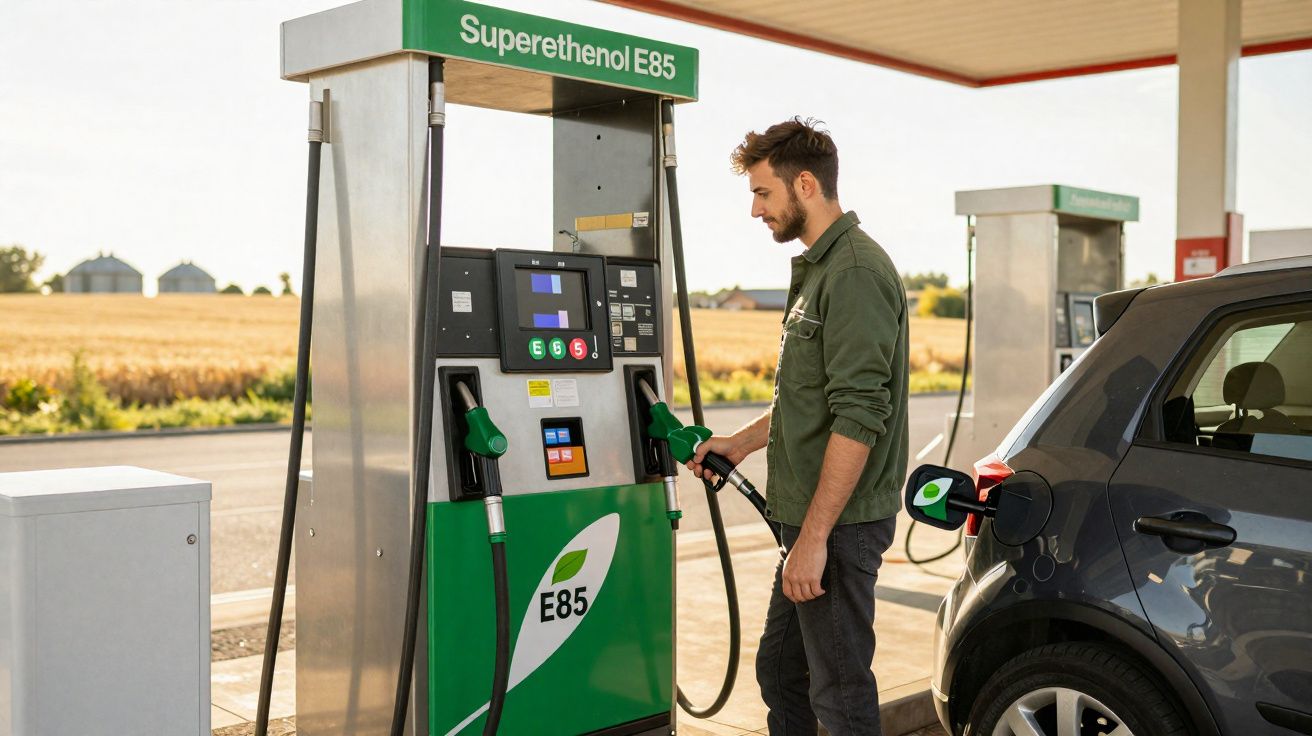
French drivers, pinched by high pump prices and bewildered by stop–start policy signals, are increasingly choosing an option that used to sit quietly at the edge of the forecourt.
Across France, Superethanol‑E85-a petrol–ethanol blend that for years was treated more like a novelty than a mainstream fuel-has surged into everyday use. In the process, it is reshaping parts of the fuel market and reigniting arguments about what a genuinely “clean” car should be in the 2030s.
A 15% rise that reframes the debate on Superethanol‑E85
Industry figures indicate that, in 2025, French bioethanol consumption increased by roughly 15%, climbing to more than 19 million hectolitres. Within that total, Superethanol‑E85 now accounts for around one third-meaning one in every three litres of ethanol used in France ends up in an E85 tank.
Superethanol‑E85 has shifted from niche to serious contender, rising 15% in 2025 and expanding to more than 4,000 fuel stations across France.
The timing is striking. Climate-policy arguments remain charged, EU rules on car CO₂ targets have felt like a moving target, and battery‑electric cars dominate the headlines. Yet for many households the most immediate change is happening at a very familiar piece of infrastructure: the petrol pump. Without changing how they drive, some are cutting both fuel bills and tailpipe-related emissions simply by switching fuel.
Why French motorists are moving to E85
Price does the heavy lifting at the till
For most drivers, the appeal is straightforward: cost per litre. In 2025, Superethanol‑E85 averaged about €0.73 per litre, while the widely used SP95‑E10 sat at roughly €1.69 per litre. Even allowing for a modest rise in fuel consumption per mile, the price difference remains difficult to overlook.
Modelling by the sector illustrates what that can mean over a year:
- At 13,000 km per year, switching from SP95‑E10 to E85 saved about €705, assuming 25% higher fuel consumption.
- At 20,000 km per year, the saving increases to roughly €1,085 on the same assumption.
If the real‑world consumption penalty is nearer 20%, the savings rise again-towards €739 at 13,000 km and about €1,137 at 20,000 km.
For many French households, E85 can keep several hundred euros a year in the family budget, even after allowing for higher fuel use.
Those sums help explain adoption since the fuel’s introduction: around 418,000 motorists have taken up Superethanol‑E85 since its rollout in 2006. Of these, roughly 62% drive petrol cars converted using an approved flex‑fuel conversion kit, while about 38% use factory‑built flex‑fuel vehicles.
Availability is no longer the obvious weakness
For a long time, the most common complaint was practical: drivers simply could not reliably find E85. That argument is steadily losing force. By 2025, more than 4,000 French fuel stations were selling Superethanol‑E85, which is about 42% of the national network.
Coverage is now extensive enough that around 93% of motorists in France live within 10 kilometres of an E85 pump. In many areas it is now displayed alongside diesel and standard petrol on the same forecourt, rather than requiring a special journey.
How E85 pencils out in everyday driving
A realistic commuter example
Consider a typical commuter covering 18,000 km per year in a small petrol hatchback:
- Using SP95‑E10 at €1.69 per litre, and averaging 6.5 l/100 km, annual fuel spend is roughly €1,980.
- Switching to E85 at €0.73 per litre, with 25% higher consumption, brings annual fuel costs down to around €1,100.
Even after fitting an approved conversion kit-typically €700 to €1,400 installed-many drivers could see payback in two to three years.
That said, it is not a zero‑risk decision. Some older engines may be unsuitable; non‑certified kits can invalidate warranties or lead to mechanical problems. Winter cold‑start behaviour and how consistently E85 is available on motorways can also affect day‑to‑day convenience. Even so, for a sizeable portion of the fleet-particularly more recent petrol models-the numbers have become increasingly persuasive.
Climate benefits, without overselling perfection
Lower life‑cycle impact than fossil petrol
Bioethanol is not presented by the French industry as carbon‑neutral. Emissions arise from agriculture, processing and transport. Even so, assessed across the full life cycle, the picture remains materially better than for purely fossil fuels.
In 2025, bioethanol used on French roads displaced about 1 million tonnes of oil equivalent. That substitution is estimated to have avoided around 2.7 million tonnes of CO₂-often compared with the annual exhaust emissions of roughly 1.3 to 1.4 million cars.
The underlying logic is the carbon cycle: much of the CO₂ released at the tailpipe was previously absorbed by crops while growing. The cycle is not perfectly closed-farm machinery uses diesel, factories consume energy-but the overall life‑cycle balance is still significantly lower than conventional petrol.
Still a modest share of the overall road‑fuel mix
Despite rapid growth, E85 remains a relatively small component of total French road fuels. In 2025, road‑fuel consumption totalled about 47.5 million cubic metres. Diesel continued to dominate at around 32 million cubic metres (just over two thirds), while petrol products reached about 15.6 million cubic metres, up 5.7% year on year.
| Fuel type | 2025 volume (million m³) | Share of road fuels |
|---|---|---|
| Diesel | 32.0 | 67.3% |
| Petrol (all grades) | 15.6 | 32.7% |
| Bioethanol (all uses) | 1.9 | ~4.0% |
With volumes of about 1.9 million cubic metres, bioethanol represents just under 4% of road fuels. The trend is upward, but the wider system is still structured primarily around diesel-despite its gradual decline.
A distinctly French supply chain behind every litre
From farms and crops to the fuel pump
Each litre of E85 typically comes from a value chain that is largely domestic. French agriculture supplies the inputs-especially sugar beet, cereals and other crops. The sector provides a supplementary market for around 55,000 farm holdings, helping to steady incomes when food‑commodity prices are volatile.
Industrial jobs and co‑products
On the industrial side, the bioethanol ecosystem supports roughly 9,000 full‑time equivalent roles. Ethanol is produced in sugar factories and starch plants, which also process co‑products and residues that could otherwise be lower value. In practical terms, E85 helps pay for both the main output and the side streams, extracting more value from every tonne harvested.
Bioethanol in France is not an abstract “green” concept; it underpins tens of thousands of farms and close to 9,000 industrial jobs.
What French drivers say they want next
Survey data from IFOP, based on 1,000 people questioned on behalf of the national bioethanol collective, sheds light on how motorists see their options. The internal combustion engine still dominates preferences, either alone or as part of a hybrid set‑up. About 76% of respondents favour some form of combustion engine: 52% lean towards petrol, while 24% still prefer diesel.
Just 10% say their next vehicle would be fully electric-well below the trajectory implied by EU ambitions. Among drivers considering a future petrol vehicle, about 17% are looking at models able to run on E85, whether hybrid or purely combustion‑based. That points to sizeable headroom for flex‑fuel growth.
High recognition, but doubts that slow uptake
The information gap on a modern forecourt
E85 is no longer obscure. The same IFOP polling indicates that 76% of French people have already heard of Superethanol‑E85. Around 58% view it as a credible alternative to fossil fuels, alongside battery‑electric cars.
However, the barriers are often about perception rather than engineering. Roughly 30% of those surveyed say lack of knowledge is the primary obstacle. Another 30% claim there are too few stations, despite the fact that most motorists are within 10 kilometres of an E85 pump.
The pumps exist and the price difference is tangible, yet many motorists still assume E85 is scarce or complicated.
This mismatch highlights a communication problem for both industry and government. Drivers are sensitive to price, but cautious about engine reliability and warranties. Clear, accessible guidance on vehicle compatibility and certified conversion kits could reduce hesitation.
Practical checks before converting to Superethanol‑E85
For drivers tempted by the savings, the most important step is ensuring the car and the conversion route are properly matched. Checking manufacturer compatibility, choosing an approved flex‑fuel conversion kit, and keeping documentation for insurance and warranty purposes can be as important as the pump price. It also helps to plan for seasonal behaviour-particularly winter cold starts-and to confirm typical E85 availability on regular long‑distance routes, including motorways.
In addition, drivers comparing options should weigh the conversion cost against their annual mileage: the economics are strongest where annual distance is high, and weaker for low‑mileage households even if the per‑litre saving looks dramatic.
Brussels signals a place for “cleaner combustion” after 2035
Post‑2035 could mean more than battery power
On 16 December 2025, the European Commission proposed reopening the CO₂ rulebook for light vehicles. The draft revision creates a pathway for selling combustion‑engine cars after 2035, provided they run on fuels meeting strict climate criteria-including fuels that incorporate bioethanol blends.
The Commission explicitly positions sustainable biofuels as a complementary tool alongside electrification. For the French E85 ecosystem, that offers a renewed sense of political visibility. It also strengthens the case for plug‑in hybrids optimised to run mainly on E85-using battery range for everyday trips and low‑carbon liquid fuel for longer journeys.
Towards fully renewable E85
From “lower carbon” to near‑neutral fuel
The French sector’s next target goes beyond crop‑based ethanol. Work is progressing on an E85 blend that would be 100% renewable, built around a tighter definition of “CO₂‑neutral” fuels. Under that approach, all carbon contained in the fuel would be drawn from the atmosphere-either captured by plants or taken from industrial flue gases-then used to produce synthetic e‑fuels.
Technical standards are now under discussion at the European Committee for Standardization, with the aim of updating E85 specifications to accommodate new components. If the shift succeeds, future flex‑fuel plug‑in hybrids could operate with no fossil petrol at all, and show life‑cycle emissions comparable to-or in some cases lower than-those of a pure battery‑electric car, depending on the electricity mix.
A related challenge is how sustainability is verified and communicated. As fuel blends diversify, robust certification and transparent reporting become essential so motorists can distinguish between genuinely low‑carbon pathways and claims that do not hold up across the full life cycle.
Key terms that keep appearing
- Superethanol‑E85: fuel containing 65% to 85% ethanol, blended with petrol, for use only in compatible flex‑fuel engines.
- SP95‑E10: standard unleaded petrol with up to 10% ethanol by volume, approved for most modern petrol engines.
- Flex‑fuel vehicle: a vehicle designed so its engine and fuel system can run on any mix of E85 and conventional petrol.
- Flex‑fuel conversion kit: an additional electronic module that adjusts injection and engine settings so certain petrol cars can safely operate on E85.
While battery‑electric vehicles continue to grow-reaching about 24% of new car sales in France in December 2025-France’s experience with E85 underlines that motorists are not committing to a single technological route. Many are spreading their bets: mixing plug sockets with fuel pumps, and focusing on whatever best protects the household budget while keeping emissions moving in the right direction.





Comments
No comments yet. Be the first to comment!
Leave a Comment