
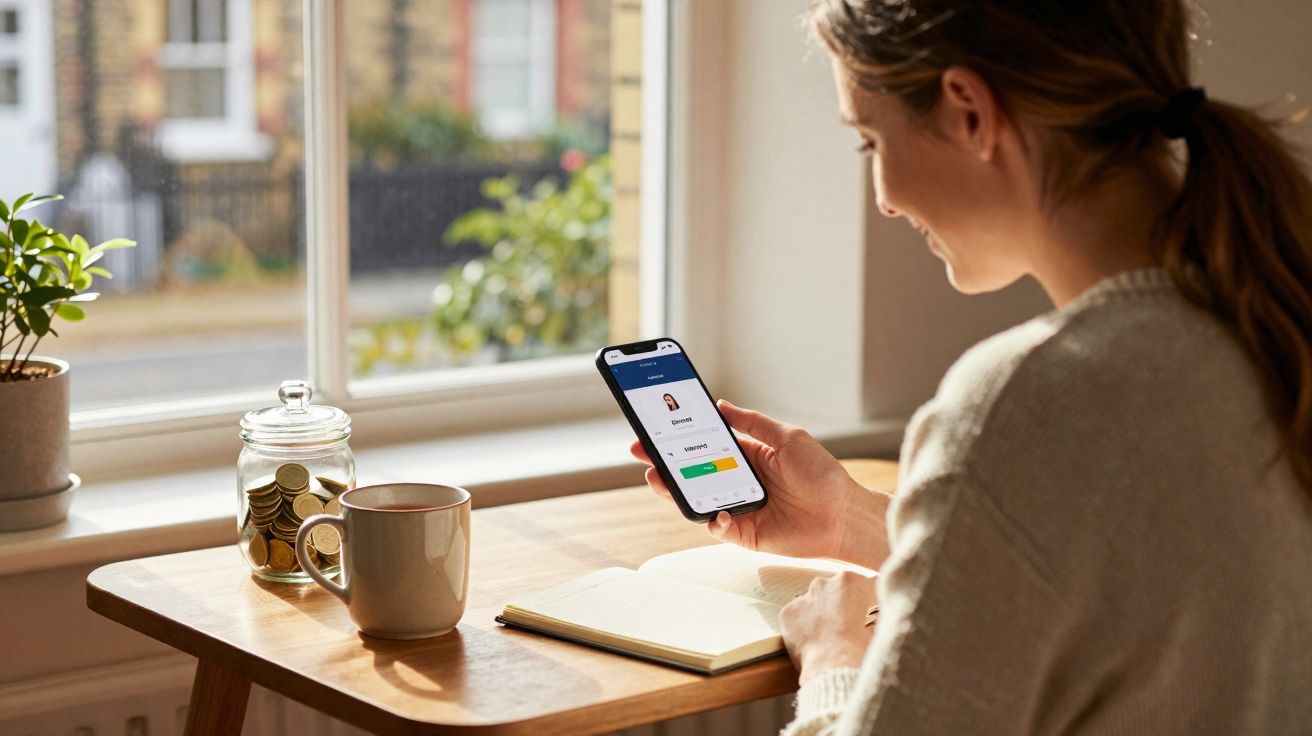
At the end of the month, Ana opened her banking app and everything still looked reassuringly green: no overdraft, no odd fees, nothing out of place.
Even so, when she lay down at night, a heaviness settled in her chest. She stared at the ceiling and the thought arrived on repeat: “If I lost my job tomorrow, how long would I cope?” The reply came fast, almost by reflex: “Not long.” It wasn’t that her pay was terrible. It was that her money slipped away like water down drains she didn’t even notice. The bills were paid. The credit card was up to date. But the sense of security? That always felt missing.
The quiet habit that drains your sense of security (even when the balance looks fine)
There’s a subtle, everyday money habit-so common it’s practically treated as normal-that quietly erodes your sense of security: living right up to the edge of the month with no breathing space at all. The issue isn’t necessarily spending loads; it’s spending everything. It’s reaching payday with £0 left over, without putting aside even 1% or 2% for the future. On the screen, it can look like you’re managing. Emotionally, it feels like crossing a bridge with no handrail.
That absence of “slack” creates a low-level tension that follows you onto the bus, into the office, and back into bed at night. It chips away-penny by penny-at your peace of mind.
Most people recognise the awkward moment when someone asks, “Do you have any savings at all, even a small amount?” and the answer catches in your throat. In recent UK financial wellbeing research, many households say they “struggle” to save, even when their income isn’t the worst. Often it isn’t a lack of money so much as a pattern of organising life to spend right down to the last pound: a takeaway lunch because cooking feels like effort, a streaming subscription nobody uses, a “small” monthly instalment that quietly becomes permanent. Bit by bit, the present takes up all the room-and the future gets squeezed into a corner.
When your brain registers there’s no safety margin, it goes into a silent kind of alert. No alarms sound, but your body feels it. Your mind starts running worst-case scenarios on a loop: “What if I get ill?”, “What if the service charge goes up?”, “What if the car needs repairs?” With no reserve, every surprise becomes a genuine threat rather than a distant possibility. Sleep suffers, work decisions warp, and even relationships take a hit. Many people file that anxiety under “normal adult stress”, without noticing how much of it comes from living tethered to the next payslip. The emotional bill arrives even while the bank balance stays out of the red.
How to break the “spend everything” cycle without noticing
The move that changes this story isn’t dramatic or glamorous. It’s simply putting a small amount aside the moment your pay lands-before the rest of the month gets a chance to claim it. It doesn’t have to be 10% or 20%. It can be 1%, 2%, or any figure that doesn’t sting. The key isn’t the size; it’s the quiet decision of what comes first.
Sending £5 to a separate account on payday can do more for your head than trying to save £35 on the last day of the month. Your brain gets the message: “There’s a plan.” That tiny action cracks the habit of spending everything, creating a sliver of safety where previously there was only urgency. Over time, that sliver can widen.
A common trap is waiting for the “perfect moment” to start: when your salary rises, when the debt is cleared, when the new year begins. That ideal day rarely turns up. Life will always provide a fresh excuse to spend it all-flash sales, last-minute plans, unexpected problems. And let’s be honest: nobody overhauls everything overnight. Nobody reviews every expense, renegotiates every contract, and cuts every non-essential in one heroic afternoon. Real change is smaller, repeated, and slightly boring. It begins the day you decide a symbolic amount will be saved even in a tight month-not as a punishment, but as a way to breathe a little easier.
A financial planner interviewed for this piece put it neatly: “The money you don’t miss is the money that most improves your sense of security. It doesn’t hurt to move it, but it’s a relief to know it’s there.”
- Start tiny: pick an almost laughably small figure to build the habit, not to “get rich quickly”.
- Build barriers: keep your reserve in a separate account (ideally outside your main banking app) so it’s less likely to become impulse spending.
- Name the money: “peace fund”, “breathing-space months”-anything that keeps the emotional purpose front and centre.
- Review one expense: cancel a forgotten subscription and automatically redirect the same amount instead.
- Protect the action: treat the transfer like a non-negotiable bill, not “whatever’s left” at month-end.
An extra step that helps in the UK: automate it like a bill
If you’re paid monthly, setting up a standing order for payday (or the day after) can remove willpower from the equation. Think of it as paying your future self first. You can also use features many UK banks offer-pots, spaces, or round-ups-to make saving feel less like a decision and more like a default.
Where this “reserve” sits matters more than chasing returns
At the beginning, the goal isn’t to maximise interest-it’s to keep the money safe and easy to access. An easy-access savings account is often enough. Some people prefer keeping it with a separate provider to add friction (so it’s not a two-tap transfer back into spending). Later, once the habit is established and the buffer is stable, you can consider whether a Cash ISA or other options fit your broader plans.
Why your sense of security is worth more than the balance itself
Sometimes it’s not about big numbers; it’s about small stories. A cleaner who puts aside £10 a week can feel more stable than a high earner who needs the next pay packet for absolutely everything. Financial security has less to do with status and more to do with predictability. The real, quiet question isn’t “How much do you earn?” It’s how long can you handle an unexpected expense without panicking. When you know you could cover at least one month of bills without income, your posture shifts. You negotiate with more confidence, ask for a pay rise with less fear, and say no to poor offers more firmly. It isn’t magic-it’s room to manoeuvre.
Not spending everything also reveals another layer: your relationship with desire. In a culture that nudges you towards buying all the time, saying “no” to an immediate purchase so you can say “yes” to future breathing space is almost an act of rebellion. You don’t need to become a monk or live without any pleasures. The point is to choose deliberately which treats you want now and which you’re willing to delay. Setting aside money isn’t cold or purely mathematical. It’s deeply emotional-like leaving a note for tomorrow’s you that says, “I thought about you.” Repeated over months, that feeling of financial abandonment starts to ease.
Perhaps the most delicate part is admitting the quiet habit is there. It shows up not only for people on low incomes, but also for those on comfortable salaries who still live with no slack. Your banking app doesn’t display anxiety; it only shows transactions. Your body is the one that carries it-in sleepless nights, repetitive thoughts, and the constant feeling of living “by a thread”. When you make a small course correction-save first, spend second-you don’t just change the flow of money. You slowly retrain your perception of risk. And that shift, invisible at the start, may be exactly what separates a life steered by fear from a life guided by calmer choices.
| Key point | Detail | Value to the reader |
|---|---|---|
| Identify the habit of spending everything | Notice when the month ends at £0 even though no bills are overdue | Naming the problem reduces vague guilt and makes action practical |
| Start with tiny reserves | Set aside a small amount as soon as money arrives, ideally automatically | Creates an early sense of protection without daily hardship |
| Protect your sense of security | Keep the money in a separate account and give the reserve a clear purpose | Builds peace of mind and confidence when surprises happen |
FAQ
Question 1: If I earn very little, does this habit still make a difference?
Yes. Even symbolic amounts create two shifts: you practise saving, and you gain the feeling of having some cushion-however small. The amount can grow over time, but the action needs to start small.Question 2: Should I prioritise a reserve or paying off debts first?
In practice, many people do both: they focus most effort on the debt, but keep a minimal reserve so they don’t need to use credit for every unexpected cost. Without that breathing space, debt tends to return.Question 3: Where should I keep this money separately?
An easy-access savings account, a basic savings pot, or another simple option with quick withdrawal. The criteria are safety and liquidity, without complication. Early on, the aim is habit-building, not maximising returns.Question 4: How do I stop myself dipping into the reserve for any reason?
Add barriers: use a different bank, a separate account, and don’t link a card to it. It also helps to set clear rules-only for genuine emergencies, not discounts or spur-of-the-moment wants.Question 5: How long does it take to feel more secure?
It depends on income and what you save, but many people report an emotional shift within the first few months, once they can see they’d manage at least a few weeks of expenses without spiralling into panic.






Comments
No comments yet. Be the first to comment!
Leave a Comment